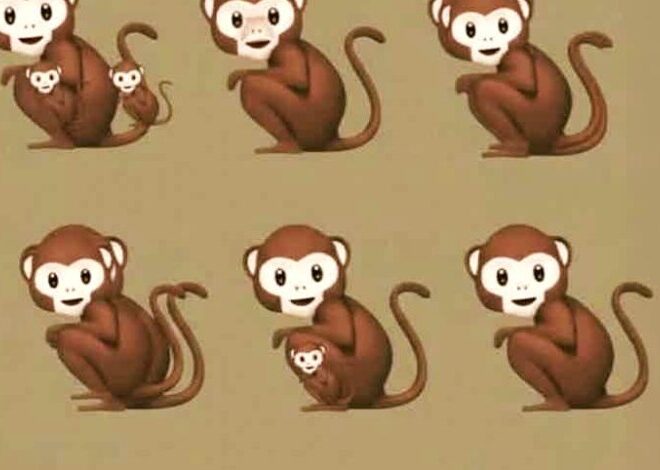
“Only the Lucky Can Find the Odd One Out — Are You One of Them?”
At first glance, it looks almost too simple to matter.
Six clovers. Slightly different from one another. A quiet visual arrangement placed in front of you with a single instruction: choose the one that doesn’t belong.
Most people assume it’s a game of observation. Something quick. Something harmless. A small test of attention.
But what makes this exercise interesting isn’t the clovers at all.
It’s you.
Because the moment your eyes land on the image, something subtle begins to happen inside your mind. You don’t just see the clovers—you begin to interpret them. You assign meaning, hierarchy, importance. Your brain starts searching for imbalance in a system that may not even have one. And in doing so, it reveals something far more complex than visual perception alone.
It reveals how you think.
The Illusion of “The One That Doesn’t Belong”
Human beings are not passive observers of the world. We are pattern-seeking systems. We are wired to detect difference, threat, order, and meaning—even when none is intentionally designed.
So when faced with six nearly similar clovers, the mind refuses to accept neutrality. It assumes intention. It assumes that one must be different, one must be incorrect, one must be excluded.
But the deeper truth of this exercise is unsettling in a quiet way:
There may be no objective answer at all.
And yet, your brain insists there is.
That tension between certainty and ambiguity is where personality quietly begins to surface.
The First Glance Is Never Random
Within milliseconds of seeing the clovers, your mind begins filtering:
- Shape vs symmetry
- Color tone vs saturation
- Spacing vs balance
- Familiarity vs anomaly
You are not consciously analyzing all of this. Instead, your brain is rapidly deciding what matters most.
And what you prioritize—often without realizing it—says something meaningful about your internal cognitive style.
Some people notice overall structure first. Others lock onto detail. Some feel drawn to what looks “out of place,” while others search for harmony before difference.
None of these approaches are wrong.
But they are different ways of seeing the world.
Why People Never Agree on the Same Clover
If you ask ten people to complete this task, you will rarely get a unanimous answer. Not because the puzzle is difficult, but because perception is not shared—it is constructed individually.
Two people can look at the same image and genuinely experience two different “truths.”
One person may focus on brightness and conclude that a lighter clover feels unnatural.
Another may focus on curvature and see irregular edges as the defining flaw.
Another may rely entirely on instinct and choose within seconds, unable to explain why.
What this reveals is not confusion—but diversity in cognition.
We often assume disagreement means someone is wrong. But in reality, it often means people are processing the same information through entirely different mental frameworks.
The Psychology Behind the Choice
Let’s go deeper—not into the clovers themselves, but into what the act of choosing tends to reflect.
When someone selects quickly, without overthinking, it can suggest a mind that trusts intuition. These individuals often rely on immediate emotional or perceptual signals rather than extended analysis. In everyday life, this may translate into decisiveness, adaptability, or strong instinctive judgment.
When someone takes longer, comparing each detail carefully, it may reflect a more analytical cognitive style. These individuals tend to search for structure, consistency, and logical justification before committing to a conclusion. In daily life, this can appear as caution, precision, or a desire for accuracy over speed.
When someone chooses based on “what feels right” rather than what looks different, it can reflect emotional cognition—decision-making guided by internal coherence rather than external comparison.
And when someone struggles to choose at all, it may reflect heightened sensitivity to ambiguity—the awareness that multiple interpretations can exist simultaneously.
None of these traits are superior.
They are simply different ways the mind organizes reality.
The Symbolism Hidden in the Clover
The clover itself is not accidental symbolism.
Across cultures, clovers—especially four-leaf variations—have long been associated with luck, rarity, and meaning beyond appearance. This cultural background subtly influences perception, even when we think we are being purely logical.
If you expect rarity, your brain begins to search for it.
If you expect imbalance, your mind begins to highlight imperfection.
If you expect meaning, you begin to assign it.
In this way, perception is never fully neutral. It is always shaped by prior experience, cultural memory, and subconscious expectation.
Even something as simple as a clover becomes a mirror reflecting what you already believe the world should contain.
The Mind’s Need to Assign “The Odd One Out”
One of the most fascinating aspects of this exercise is not which clover you choose—but the fact that you feel compelled to choose at all.
Why must one be “wrong”?
Why must one be excluded?
This tendency reflects a deeper cognitive bias: the human preference for categorization. Our minds prefer systems with order, boundaries, and classification. It is easier to function in a world where things belong or do not belong, where patterns are consistent, and where anomalies are identifiable.
But life rarely operates that cleanly.
People, situations, emotions, and experiences often exist in overlapping states—neither fully one thing nor another.
The clover test quietly exposes this discomfort.
What Your Attention Is Really Doing
Where your eyes land first is not random either.
Eye-tracking studies in cognitive science consistently show that attention is drawn to contrast before content. This means your brain prioritizes what stands out, even before understanding what it is looking at.
That “standout” element might be:
- Slight asymmetry
- A shift in tone
- A perceived imbalance
- A shape that feels unfamiliar
But what is crucial here is not the object—it is your sensitivity to deviation.
Some people are highly tuned to detect change. Others are more attuned to cohesion. Both are essential cognitive strengths, especially in different real-world contexts.
One helps detect risk. The other helps maintain stability.
The Emotional Layer Beneath the Decision
Although this appears to be a visual puzzle, emotion quietly plays a role.
People who prefer certainty may feel discomfort when no obvious answer emerges. Those comfortable with ambiguity may find the exercise enjoyable rather than frustrating.
Some may feel an urge to “be correct,” even when correctness is undefined. Others may detach entirely and treat it as abstract exploration.
This emotional response is subtle—but important. It shows how even simple decisions are never purely logical. They are shaped by tolerance for uncertainty, confidence in judgment, and emotional interpretation of ambiguity.
The Real Purpose of the Exercise
On the surface, it looks like a test of perception.
But underneath, it is something else entirely.
It is a reflection of cognitive diversity.
It demonstrates that:
- People do not see the same world in the same way
- Attention is selective, not universal
- “Correctness” is often a matter of perspective
- Interpretation shapes reality more than observation alone
The clovers are not the subject.
You are.
A Mirror Disguised as a Puzzle
What makes this kind of exercise powerful is its simplicity. There is no technical knowledge required. No specialized training. No hidden instruction manual.
Just perception.
And yet, within that simplicity, something quietly profound happens. You become aware—however briefly—of how your mind organizes reality.
Do you trust instinct or analysis?
Do you see difference first, or structure first?
Do you decide quickly, or hesitate in complexity?
Do you need certainty, or can you sit with ambiguity?
These are not just puzzle behaviors.
They are life behaviors.
Why This Resonates With So Many People
Exercises like this circulate widely because they feel personal without being invasive. They do not ask for your history, your identity, or your story—but they still feel like they reveal something about you.
That emotional resonance comes from recognition.
People see their own thinking patterns reflected back at them in a harmless, visual form.
It feels like discovery.
Even when nothing is technically “measured,” something is still understood.
Final Reflection
In the end, there may be no clover that truly “doesn’t belong.”
Or perhaps all of them do—depending on how you define belonging in the first place.
And that is the quiet lesson embedded in the exercise:
Not everything that feels like a choice has a single correct answer.
Not everything that stands out is actually different in any meaningful way.
And not everything your mind labels as “distinct” is objectively separate.
Sometimes, what you are really observing is not the image in front of you—but the architecture of your own perception.
And once you notice that, the puzzle stops being about clovers entirely.
It becomes about the way you see the world when you think no one is watching.