How Many Monkeys You Spot Could Reveal If You’re a Narcissist
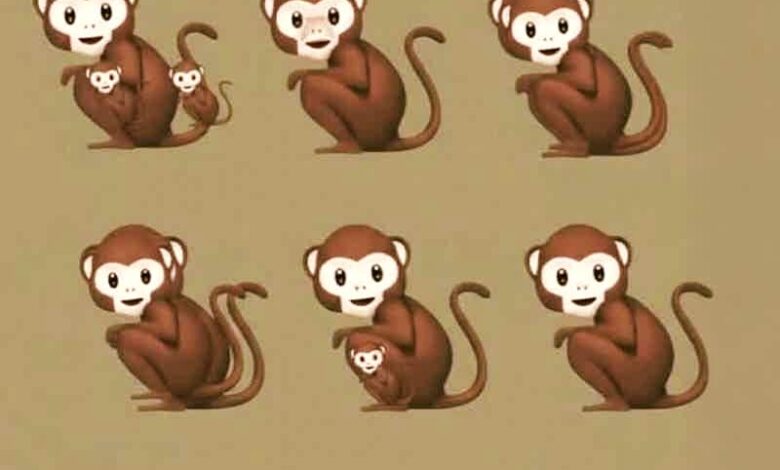
At first glance, the image looks like a playful cartoon, rows of cheerful monkeys lined across a simple, colorful background. The scene feels light and harmless, the kind of thing you might glance at for a second before moving on.
Then your eyes catch the bold caption: “The number of monkeys you see determines if you’re a narcissist.” It’s a clever hook—just provocative enough to make you stop, just absurd enough to make you curious. Almost without thinking, you start counting.
At first, the task feels easy. A handful of clearly outlined monkeys stand out immediately, and you might feel confident in your answer within seconds. That initial certainty is part of the design. The image rewards quick perception just enough to make you think you’re done.
But then something shifts.
You notice a shape that looks like a monkey within another monkey. A tail that forms a face. A pattern that repeats in a way that suddenly suggests there are more figures embedded in the design than you first realized. What seemed simple becomes layered. What felt obvious becomes uncertain.
This is where the image does something interesting—not psychologically diagnostic, but cognitively revealing.
Your brain doesn’t passively record what you see. It actively constructs it. It filters, prioritizes, and organizes visual input based on efficiency. When you first look at the image, your brain is trying to solve it quickly, not perfectly. It grabs the most obvious elements and forms a conclusion.
That’s why some people stop early. Not because they’re careless, but because their brain is optimized for speed and pattern recognition at a broader level. They see the “whole” before the details.
Others slow down. They scan, revisit, question. They don’t trust the first answer as final. These viewers often uncover hidden figures because their attention lingers longer, allowing smaller patterns to emerge over time.
Neither approach is wrong—they’re just different strategies.
The viral caption, of course, is nonsense. There is no credible link between counting hidden monkeys and traits like narcissism. That label exists purely to provoke a reaction. It nudges you into taking the task more seriously than you otherwise would, and more importantly, it makes you want to compare your result with others.
That comparison is the real engine behind its popularity.
You count. You wonder if you got it “right.” Then you ask someone else. Suddenly it’s not just a puzzle—it’s a shared experience. People debate, defend their numbers, and sometimes even argue over what “counts” as a monkey. The image becomes social.
And that social layer reveals something else: people don’t just see differently—they believe in what they see differently.
Someone who counted fewer monkeys might feel confident and move on. Someone who found more might feel a sense of discovery, even superiority. Not because the number matters, but because effort and interpretation become tied to identity, even in a trivial task.
That’s the subtle psychological hook—not narcissism, but investment.
The longer you look, the more the image rewards you. Hidden monkeys begin to feel like secrets uncovered. The act of searching becomes satisfying in itself. You shift from “What’s the answer?” to “What else is here?”
And that shift is valuable beyond the puzzle.
It mirrors how we interact with the world. First impressions are fast, efficient, and often incomplete. Deeper understanding requires time, attention, and a willingness to question what seemed obvious at first.
This is why illusions like this resonate so widely. They compress a complex truth into a simple experience: what you see depends on how you look.
They also highlight a limitation we rarely acknowledge—our perception feels complete even when it isn’t. The brain fills gaps so seamlessly that we rarely notice what we’ve missed.
Only when prompted—by a puzzle, a disagreement, or a second look—do we realize there was more there all along.
In that sense, the monkeys are just a vehicle. The real subject is attention.
Where do you focus first?
How quickly do you decide you’re finished?
Do you revisit your assumptions when new details appear?
Those questions matter far more than any number you arrive at.
So if you go back and count again, the experience changes. You’re no longer just identifying shapes—you’re observing your own process. You notice when you rush, when you hesitate, when you doubt, and when you discover.
And that awareness is the only meaningful takeaway here.
Not whether you saw 7 monkeys or 17—but how you looked, how you thought, and how willing you were to look again.
Because the real lesson isn’t hidden in the image.
It’s in the moment you realize your first answer wasn’t the whole picture.