My Daughter Rang the Bell After Two Years of Chemotherapy—Then Her Doctor Ran After Us and Said, “Wait… There’s Something You Need to See”
Part One: The Sound We Had Waited Two Years to Hear
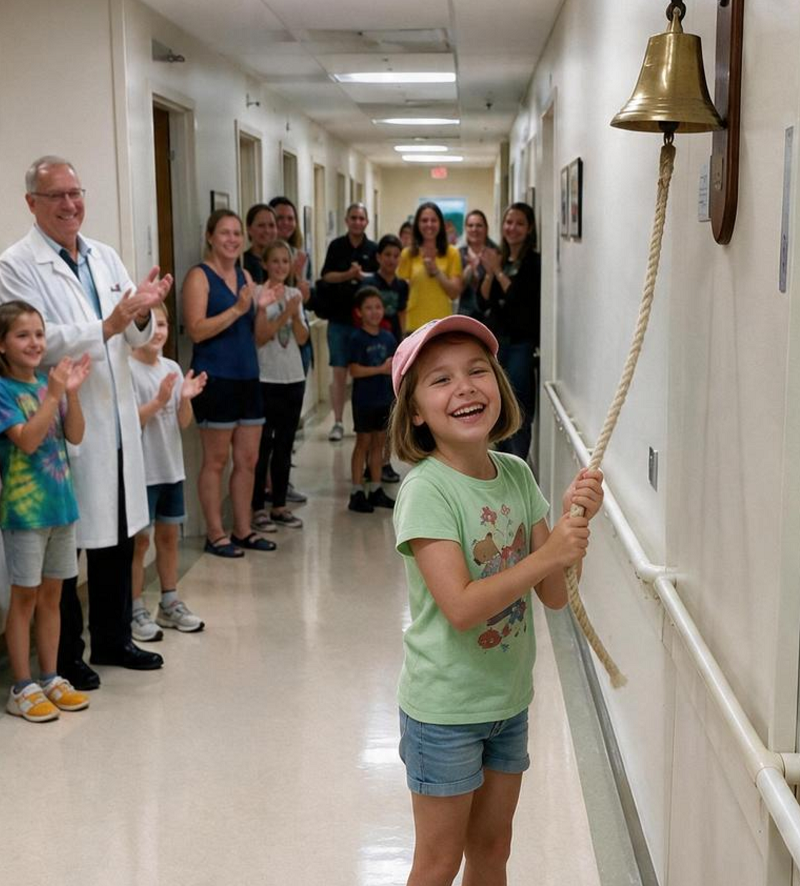
The hallway outside the pediatric oncology ward erupted in applause.
My ten-year-old daughter, Martha, stood beneath the brass victory bell with both hands still curled around its thick rope. The bell swung gently above her, and its final note seemed to hover in the air, unwilling to disappear.
Doctors smiled.
Nurses cheered.
Parents we had never met wiped tears from their faces.
For two years, I had imagined this moment. During sleepless nights, frightening test results, and endless hours beside Martha’s hospital bed, I had pictured her standing beneath that bell.
But the reality was more beautiful than anything I had allowed myself to imagine.
One of the nurses handed Martha a certificate decorated with glittering stars. She raised it above her head as proudly as an athlete lifting a championship trophy.
“I did it, Mom!” she cried.
Her smile reached from one freckled cheek to the other.
I pulled her into my arms.
“You did it, sweetheart,” I whispered. “You really did.”
She laughed because I was holding her too tightly, but I couldn’t make myself let go.
For the first time in two years, I wasn’t forcing myself to smile for her sake. I wasn’t hiding fear behind cheerful words or pretending everything would be fine when I had no idea what the next test would reveal.
This smile was real.
Her treatment was finished.
We were going home.
As Martha waved at the staff surrounding her, I believed the most difficult chapter of our lives had finally ended.
I had no idea that before we reached the hospital doors, we would discover a secret that had been kept from us for almost two years.
Part Two: The Day Childhood Disappeared
People sometimes ask what the hardest part of childhood cancer is.
They expect me to say the chemotherapy.
The needles.
The nausea.
The endless waiting for test results.
Those things were terrible, but they weren’t the hardest part.
The hardest part was watching my daughter slowly forget how to be a child.
Before the diagnosis, Martha collected shiny stones from sidewalks and gardens. She was convinced each one contained a tiny dinosaur egg waiting to hatch.
She gave names to squirrels.
She refused to eat ordinary round pancakes because, according to her, pancakes tasted better when they were shaped like stars.
Then, one Wednesday afternoon, I noticed several dark bruises on her arms and legs.
Martha couldn’t remember falling.
She hadn’t bumped into anything.
Three days later, a doctor sat across from us and spoke the word that divided our lives into a before and an after.
Leukemia.
I remember watching his lips move, but I barely heard anything else he said.
Treatment.
Hospitalization.
Chemotherapy.
Blood counts.
The words floated around me without meaning.
I held Martha’s hand so tightly that my fingers began to ache. All I could think was that there had been a mistake. This happened to other families. Other children. Not my daughter.
Martha looked up at me.
“Mom?”
I forced myself to meet her eyes. “Yes, sweetheart?”
“Are we still getting pizza tonight?”
That simple question broke something inside me.
I began to cry.
Martha’s face fell because she thought I was upset about canceling dinner.
“We can get it another day,” she said quickly. “It’s okay.”
I turned away so she wouldn’t see me falling apart.
That was how our new life began.
Hospital rooms replaced playgrounds.
Appointments replaced school trips.
Medication schedules replaced bedtime stories.
And waiting became the rhythm of every day.
We waited for doctors.
We waited for blood results.
We waited to see whether the treatment was working.
We waited for fevers to fall and numbers to rise.
As a single mother, I learned that fear did not excuse me from responsibility. Someone still had to organize Martha’s medication, speak with insurance representatives, ask doctors difficult questions, and remember which foods she could tolerate after treatment.
Someone still had to braid the few strands of hair she had left when she asked to look pretty.
There was never a convenient moment for me to collapse.
So I created a routine.
Every night, after Martha fell asleep, I slipped into the hospital bathroom and locked the door. I sat on the closed toilet lid and gave myself exactly five minutes to cry.
Not six.
Not ten.
Five.
Then I washed my face with cold water, practiced a smile in the mirror, and returned to her bedside.
I thought Martha never noticed.
I was wrong.
One afternoon, during her second round of chemotherapy, I came back from the bathroom and found her watching me over the top of a coloring book.
“You cried again,” she said.
I stopped beside the bed.
“What makes you think that?”
“Your nose turns pink.”
I tried to laugh. “My nose does not turn pink.”
“It does.”
She patted the mattress beside her.
“Come here, Mom.”
I sat carefully on the edge of the bed. Martha reached up and wiped away a tear I had missed beneath my eye.
“We’re going to beat this,” she whispered. “You’ll see.”
At times like that, I wasn’t sure which one of us was taking care of the other.

Part Three: The Little Girl Everyone Came to Love
Martha wasn’t brave every moment.
There were days when she cried before another needle.
There were mornings when she refused to look in the mirror because more of her hair had fallen out during the night.
Sometimes she became angry at nurses who were only trying to help her.
She was still a frightened little girl facing something no child should have to understand.
Yet she never remained defeated for long.
Even on difficult days, she found ways to notice other people.
One morning, I found her sitting cross-legged on the bed, concentrating intensely on a stack of construction paper.
“What are you making?” I asked.
“Birthday cards.”
I glanced at the calendar. “It isn’t your birthday.”
“They aren’t for me.”
“Whose birthday is it?”
“Nurse Angela’s. Next week.”
I stared at her. “How do you know that?”
“I asked.”
Martha added another crooked flower to the card.
“Nobody should have to work on their birthday without getting a card.”
When Martha gave it to her, Angela cried.
A month later, Martha learned that Mr. Howard, one of the hospital janitors, had a granddaughter who loved dinosaurs.
The following afternoon, she took her favorite dinosaur sticker from her bedside table.
I knew how much she loved it.
“Martha, are you sure?”
She nodded and pressed it into Mr. Howard’s hand.
“I have other stickers,” she told him. “Now your granddaughter can have one too.”
Mr. Howard looked at the sticker as though Martha had handed him something precious.
For months afterward, he carried it inside the plastic cover of his work badge.
Then there was Johnny, the security guard.
Every Tuesday morning, he pretended he had forgotten how to open one of the electronic doors.
“Oh no,” he would groan dramatically. “I suppose I’m trapped here forever.”
Martha would roll her eyes.
“You forgot again, Johnny?”
“I’m afraid so, Little Miss.”
She would take his badge, scan it across the reader, and wait proudly for the door to unlock.
“There,” she would announce. “I rescued you.”
Johnny always stood at attention and saluted her.
“My hero.”
Martha loved their little routine.
I assumed it had happened naturally. I never wondered why Johnny only seemed to forget how the doors worked on Tuesdays.
The cafeteria employees remembered that Martha hated peas but adored strawberries. Whenever strawberries were served, an extra bowl somehow appeared on her tray.
One rainy afternoon, Martha leaned close to me and whispered, “I think the cafeteria ladies like me.”
“I’m fairly certain they do,” I said.
She smiled with quiet satisfaction.
“I like them too.”
During those years, my attention became so consumed by medical details that I stopped recognizing the small acts taking place around us.
I noticed the colorful bandages, but I never asked why Martha was never given the plain white ones.
I saw nurses wearing socks covered in ducks, dinosaurs, and superheroes, but I thought they simply enjoyed unusual clothing.
I watched the child-life specialist appear with bubbles whenever Martha became frightened before a procedure.
I found tiny jokes tucked into Martha’s prescription bags.
I assumed we had been fortunate enough to meet exceptionally kind people.
I never imagined that those moments had been discussed, organized, and carefully planned.
Part Four: The Bell
Two years after Martha’s diagnosis, Dr. Collins entered her room carrying her chart.
There was something different about him that morning.
Usually, he maintained a calm, professional expression, especially when he was about to discuss test results.
This time, he was smiling before he spoke.
He looked at the chart, then at Martha.
“I’ve waited a very long time to say this.”
The room fell silent.
I could hear the faint hum of the ventilation system and the squeak of shoes passing in the hallway.
Dr. Collins closed the chart.
“Your treatment is officially complete.”
For several seconds, neither Martha nor I reacted.
After two years of teaching myself not to celebrate too early, I was afraid to believe him.
Martha was the first to speak.
“So…” she whispered, “does that mean I get to ring the bell?”
Dr. Collins laughed.
“I believe you’ve earned it.”
News traveled quickly through the ward.
Doctors stepped out of offices.
Nurses left the medication station.
Parents gathered outside patient rooms.
Children who were still receiving treatment watched from wheelchairs and doorways.
Martha stood beneath the bell and wrapped both hands around the rope.
Before pulling it, she turned toward me.
“Ready, Mom?”
I nodded, although tears had already blurred my vision.
She pulled the rope.
The bell rang once.
Then twice.
Then a third time.
Cheers swept through the corridor.
People who had never met my daughter applauded as though she had just won the most important competition in the world.
Someone handed her balloons.
Another nurse wrapped her arms around me so suddenly that I nearly dropped our overnight bag.
“We’re going to miss her,” she whispered.
I looked around at the people who had witnessed our worst days and celebrated every small improvement.
“We’re going to miss all of you too.”
We hugged nurses, doctors, volunteers, and staff members who no longer felt like strangers.
Walking away from that ward did not feel like leaving a hospital.
It felt like saying goodbye to a second family.
Martha skipped beside me, gripping her certificate in both hands.
As we approached the glass entrance, she pointed outside.
“The sun looks brighter today.”
I laughed softly.
“I think it’s the same sun.”
She shook her head with complete seriousness.
“No, Mom. Today it’s smiling.”
I squeezed her hand.
“Then let’s go enjoy it.”
We were only a few steps from the front doors when someone called my name.
“Juliette! Wait!”
I turned.
Dr. Collins was running toward us.
By the time he reached us, he was breathing hard. He placed one hand against the wall and tried to catch his breath.
For a moment, he said nothing.
He looked at Martha.
Then he looked at me.
His eyes were shining with tears.
“There’s something you need to know,” he said. “Something we’ve kept private until now.”
My happiness vanished beneath a sudden wave of fear.
“What is it?”
He glanced at Martha and smiled reassuringly.
“Would you both come back with me for a few minutes?”
Martha tightened her grip on my hand.
“Are we in trouble?”
Dr. Collins chuckled.
“No, Martha. Quite the opposite.”

Part Five: The Secret Room
Dr. Collins led us back through the oncology ward we had just finished saying goodbye to.
We passed the nurses’ station, the treatment rooms, and the small waiting area where Martha had completed hundreds of puzzles.
He stopped outside an old conference room at the end of the hallway.
I had walked past that door countless times but had never been inside.
Dr. Collins rested his hand on the knob.
“Are you ready?”
I didn’t know what he meant, but I nodded.
He opened the door.
I stopped in the doorway.
The room was full.
Nurse Angela stood near the front. Mr. Howard was beside her, still wearing his work badge. Johnny, the security guard, leaned against the wall. The child-life specialist, cafeteria workers, pharmacists, receptionists, volunteers, and several nurses were gathered throughout the room.
Nearly every person who had become part of our lives during the past two years was there.
They all looked as though they were trying not to cry.
Martha stared at them.
“Is this for me?”
Dr. Collins knelt beside her.
“Yes,” he said. “It is.”
He stood and faced me.
“For two years, you believed Martha’s care team consisted mainly of her doctors and nurses.”
I looked around the crowded room.
“Didn’t it?”
Angela laughed softly through her tears.
“That’s what we wanted you to believe.”
Dr. Collins folded his hands in front of him.
“Every Thursday afternoon, after rounds, anyone who was available met in this room.”
“You had meetings?” I asked.
“We did.”
“About Martha’s treatment?”
“Not exactly.”
He opened a folder and removed several pages.
“These meetings were about Martha.”
I looked from him to the others.
“I don’t understand.”
Dr. Collins began reading from the first page.
“What made Martha smile this week?”
He turned to another.
“Who can make her laugh before Friday’s procedure?”
Another page.
“Does anyone know a new card game?”
He continued.
“Who can bring bubbles?”
“Who remembers that she becomes anxious before spinal taps?”
“Can someone find more dinosaur stickers?”
“Does anybody know how to make star-shaped pancakes?”
My eyes moved across the room.
“You planned those things?”
Mr. Howard rubbed the back of his neck.
“Someone had to.”
Angela smiled.
“To be honest, it became a little competitive.”
“Competitive?” Martha repeated.
One of the cafeteria workers raised her hand.
“The dinosaur pancakes were my idea.”
Another woman immediately objected.
“You only made the first batch. I perfected them.”
Martha stared at them.
“They weren’t part of the normal breakfast?”
“No, sweetheart,” the first woman admitted. “Those were only for you.”
“I practiced making them at home,” the second added.
Martha’s mouth fell open.
Johnny stepped forward.
“I have a confession too.”
She looked at him suspiciously.
“I never forgot how to use the electronic doors.”
“You didn’t?”
“No.”
He tapped the pocket where he always kept his badge.
“I pretended because you smiled every time you rescued me.”
Martha turned toward me.
“Did you know?”
I shook my head.
“I had absolutely no idea.”
The room filled with warm laughter.
Mr. Howard opened his wallet and carefully removed something from behind a photograph.
It was the dinosaur sticker Martha had given him.
The colors had faded, and the edges were slightly worn.
“You still have it?” Martha asked.
“I told my granddaughter I would never lose it.”
He held the sticker carefully between his fingers.
“She asks about you every year on her birthday.”
Angela stepped forward with a stack of colorful cards tied together with ribbon.
“I kept every birthday card you made for me.”
Martha’s cheeks turned pink.
“They weren’t very neat.”
“They were perfect,” Angela said. “You remembered my birthday when some people in my own family forgot.”
The child-life specialist spoke next.
“Do you remember all those magic tricks?”
Martha brightened.
“You could never guess my card.”
The woman gave her an embarrassed smile.
“I cheated.”
Martha gasped.
“I knew it!”
Everyone laughed.
“You were having a particularly difficult week,” the specialist explained. “Losing a few card games seemed like a small sacrifice if it made you happy.”
One by one, they revealed the truth behind moments I had thought were coincidences.
A volunteer had spent an entire weekend learning to fold paper cranes because Martha once said birds looked happier than hospital walls.
The pharmacist had written every joke hidden inside her medication bags.
The receptionist had rearranged Martha’s appointments whenever possible after noticing that she loved watching the aquarium workers feed the fish on Wednesday mornings.
The cafeteria manager kept strawberries in a separate refrigerator because Martha called them “little pieces of summer.”
As they spoke, I felt overwhelmed by a realization that left me unable to answer.
For two years, I had believed I was watching everything.
I counted pills.
I recorded temperatures.
I memorized side effects.
I tracked every test result and medical appointment.
Yet while I was concentrating on keeping Martha alive, an entire community had been quietly working to preserve her childhood.
Part Six: The Wall of Ordinary Dreams
Dr. Collins waited until the room became quiet again.
“There’s one more thing.”
He walked toward a folding divider positioned against the far wall.
Then he slowly pulled it aside.
Behind it was an enormous mural covered with hundreds of painted handprints.
They stretched from floor to ceiling.
There were tiny handprints belonging to toddlers and larger ones belonging to teenagers. Some were painted red or blue. Others were surrounded by flowers, stars, rainbows, animals, and planets.
Beneath each handprint was a handwritten sentence.
I moved closer and began reading.
“I’m going camping.”
“I’m sleeping in my own bed.”
“I’m learning to ride my bike.”
“I’m eating Grandma’s cookies.”
“I’m going swimming.”
“I’m getting braces.”
“I want pancakes every Saturday.”
None of the wishes involved fame, money, or extraordinary adventures.
They were simple dreams.
Ordinary dreams.
And that was what made them so beautiful.
Dr. Collins carried a small tray of blue paint to Martha.
“This wall belongs to every child who finishes treatment and rings the bell.”
He pointed toward an empty space near the center.
“It wouldn’t be complete without you.”
Martha stared at the wall.
Then she carefully dipped her palm into the blue paint.
She pressed her hand against the empty space and held it there for several seconds.
When she pulled it away, a perfect blue handprint remained.
Dr. Collins gave her a marker.
“What would you like to write underneath it?”
Martha thought for so long that no one in the room moved.
Finally, she leaned toward the wall and began printing the words slowly.
When she stepped aside, we read what she had written.
I can’t wait to be late for school again.
The room dissolved into tears.
Even Mr. Howard covered his face.
I laughed as tears ran down my cheeks.
“Late for school?” I asked.
Martha shrugged.
“I’ve already missed enough of it, Mom.”
Dr. Collins looked around the room before turning to me.
“This is why we never remove the handprints.”
His voice became quieter.
“Medicine helped heal Martha’s body.”
He paused, struggling to continue.
“But everyone here wanted to protect the little girl living inside it.”
No one spoke.
There was nothing we could say that would be large enough for what they had given us.

Part Seven: The Walk Into the Sunlight
Several minutes later, we made our way toward the hospital entrance for the second time.
This time, the staff followed us.
No one had planned it. They simply walked behind us until the entire group stood beneath the awning outside the hospital.
Martha stepped into the afternoon sunlight.
She tilted her face toward the sky and closed her eyes.
Then she began moving down the sidewalk.
But instead of walking normally, she hopped over every crack.
I watched her for a moment.
“What are you doing?”
She turned around with the largest smile I had seen in years.
“I missed sidewalks, Mom!”
Behind us, several nurses covered their mouths.
Angela leaned against Mr. Howard because she was crying too hard to remain upright.
They weren’t crying simply because Martha had completed chemotherapy.
They were crying because she was behaving like a ten-year-old again.
She was no longer asking about blood counts or treatment schedules.
She was worried about cracks in the sidewalk.
I reached for her hand.
She squeezed mine.
Then she looked back toward the people standing beneath the hospital awning and waved both arms wildly.
Every one of them waved back.
When we reached the parking lot, I turned for one final look.
Through the glass doors, I could still see the mural inside the conference room.
Martha’s fresh blue handprint was drying among hundreds of others.
For two years, I had believed I was carrying my daughter through the most difficult journey of our lives.
But I had not carried her alone.
I brought her home after exhausting appointments.
I stayed beside her during frightening nights.
I held her when she cried.
But those people carried her through every day when my own strength was nearly gone.
They filled frightening rooms with bubbles.
They turned procedures into card games.
They made dinosaur pancakes.
They saved strawberries.
They pretended to need rescuing so that a sick little girl could feel like a hero.
They protected pieces of her childhood until she was strong enough to reclaim them.
Part Eight: What We Had Really Been Fighting For
Martha continued skipping toward the car, carefully avoiding every crack as though it were the most important task in the world.
I followed behind her, smiling through my tears.
For two years, I had believed the miracle we were waiting for would be the moment a doctor told us the treatment had worked.
I was wrong.
The greatest miracle was not the certificate in Martha’s hands.
It was not the sound of the bell echoing through the hospital hallway.
It was not even the sight of her stepping into the sunlight after finishing chemotherapy.
The real miracle was watching my daughter care about ordinary things again.
Being late for school.
Eating pancakes on Saturday mornings.
Jumping over sidewalk cracks.
Watching fish being fed.
Collecting shiny stones and wondering whether dinosaurs might be hidden inside them.
Those small, ordinary moments had once seemed unimportant.
Now they felt more valuable than anything in the world.
Martha reached the car and turned toward me.
“Mom, can we get pizza tonight?”
The question carried me back to the day of her diagnosis, when she had asked the same thing without understanding why I was crying.
This time, my tears came from somewhere completely different.
I opened my arms, and she ran into them.
“We can get anything you want,” I told her.
She pulled back and considered her options with great seriousness.
“Pizza,” she decided. “And maybe strawberries.”
I laughed.
“Pizza and strawberries it is.”
As I helped her into the car, I looked once more toward the hospital.
Somewhere inside, her blue handprint rested among the hopes of hundreds of children.
Beneath it were nine simple words about being late for school.
And I finally understood.
That was the future we had fought for.
Not a perfect life.
Not a life without fear.
Just a life filled with school mornings, messy bedrooms, Saturday pancakes, forgotten homework, scraped knees, sidewalk games, and all the wonderfully ordinary troubles of childhood.
Martha had rung the bell because her treatment was over.
But the people inside that hospital had given her something even greater.
They had made sure that when she walked away, she was not only healthy enough to go home.
She was still herself.
Note: This story is a work of fiction inspired by real events. Names, characters, and details have been altered. Any resemblance is coincidental. The author and publisher disclaim accuracy, liability, and responsibility for interpretations or reliance. All images are for illustration purposes only.

Related Posts

Heart warming story, I Bought a $12 Prom Dress from a Thrift Store, Inside Was a Note That Changed Three Lives Forever
I Gave up Having My Own Children to Raise My Husband’s Three Kids After Their Mother Passed Away – 10 Years Later, the Oldest Asked, ‘Would You Still Have Made That Choice If You Had Known the Truth About Mom?’