My Sister Left Her Disabled Son At My Door—Eleven Years Later, She Came Back With A Lawyer
Part One: The Night Everything Changed
My sister left her four-year-old son standing outside my apartment with nothing but a tiny suitcase.
Then she disappeared.
For almost eleven years, she never called, never sent a birthday card, and never asked whether he was safe. I believed she had erased us from her life forever.
I was wrong.
Years later, she appeared on my doorstep beside a lawyer, claiming she wanted her son back.
My name is Amy. I am thirty-seven now, but when this story began, I was twenty-seven and barely managing to take care of myself.
I lived in a cramped apartment in Queens where the pipes rattled at night and the kitchen was barely large enough for one person to turn around. I worked mornings at a neighborhood diner and evenings at a small bookstore.
Most days, I left home before sunrise and returned long after dark.
My clothes smelled like coffee, cooking oil, and old paper. My feet constantly ached, my checking account was almost always close to empty, and my refrigerator usually held little more than yogurt, instant noodles, and whatever leftovers I could bring home from the diner.
I had once imagined traveling, building a career, and perhaps starting a family someday.
By twenty-seven, those dreams felt like belongings packed into boxes I no longer had time to open.
I was simply trying to survive.
Becoming a mother was the last thing I expected.
But I had always loved my nephew, Evan.
He had been born while I was still in college. He was a bright-eyed little boy with thick eyelashes, an infectious laugh, and a gift for making everyone around him smile.
Life had not been gentle with him.
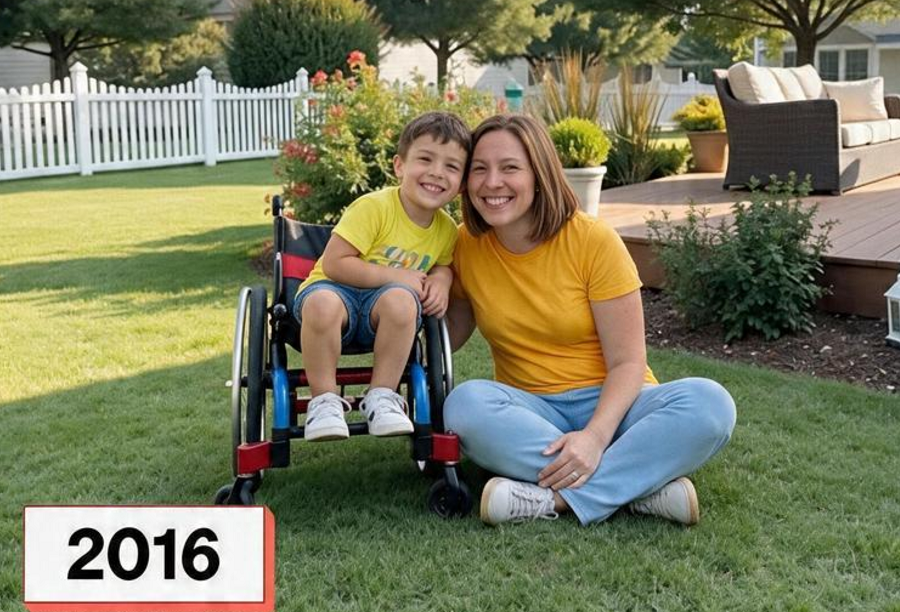
Evan was born with a congenital condition affecting his legs. He needed braces, regular physical therapy, and frequent medical appointments. Standing could be painful, and walking required enormous effort.
Yet he was rarely bitter.
He loved picture books, toy rockets, chocolate milk, and asking questions no adult knew how to answer.
“Do stars ever get lonely?”
“Can the moon see us?”
“Do dogs know when people are sad?”
He was curious about everything.
And despite the pain he endured, he remained the happiest child I knew.
Then, one freezing Friday night, his entire world fell apart.
I had just finished a double shift. My hair smelled like hash browns and dust from the bookstore shelves, and every muscle in my body ached.
All I wanted was a hot shower, a bowl of noodles, and an hour of terrible television before falling asleep on the couch.
But as I turned the corner toward my apartment building, I noticed two figures beneath the flickering streetlamp.
One was a woman in a beige coat.
The other was a small boy holding a suitcase decorated with cartoon stickers.
I stopped walking.
“Lila?”
My older sister lifted her head.
Her long hair was tied neatly behind her, and one hand rested on Evan’s shoulder. Her expression was unnervingly calm.
There were no tears.
No trembling hands.
No sign that what she was about to do was tearing her apart.
“Amy,” she said quietly. “I can’t do this anymore.”
The cold seemed to seep through my shoes.
“What are you talking about?”
She drew in a slow breath and gently guided Evan toward me.
“I met someone,” she said. “He wants us to start a new life together, but he doesn’t want children.”
For a moment, I thought I had misunderstood her.
I stared at her, waiting for the rest of the explanation.
It never came.
“You’re choosing a man over your son?”
Her jaw tightened.
“You don’t understand what my life has been like. The appointments, the therapy, the bills, the constant responsibility. I’m exhausted, Amy.”
“He’s four years old.”
“I know how old he is.”
“He needs you.”
Lila glanced down at Evan, but only for a second.
“I deserve a chance to be happy,” she said. “I deserve a normal life.”
The words struck me harder than the freezing wind.
A normal life.
As though her own child were an obstacle standing between her and happiness.
I stepped closer and placed an arm around Evan’s shoulders.
He looked up at me, confused but silent. His small hands were wrapped around the handle of his suitcase.
“You’ve always been good with him,” Lila continued. “He loves you. You can take better care of him than I can.”
“You cannot simply leave your child on a sidewalk.”
But she had clearly rehearsed every part of this moment.
She crouched, pressed a quick kiss to Evan’s forehead, and placed the suitcase at my feet.
Then she stood.
“Lila, stop.”
She turned away.
“What are you doing?” I shouted. “Come back here!”
She walked toward a black car waiting at the curb.
I called her name again, but she opened the passenger door and climbed inside.
She never looked back.
The car pulled away, its red taillights disappearing into the night.
Beside me, Evan tugged gently on my sleeve.
“Auntie Amy?”
I looked down.
“Where is Mommy going?”
His voice was so quiet that something inside me shattered.
I lowered myself onto the cold pavement and wrapped both arms around him.
“I’m here,” I whispered. “You’re coming home with me.”
“Is Mommy coming back?”
I could not bring myself to lie.
So I held him more tightly.
“I’m not going anywhere,” I promised. “No matter what happens, I’m staying.”
At that moment, I had no idea how I would keep that promise.
I had no money, no extra bedroom, and no experience raising a child with complex medical needs.
But Evan had no one else.
And somehow, that made the decision for me.

Part Two: Learning to Become a Mother
That first night, I made Evan hot cocoa and added far too many marshmallows because I did not know what else to do.
I gave him one of my T-shirts to sleep in and let him take the bed while I sat beside him.
He asked about his mother twice.
The first time, I told him she had gone away.
The second time, I pretended not to hear because I was afraid my voice would break.
He finally fell asleep clutching the corner of my blanket.
I remained beside him for hours, listening to his breathing and staring at his tiny suitcase near the door.
How could a mother pack her child’s belongings, deliver him to someone else, and leave without looking back?
The following morning, reality began pressing down on me.
I called Lila repeatedly.
Every call went unanswered.
I sent text messages, emails, and messages through social media.
Nothing.
Within days, her phone had been disconnected. Her accounts disappeared, and no one in the family seemed to know where she had gone.
It was as though she had erased herself from Evan’s life overnight.
Meanwhile, I was trying to understand the life she had abandoned.
I spoke with Evan’s pediatrician, his physical therapist, his school, and several medical offices. I searched through the documents inside his suitcase, trying to make sense of appointment dates, insurance forms, prescriptions, and treatment plans.
I asked questions I had never imagined needing to ask.
How often did he need therapy?
Which braces were appropriate for him?
What should I do when the pain became severe?
Would his insurance cover new equipment?
Could I legally make medical decisions for him?
Every answer seemed to create three more questions.
I felt as though I had been dropped into the middle of an ocean and told to swim while holding a child above the water.
One night, after Evan had fallen asleep, I locked myself in the bathroom and sat on the floor.
My checking account contained forty-three dollars.
Rent was due in less than a week.
Evan needed groceries, transportation to therapy, and eventually a new set of braces.
I covered my face with my hands and cried as quietly as I could.
I was terrified.
Not because I did not love him, but because love did not pay bills or magically turn a frightened aunt into a capable parent.
For several minutes, I considered calling social services.
Perhaps someone with more money, more space, and more experience could give him a better life.
Then the bathroom door creaked open.
Evan stood in the doorway, rubbing his eyes.
“Auntie?”
I wiped my face quickly.
“What are you doing awake?”
“I had a bad dream.”
He shuffled toward me and rested his head against my shoulder.
“Can I stay with you?”
I held him as he slowly fell asleep in my arms.
That was when I understood something.
He was not looking for the richest person.
He was not looking for the most qualified person.
He was looking for someone who would still be there when he woke up.
So I made my decision.
We would struggle.
We would make mistakes.
But we would struggle together.
Part Three: The Hardest Years
The first year nearly broke me.
I sold my old car because I could no longer afford the payments and began taking buses across the city with Evan.
Traveling anywhere became an exhausting operation. I carried his bag, helped him with his braces, folded and unfolded equipment, and learned which bus drivers would wait patiently and which ones would sigh when we took too long.
I accepted every extra shift I could find.
Some days, I worked sixteen hours. On others, I left the diner, rushed Evan to an appointment, dropped him with a trusted neighbor, and hurried to the bookstore.
Our tiny apartment filled with therapy equipment.
Foam rollers leaned against the sofa. Balance boards occupied the hallway. Special chairs and support cushions appeared in every corner.
My landlord complained about the clutter and the sounds of Evan practicing his exercises.
I stopped caring.
My life was no longer organized around convenience.
It was organized around helping a little boy stand.
The therapy sessions were often painful.
I watched Evan’s face tighten as he forced his legs to move. I saw him fall, bite his lip, and push himself upright again.
Sometimes, after an especially difficult session, he cried against my shoulder.
But even then, he refused to surrender.
“One day I’m going to run,” he told me during one appointment.
He was gripping my hand so tightly that my fingers had gone numb.
“You think so?”
“I know so.”
His confidence made me smile.
“Then I’ll be waiting at the finish line.”
People were not always kind.
At playgrounds, I sometimes noticed parents staring at his braces. A few children whispered or pointed. Once, I saw a mother quietly guide her son away from Evan as though his condition were something contagious.
The cruelty hurt me more than it seemed to hurt him.
Evan was too busy studying the climbing frame.
“Do you think I can get up there?” he asked.
“I think we can find a way.”
So we did.
His teachers sometimes underestimated him as well. They assumed his physical limitations meant he would struggle academically.
They were wrong.
Evan learned to read earlier than many children in his class. He loved science, puzzles, astronomy, and complicated questions about how the human body worked.
He did not want anyone’s pity.
He wanted time, patience, and the opportunity to prove himself.
And he did.
By the age of ten, he could walk short distances using crutches.
His doctors called his progress extraordinary.
Some called it miraculous.
But I had watched every hour of therapy, every fall, every painful stretch, and every moment when he chose to try again.
It was not magic.
It was determination.
It was discipline.
It was a child refusing to let the world decide what he could become.

Part Four: The Life We Built Together
The years passed slowly at first, then all at once.
I eventually left the diner and accepted a full-time management position at the bookstore. The salary was not impressive, but it gave us stability and allowed me to spend more evenings at home.
After years of saving, we moved out of the apartment and into a small house.
It was modest, with faded kitchen cabinets and a fence that needed repairing, but to us, it felt like a palace.
Evan had his own bedroom.
He arranged his books by subject and placed a model of the solar system above his desk. The backyard was large enough for his therapy exercises, and on warm afternoons, I watched from the porch as he practiced moving between two support rails.
By then, the distinction between aunt and mother had almost disappeared.
I attended every school meeting.
I knew every medication, every therapist, every teacher, and every fear he tried to hide.
I celebrated his victories and sat beside him after disappointments.
I helped him study for exams, taught him how to cook scrambled eggs, and listened patiently while he explained facts about planets I had already heard dozens of times.
He still called me Aunt Amy in public.
But occasionally, especially when he was tired or frightened, another word slipped out.
Mom.
The first time it happened, he was twelve.
He had fallen during therapy and badly bruised his knee.
“Mom, it hurts,” he cried.
Then he froze.
His eyes widened as though he had said something forbidden.
Neither of us mentioned it.
I simply took his hand and said, “I know. I’m right here.”
After that, the word appeared more often.
Quietly.
Carefully.
As if he were testing whether it belonged to us.
It did.
When Evan was fifteen, he came home from school one afternoon with his cheeks red from the cold and a grin stretching across his face.
He leaned his crutches against the wall and pulled a certificate from his backpack.
“Guess what happened.”
I pretended to consider the question.
“You were selected for a mission to Mars?”
“Better.”
He held up the certificate.
The words Best Academic Achievement were printed across the top.
I read them twice before looking at him.
“You did it.”
“I did.”
I wrapped my arms around him, laughing and crying at the same time.
Then he became unusually serious.
“I think I know what I want to do when I’m older.”
“What?”
“I want to become a physical therapist.”
I looked at him in surprise.
“I want to work with children like me,” he continued. “Kids who think they’ll never walk or do the things everyone else does. I want to show them that their lives aren’t over.”
Every sacrifice suddenly felt worthwhile.
The sleepless nights.
The unpaid bills.
The hours on buses.
The fear that I would never be enough for him.
All of it had led to the young man standing before me.
For the first time in years, I allowed myself to believe the worst was behind us.
I thought we had finally reached our happy ending.
One week later, someone knocked on our front door.
Part Five: The Woman on the Porch
I assumed it was a neighbor or a delivery driver.
Instead, when I opened the door, I found myself staring at the sister I had not seen in nearly eleven years.
Lila stood on my porch wearing an elegant coat and carefully applied makeup.
Time had changed her.
She was thinner than I remembered, and there were sharp lines around her eyes. She appeared polished from a distance, but beneath the expensive clothes and perfect hair, she looked tired.
Beside her stood a man in a charcoal suit holding a leather briefcase.
He gave me a professional nod.
Lila smiled as though she had stopped by after a brief absence.
“Hello, Amy.”
I could not speak.
For years, I had imagined this moment.
In some versions, I screamed at her.
In others, I demanded answers.
But now that she was standing in front of me, I felt only a cold emptiness.
“We need to talk,” she said.
I stepped outside and pulled the door partly closed behind me.
“You should not be here.”
Her smile faded.
“I know you’re angry.”
“Angry?”
“I made a terrible mistake.”
“You abandoned your child on a sidewalk.”
“I was young and overwhelmed.”
“You were his mother.”
She glanced toward the house.
“I shouldn’t have left Evan,” she said. “I understand that now.”
The man beside her cleared his throat.
“My name is Daniel. I represent Lila.”
I turned toward him.
“Represent her?”
Lila spoke before he could continue.
“I want my son back.”
For several seconds, the words did not make sense.
“You want what?”
“I want to be his mother again.”
Daniel opened his briefcase.
“Lila intends to pursue custody. We came here first because we hoped the matter could be resolved through a private agreement.”
I stared at them.
Then I laughed.
It was not because anything was funny. The idea was simply too unbelievable for any other reaction.
“You think you can return after eleven years and take him?”
Lila’s expression hardened.
“I’m still his biological mother.”
“You were not there when he woke up crying for you. You were not there for his surgeries, his therapy, his first day of school, or the nights when pain kept him awake.”
“I know I failed him.”
“You never called. You never sent money. You never mailed a birthday card.”
“I’m trying to make things right.”
“No. You are trying to take credit for a life you did nothing to build.”
For the first time, irritation flickered across her face.
“I heard he’s doing extremely well,” she said. “Colleges are already interested in him. His story could open doors. Schools respond strongly to stories about courage and resilience. There could be scholarships, interviews, perhaps other opportunities.”
I stared at her.
She continued, speaking faster now.
“He has become valuable, Amy.”
Valuable.
That single word revealed more than any confession could have.
“You do not see a son,” I said quietly. “You see a success story you can attach yourself to.”
“That is not fair.”
“You abandoned him when caring for him was difficult. Now that he is achieving things, you want to stand beside him and pretend you helped.”
Before she could answer, the front door opened behind me.
“Auntie Amy?”
I turned.
Evan stepped onto the porch with his crutches beneath his arms.
His eyes moved from me to Lila and then to the lawyer.
“Is something wrong?”
Lila’s entire expression changed.
Her face brightened, and she stepped forward with her arms partly raised.
“Evan! Sweetheart, it’s me.”
He stared at her.
For one painful second, he looked like the confused four-year-old who had once stood beneath a streetlamp with a cartoon suitcase.
Then he moved closer to me and slipped his hand into mine.
“Mom?”
The word was meant for me.
Lila smiled as though it belonged to her.
“Yes, sweetheart.”
Evan’s face hardened.
“You’re not my mom,” he said.
Her smile vanished.
“I gave birth to you.”
“You left me.”
“I made a mistake.”
“Amy stayed.”
His voice did not rise. He did not insult her or cry.
He simply told the truth.
“She took me to every appointment,” he continued. “She helped me learn to walk. She worked all the time so I could have what I needed. She is my mom.”
Lila looked as though he had struck her.
Evan leaned toward me.
“Do I have to speak to her?”
“No,” I answered. “You do not.”
I stepped between him and the two strangers on our porch.
“You need to leave.”
Lila started to argue, but her lawyer placed a hand on her shoulder.
“We should go.”
She looked past me toward Evan one final time.
Then she turned and walked away.
We watched until they disappeared down the driveway.
That night, neither Evan nor I slept well.
I knew Lila had not returned merely to talk.
And I knew she would not give up easily.

Part Six: The Fight for My Son
The legal documents arrived the following week.
Lila was filing for custody.
The sight of her name on those papers filled me with a fear I had not experienced since the night she left Evan outside my apartment.
Biology carried weight in court.
What if the years I had spent raising him were treated as temporary?
What if love, sacrifice, and loyalty mattered less than the fact that she had given birth to him?
I hired the best lawyer I could afford.
Together, we gathered everything.
Medical files.
School records.
Receipts.
Photographs.
Letters from teachers, neighbors, doctors, and physical therapists.
They described the appointments I had attended, the decisions I had made, the nights I had spent beside hospital beds, and the home Evan and I had built together.
Lila presented herself as a changed woman.
She told the court she had been young, frightened, and emotionally overwhelmed. She claimed she had spent years regretting her decision.
Her attorney produced photographs of a beautifully decorated bedroom she had supposedly prepared for Evan.
There were new books, expensive furniture, and framed inspirational messages on the walls.
But a decorated room could not replace eleven missing birthdays.
A new bed could not erase a decade of silence.
The proceedings continued for months.
Each hearing left me exhausted.
I tried to shield Evan from the worst of it, but he understood more than I wanted him to.
Eventually, he insisted on speaking to the judge.
I begged him to reconsider.
“You do not have to prove anything,” I told him.
“Yes, I do,” he said. “She keeps telling everyone she came back because she loves me. I want them to hear what happened from me.”
When Evan entered the courtroom, he wore his braces and carried his crutches.
He sat upright, his expression calm.
When he began speaking, the room fell silent.
“I don’t remember every detail from the night she left,” he said. “But I remember thinking I had done something wrong.”
My chest tightened.
“I thought maybe I was too difficult to take care of. I thought she left because I couldn’t walk like other children.”
Lila lowered her eyes.
“For a long time, I felt like something people could throw away when I became inconvenient.”
His voice trembled slightly, but he continued.
“Amy never made me feel that way. She stayed when things were hard. She helped me with therapy, took care of me when I was sick, and believed in me when other people didn’t.”
He looked toward me.
“She is the person who raised me. She is the person I trust. She is my mother.”
Tears blurred my vision.
Several people in the courtroom were crying, but Evan remained composed.
He had not spoken with anger.
He had spoken with clarity.
And sometimes, truth delivered calmly is more powerful than any accusation.
When the judge finally announced the decision, I could barely breathe.
Permanent custody was granted to me.
Lila’s petition was denied, and she was not given the right to force contact against Evan’s wishes.
The moment the ruling was read, the tension I had carried for months finally broke.
I covered my face and cried.
Evan reached for my hand.
“It’s over,” he whispered.
On the way home, we stopped for ice cream.
It felt strange to celebrate after months of fear, but we needed something ordinary and joyful.
We sat in a booth near the window, eating oversized sundaes while snow began falling outside.
For the first time since Lila had appeared, I felt safe.
I believed the fight was finished.
But Evan had one more decision to make.
Part Seven: One Final Request
A few days later, I was folding laundry in the living room when Evan entered carrying a large envelope.
He sat across from me without speaking.
“What is that?” I asked.
He placed the envelope on the coffee table.
“I want to do it.”
“Do what?”
“I want you to adopt me.”
My hands froze over the towel I was folding.
“Evan…”
“I know the court said I can stay with you. And I know I already call you Mom.”
He paused.
“But I don’t want there to be any question anymore. Not on paper. Not anywhere.”
I could not speak.
He looked down at his hands.
“You chose me when you didn’t have to. You gave up so much, and you never made me feel like I owed you for it.”
“You never owed me anything.”
“I know.”
His eyes met mine.
“That’s why I want it to be official.”
I moved beside him and took both his hands.
“Are you absolutely certain?”
“I’ve never been more certain about anything.”
The adoption process required more paperwork, more meetings, and more patience.
But compared with everything we had already survived, it felt almost easy.
On the day the adoption was finalized, Evan and I stood together in the courthouse.
The judge signed the documents and smiled at us.
“Congratulations,” she said.
One word.
One signature.
And eleven years of love finally had a legal name.
Outside the courthouse, sunlight broke through the clouds.
Evan stopped at the top of the steps and looked at me.
“Mom?”
Even after all those years, hearing him say it still filled my heart.
“Yes?”
“We did it.”
I hugged him carefully, laughing through my tears.
“Yes,” I whispered. “We did.”
Part Eight: The Meaning of Staying
People often say that being a parent is about biology.
I learned that biology may begin a life, but it does not build one.
Parenthood is staying awake beside a frightened child.
It is learning medical terms you never expected to understand.
It is stretching forty-three dollars until the next paycheck.
It is taking buses in the rain, waiting through appointments, celebrating tiny improvements, and offering hope when your own strength is nearly gone.
It is showing up.
Again and again.
Especially when leaving would be easier.
Lila gave birth to Evan.
But I watched him become the young man he was meant to be.
I was there when he struggled to stand.
I was there when he took his first steps with crutches.
I was there when he won his academic award and announced that he wanted to help children facing the same challenges he had overcome.
I did not rescue Evan alone.
In many ways, he rescued me too.
Before he came into my life, I believed I was merely surviving.
Because of him, I discovered that my life could have purpose.
He taught me that courage is not always loud. Sometimes courage is a child falling during therapy and quietly asking to try again.
He taught me that families are not defined only by the people who share our blood.
They are defined by the people who remain beside us when life becomes difficult.
My sister walked away because she believed Evan stood between her and a better life.
She never understood that loving him became the best part of mine.
And on the day he officially became my son, I finally understood something else.
I had promised a frightened four-year-old that I would never leave him.
Eleven years later, standing outside the courthouse with his hand in mine, I realized I had kept that promise.
Not because it was easy.
Not because I was prepared.
But because he was worth staying for.
Note: This story is a work of fiction inspired by real events. Names, characters, and details have been altered. Any resemblance is coincidental. The author and publisher disclaim accuracy, liability, and responsibility for interpretations or reliance. All images are for illustration purposes only.

Related Posts
I Hand-Knitted My Wife’s Wedding Dress for Our Vow Renewal – The Guests Laughed… Until She Picked Up the Microphone and Silenced the Entire Room
I Had My Son Do a DNA Test Which Confirmed Paternity, but Then His Fiancée’s Mother Called and Left Me Totally Shocked