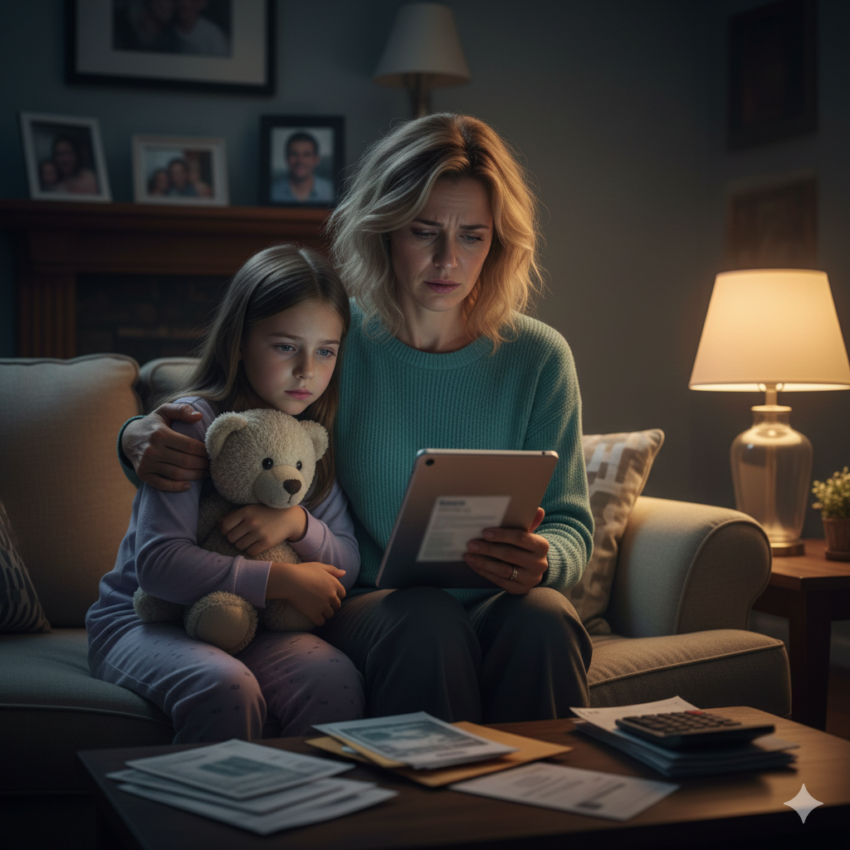
When my husband, Jake, died, my entire life split cleanly in two—before and after.
Before was full of routines, shared jokes, long talks after the kids were asleep.
After was silence… paperwork… and a fear so heavy it felt hard to breathe.
Jake’s passing didn’t just leave me heartbroken—it left me responsible for everything. The bills. The future. The children who now looked at me for reassurance I didn’t always have. The money he left behind wasn’t a fortune. It wasn’t extra. It was survival.
Every decision I made after that revolved around one question: How do I protect my kids?
I thought the grief would be the hardest part.
I was wrong.
The Calls Began
It started quietly. Too quietly.
My sister-in-law called first, her tone gentle, almost sympathetic.
“You know Jake would’ve wanted you to help the family,” she said softly.
“He was never selfish.”
Jake wasn’t selfish.
But he was intentional.
He worked for us. For our home. For our children.
At first, I brushed it off. Grief makes people say strange things, I told myself. But then the calls multiplied.
His brother.
An aunt I hadn’t spoken to in years.
Cousins who suddenly remembered I existed.
Each conversation followed the same script—concern wrapped around expectation. “Just a little help.” “Only temporary.” “Jake would’ve wanted this.”
What they really meant was: Give us what you have.

Crossing the Line
Then they dragged my children into it.
One evening, I found my daughter trembling on the couch, phone clutched in her hand.
“She keeps calling me,” she said quietly. “She says you’re keeping money that belongs to everyone… and that Daddy wouldn’t be happy with us.”
Something inside me snapped.
Grief is one thing.
Using a child as a weapon is another.
I reassured her, held her until the shaking stopped—but the damage had already been done. Doubt had been planted where safety should have been.
The messages got uglier after that. Accusations. Threats. Long paragraphs dissecting my character, questioning my love for Jake, accusing me of greed.
People who once hugged me at holidays were now treating me like an enemy.
The Line in the Sand
That’s when I stopped answering calls.
I contacted our lawyer.
I saved every message.
Documented every voice mail. Every attempt to intimidate or guilt us.
And I pulled out Jake’s will.
I read it slowly. Carefully. Over and over.
There was no ambiguity.
No hidden meaning.
No “family share” clause.
Jake had made his wishes unmistakably clear—everything went to me, for the children, so they would never struggle the way he once had.
And for the first time since he died, I felt something solid beneath my feet.

What Comes Next
I’m exhausted. I’m grieving. And yes, I’m still afraid.
But I’m not confused anymore.
I won’t let anyone rewrite my husband’s legacy.
I won’t let guilt steal my children’s future.
And I won’t let cruelty disguise itself as family loyalty.
The storm hasn’t fully arrived yet—I know that.
But this time, I’m ready.