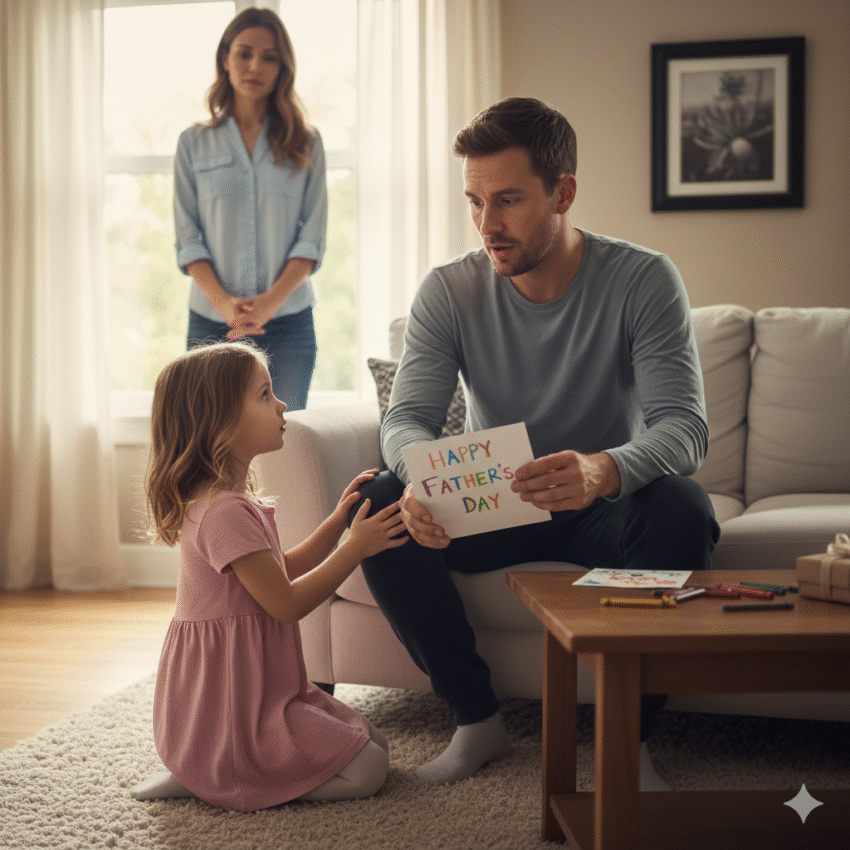
Father’s Day was supposed to be simple.
Pancakes in the morning. A crooked paper card. My daughter Lily’s arms wrapped around my neck, sticky with syrup. I imagined nothing more complicated than that—nothing heavy, nothing life-altering.
But life doesn’t always warn you before it turns.
Sometimes the truth doesn’t arrive loudly.
Sometimes it comes quietly… from the back seat of a car, spoken by a five-year-old holding a purple crayon like it holds magic.
Lily has her own way of seeing the world.
She believes the moon follows our car because it likes us. She thinks puddles are pieces of the sky that fell down. She’s convinced our neighbor’s dog understands English but chooses not to speak.
So when she asked her question—softly, carefully—I knew she wasn’t lying or being clever.
She believed what she was saying.
I didn’t react. I forced myself not to. A single wrong expression could have confused her, scared her, made her feel she’d done something wrong. So I stayed gentle. I asked small questions. I listened.
Her words came out in fragments, the way children speak when they don’t understand the meaning behind what they’ve seen. Moments when I wasn’t home. Someone she thought was a “friend.” Details that didn’t match the rhythm of our life.
She wasn’t accusing anyone.
She was just telling me what she noticed.
I turned it into a game—our own little Father’s Day “surprise dinner mission.” Lily loved that idea. It made her feel excited and important.
For me, it bought time.
And while she laughed and planned decorations, a cold weight settled deep in my chest. The quiet certainty that something had been happening right beside me… without my knowing.
On Father’s Day, my wife left early for a photography session she’d booked long ago. Lily and I stayed home to cook dinner together.

She insisted on sunflowers, pulling them from the backyard and stuffing them into a vase that nearly tipped over. She hummed while stirring batter, completely unaware she had changed the direction of our lives simply by telling the truth as she saw it.
The house felt warm. Normal.
Until evening.
Right on time—exactly when Lily had said it would—a knock sounded at the door.
When I opened it, everything was written across the visitor’s face:
surprise, guilt, and the sudden understanding that secrets had run out of places to hide.
What followed wasn’t shouting. There were no slammed doors or raised voices. It was slower than that—worse in some ways. Half-truths peeling away. Explanations finally spoken out loud. Choices from the past laid bare.
There’s a special kind of pain that comes from learning something you never wanted to know—and can never unlearn.
But the most important part of that night had nothing to do with adults.
In the days that followed, my focus stayed on Lily.
On her safety.
On her peace.
Children don’t need adult details. They don’t deserve to carry adult mistakes. What Lily needed wasn’t explanations—it was reassurance.
We talked about families. About how they’re built in many ways. I told her love isn’t about biology. It’s about showing up—again and again.
One night, as I tucked her in, her hair still damp from the bath, she traced patterns on my arm.
Then she whispered, barely louder than a breath,
“Are you still my daddy?”
That question broke me in the quietest way.
I pulled her close. “I always have been,” I told her. “And I always will be.”
Her body relaxed instantly, the way only a child’s can when they feel safe again. In that moment, not everything was fixed—but what mattered most had held.
Life slowly found its rhythm after that.
There were hard conversations—necessary ones—but they stayed away from Lily. She went back to drawing suns with sunglasses, naming bugs, and singing off-key every morning.
And I went back to being what I’d always been:
Her constant.
Not every Father’s Day ends with a picture-perfect ending. Not every family story is neat.
But sometimes, the unexpected reveals what was truly important all along—that being a parent isn’t about proof or paperwork.
It’s about presence.
And years from now, Lily may not remember the question she asked or the tension that followed. She might only remember pancakes, sunflowers, and the steady feeling of her father’s arms around her.
That’s enough.
Because no matter what changed that week, one truth never did:
I am her father.
Because I choose to be.
Every day.