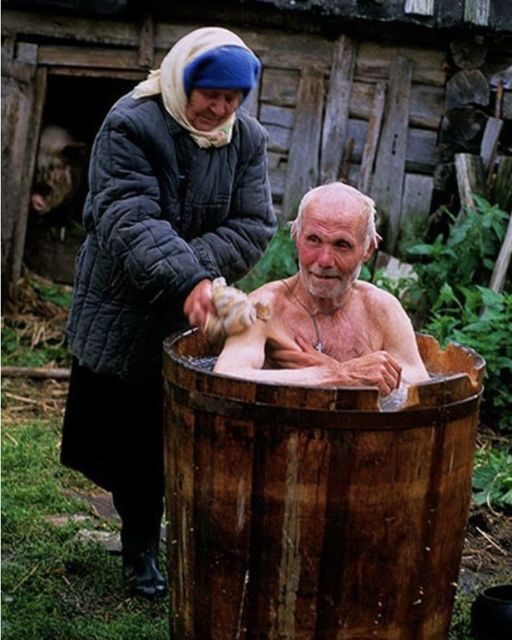
Every Sunday afternoon, rain or shine, Grandpa climbs into the barrel out back with a sigh like he’s settling into a church pew, and Grandma scrubs him down with an old cloth and a bowl of boiled water like it’s a sacred ritual.
They don’t talk much during it. Just quiet grunts, the splash of water, maybe a snort from the pigs behind the shed.
But last weekend felt different.
Grandpa had been quieter all morning. Kept fiddling with that rusted tin medallion he’s worn since the war. Grandma hummed the same tune she always does—something slow and minor—but her hands moved slower too, like she was stalling.
I leaned on the fence, watching them, thinking about how someday this would all be a memory. I almost pulled out my phone to take a picture.
But something told me not to.
Maybe it was the way Grandpa looked up at her, the way her eyes didn’t quite meet his like usual. Maybe it was the smell of rain still lingering in the grass or the way the chickens didn’t cluck like they normally did. Whatever it was, I just stood there, silent, not wanting to interrupt what felt like something sacred.
“Lina,” Grandpa finally said, voice low and rough like the gravel in our driveway.
Grandma froze. Her hand paused mid-scrub on his shoulder.
He hadn’t called her by name during these baths in years. Not since my dad left and Mom cried in the kitchen for three nights straight.
“I need to tell you something,” he continued.
Grandma looked down at her hands, then back up at him. “What’s got into you, Tom?”
He didn’t answer right away. Just reached for her hand with one of his, shaking from age or nerves—I couldn’t tell which.
“I found the letter,” he said.
Her face didn’t change much, but her shoulders stiffened.
“What letter?” she asked, but her voice sounded like she already knew.
“The one from… George,” Grandpa said. “The one you never meant for me to see.”
I felt my heart thud once in my chest.
George was my great-uncle. Grandma’s brother. Or at least that’s what I was always told.
Grandma let out a long breath. “You weren’t supposed to—”
“I know,” Grandpa said, his voice suddenly softer. “It was tucked inside that sewing tin you keep behind the old hymn books.”
Grandma’s eyes were glossy now, but she didn’t cry. She never cries in front of him. I’d only seen her cry once, when her canary died, and even then she turned away.
“He asked me to run away with him,” she finally said, voice like the whisper of a worn-out curtain in the wind. “It was 1953. You’d just been drafted.”
“I know,” Grandpa said again. “I read it. He said he loved you.”
“I never wrote back,” Grandma said, and her voice cracked just slightly. “I waited for you. Every day. I knew I’d made a vow.”
Grandpa nodded slowly. “I didn’t bring it up to accuse you. I brought it up because… you could’ve left. You had a choice. And you chose me.”
The silence that followed was so still, even the pigs seemed to hold their breath.
“You scrub my back every Sunday,” he said, looking up at her with eyes that had seen war and loss and babies born in kitchen sinks. “And I never said thank you. Not properly.”
Grandma bit her lip. Her hand moved to his cheek.
“I didn’t stay out of duty,” she said. “I stayed because I loved you.”
“And I know that now,” Grandpa whispered.
I didn’t realize I was crying until a tear hit the wooden rail of the fence.
“You could’ve chosen a different life,” Grandpa said. “But you chose this one. You chose me, even with all my silence and my hard edges and that awful drinking spell in ‘72.”
Grandma laughed—just a breathy, soft thing.
“You were always worth the fight, Tom.”
They sat like that for a while. Her hand on his cheek. His in the water. Both of them more still than I’d ever seen them.
Then Grandpa said something I’ll never forget.
“I’ve set up a savings account,” he said. “It’s under your name. For after. I wanted to surprise you with it, but now feels right.”
Grandma blinked.
“For after what?”
Grandpa swallowed. “Doctor says I got months. Maybe less. That cough I’ve had? Not just dust and age.”
She went still.
“I didn’t tell you ‘cause I didn’t want to see that look,” he said. “But you deserve the truth.”
For a moment, she didn’t say anything.
Then she reached over and smacked his shoulder.
“You old mule,” she said, tears now freely falling. “I would’ve cooked you better soup if I’d known!”
They both laughed, but it felt fragile.
“I’ve had sixty-four years of baths and beans and bickering,” he said. “And I wouldn’t trade a single second of it.”
I quietly stepped away from the fence, my heart full and heavy at once.
But the story didn’t end there.
The next week, something strange happened.
A man came down our dirt road. Said his name was Daniel. He was tall, polite, maybe in his mid-forties. Said he’d been looking for “a Lina from Shelby County” for a long time.
Turned out, he was George’s son.
Apparently, George had passed away a few years back and had told Daniel, before he died, about the woman he once asked to run away with. Said he regretted not trying harder.
Daniel had inherited some land down in Kentucky. But more than that, he’d inherited curiosity.
“I’m not here to cause trouble,” Daniel said at the dinner table that night. “Just to say thank you.”
“For what?” Grandma asked, eyes wary but gentle.
“For being the kind of woman who chooses love. My father carried your photo in his wallet until the day he died.”
Grandma looked down. Grandpa reached across the table and squeezed her hand.
It was quiet for a long moment.
Then Grandpa said, “Well, I reckon we’ve got room in the barn if you’re sticking around.”
And just like that, Daniel became part of the family.
He fixed the gutters, helped with the pigs, and played guitar in the evenings. Said he never had real grandparents and wanted to make up for lost time.
That winter, when Grandpa got too weak to make it outside for his Sunday bath, Grandma brought the boiled water inside and laid out towels in the kitchen.
He passed away two months later, quietly, with her hand in his and Daniel playing guitar in the background.
At the funeral, we found a letter Grandpa had left behind. Not for Grandma, not for me—but for Daniel.
It read:
“You were never the mistake your father thought he made. You were a ripple of love that came from a moment of longing. And you’re here now. That’s what matters.”
That letter changed something in Daniel. He started writing songs again. Started smiling wider.
A few months later, he asked Grandma if he could call her “Nan.” She cried and nodded yes.
And now, every Sunday, Daniel boils the water and washes the old dog, Daisy, who’s too frail to do it herself. Says it’s his way of honoring the tradition.
We all miss Grandpa.
But his love lingers in the steam of boiled water and the sound of a guitar playing slow, sad songs on the porch.
His life wasn’t perfect. But it was honest. And in the end, love wasn’t just in the big gestures—it was in the scrubbing, the silence, and the choice to stay.
So here’s the thing: love doesn’t always look like grand speeches or flowers.
Sometimes, love looks like boiled water on a cold Sunday. Like staying when no one would’ve blamed you for leaving. Like washing someone’s back, year after year, without ever needing to be thanked.
Sometimes, love is the quiet kind. The kind you only understand when you’re leaning on a fence, trying not to cry.
If this story touched you, share it with someone who still believes in the kind of love that stays.
And maybe… call your grandparents. They probably have a story too.