That word again—different. It felt strange. I didn’t feel like I was doing anything special.
Over the next few weeks, I noticed something. Mr. Harrington started lingering longer. Sometimes he’d bring a book, sometimes a newspaper. One morning, he brought a tiny notepad and said, “I’m trying to write again.”
“Nice,” I said, handing him his usual black coffee. “What kind of writing?”
“Memoir,” he mumbled. “Don’t know if it matters now, but… it’s something to do.”
“Of course it matters.”
He smiled, almost surprised. “You really think so?”
“Everyone’s story matters,” I said.
From then on, he shared a little more each day. His wife had passed away three years ago. His only daughter lived abroad. He had worked in construction all his life, never went to college, but had always wanted to write.
I started reading bits of his writing when he asked. Gave honest feedback. He was surprisingly good—simple, clear, heartfelt. Stories about growing up in a small town, about building homes with his bare hands. He wrote about mistakes he made, people he loved, things he never said out loud.
One afternoon, he said, “You know, if you hadn’t chased me with that umbrella, I probably wouldn’t have come back.”
“Glad I did then,” I said.
By that time, I had started working mornings at the café and tutoring evenings. I was exhausted, but I had a routine. I’d gotten to know the neighborhood a little. There was a laundromat down the street run by a woman named Nia, who always offered me a free wash when she saw me dragging my laundry in. I never accepted, but I appreciated her.
One night, I was heading home from tutoring when I saw a guy trying to break into Nia’s laundromat. I didn’t think. I yelled, and he ran off. Nia came running out in her slippers, furious but grateful.
“You could’ve been hurt,” she scolded me.
“I just didn’t want them to take your stuff,” I said, shrugging.
The next day, she left a small bag of fresh-baked pastries at the café for me. A note inside said: “You watch out for people. So now we’ll watch out for you.”
I started to feel something I hadn’t in a while—belonging. Even if I was barely getting by, people noticed. Not because I was flashy or loud. But because I showed up.
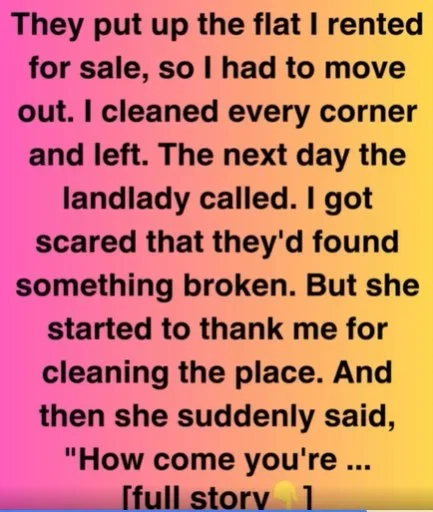
About a month later, my phone buzzed while I was on break. It was a message from my old landlady again. “Can you call me when you have a sec?”
I called her back, a little curious.
“I hope I’m not bothering you,” she said.
“Not at all. Everything okay?”
“Well… yes and no. The flat sold. The new owners were in yesterday. They said the buyer wants to rent it out. And they asked me if I knew any previous tenants who were trustworthy.”
I laughed. “And you thought of me?”
“I told them you were the best tenant I ever had. Always paid on time. Never once yelled, even when we had issues. So… they’d like to offer it to you. At the same rent. No agency fees.”
I went quiet.
“I know you probably already settled elsewhere,” she continued. “But if you want it, they’ll hold it for a week.”
I almost cried. My current place had mold in the bathroom and no natural light. I’d only taken it because I was desperate. Going back felt like a small miracle.
“I’d love to,” I said.
The next week, I moved back into my old flat. It was surreal. Familiar, but new again. I got a cheap secondhand couch and a couple of plants. The kitchen window caught the afternoon sun, and I’d sit there with a cup of tea after my shifts.
One morning, I found an envelope under my door. It had no name. Inside was a note: “Some things come back to you, when you least expect them. – Nia.” Alongside the note was a grocery store gift card. I smiled, shaking my head.
People were watching out for me. Just like I’d tried to watch out for them.
A few months later, something even more unexpected happened. Mr. Harrington got published. A small local press took interest in his memoir. He invited me to the launch at a tiny bookstore near the station. He insisted I sit up front.
When he got up to speak, he started with, “I owe this to someone who gave me their time when they didn’t have to. A young man who listened, who told me that my story mattered. He probably doesn’t think he did much. But without him, I wouldn’t be standing here today.”
I blinked hard. Everyone clapped. He looked right at me, smiling.
Afterward, he handed me a copy with a handwritten message inside: “To the quiet force who reminded me I still had a voice.”
I still keep that book on my shelf.
Things didn’t get easier overnight. I still worked long shifts, still had bills I barely managed to pay. But the heaviness I’d carried started to lift.
One night, while closing up the café, the manager pulled me aside. “You know,” she said, “you’ve brought more people here than any ad campaign. They come back for you.”
I smiled. “I think they come back for the coffee.”
She shook her head. “No, they come back for the kindness.”
A few weeks later, she offered me a new position—assistant manager. Better hours, a small raise. Nothing huge, but it meant I didn’t have to tutor late into the night anymore. I took it.
Years passed. I stayed in the same flat. Grew into the neighborhood. I eventually saved enough to start a side project—community writing workshops. People of all ages came in, shared their stories, wrote poems, even letters to people they’d never sent.
One day, a teenage girl stayed back after the workshop. She handed me a note and ran off.
“I used to think nobody saw me. But I think you do. Thank you.”
I sat in the empty room for a while, holding that note. Thinking of all the little moments that led to this one.
Here’s the thing: I never planned to “be kind” for some reward. I wasn’t trying to be remembered. I just didn’t want to be another reason someone’s day got worse.
But the world has a strange way of circling back.
That flat I cleaned when I moved out? That tiny act got me back home.
That umbrella I chased down the street? It helped publish a book.
That shout outside a laundromat? It brought me into a community.
We think the big things matter most—degrees, titles, grand gestures. But sometimes, it’s the quiet stuff. The thank-yous, the help-you-carry-that-bag moments. The “I see you”s.
Kindness leaves a trail. And if you follow it long enough, you’ll find it leads you back to something solid. Something like home.
So, if you’re out there wondering if your little efforts mean anything—if showing up, cleaning the flat, helping an old man write, or making someone’s coffee with a smile makes a difference—it does.
Even if it doesn’t echo right away, it settles. Somewhere. In someone.
And sometimes, it comes back to you when you need it most.
If this story touched something in you, take a second to like it or share it with someone who might need the reminder.
Because kindness isn’t just something we give away. It’s something we plant—and one day, it blooms.