I Brought a Homeless Elderly Man Home for Dinner – My Wife Dropped Her Plate When She Saw His Face
Here’s your story rewritten into a longer, more refined and emotionally powerful Facebook story—keeping the heart of it intact while deepening the storytelling and flow for a strong 5-minute read:
I thought I was just doing one small good thing on a cold night.
I didn’t expect it to change our lives.
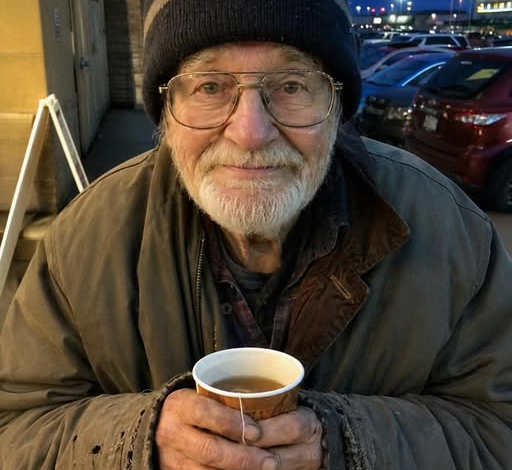
I met Walter outside a grocery store on a Thursday evening so cold it felt like the air itself was cutting through layers of clothing. The kind of cold that settles into your bones and doesn’t leave.
He was sitting near the cart return, shoulders hunched, hands tucked under his arms for warmth. His coat looked like it had survived more winters than it should have — thin, worn, and no longer doing its job.
What caught my attention wasn’t just him.
It was the small brass key hanging from a faded red string around his neck.
Something about it felt… intentional.
Important.
I walked over and asked, “Have you eaten today?”
He looked up slowly, like it took effort.
“Not today,” he said.
So I told him to come inside. Nothing dramatic — just food, warmth, maybe a few minutes of normal conversation.
“Tea too?” he asked.
“Tea too,” I said.
And just like that… that’s how I met Walter.
—
He told me he was 72.
He spoke quietly, carefully, like someone who had learned to take up as little space as possible.
We sat near the store’s entrance with hot tea and one of those pre-made sandwiches that somehow taste better when you’re freezing and hungry.
I asked if he had family.
He stared into his cup for a long time before answering.
“Maybe once.”
That answer stayed with me.
When I asked what he meant, he tapped his temple gently.
“Accident,” he said. “Long time ago. I remember pieces… but not how they fit together.”
I nodded slowly, then glanced at the key.
“What about that?”
He touched it lightly, almost like he’d forgotten it was there.
“I think it’s important,” he said. “I just don’t know why.”
—
After that night, I couldn’t just walk away.
I started bringing him food.
Coffee in the mornings. Soup at night. Gloves. Socks. A proper hat.
I learned his routine — when he stayed near the store, when he tried to get a bed at the shelter.
And little by little, we started talking more.
Not just small talk.
Real conversation.
One day I asked, “Did you ever get married?”
He thought about it for a moment, then said, “I don’t think so. I feel like I would remember disappointing someone that badly.”
I laughed harder than I expected.
There was something about him — even without his memories — that felt grounded. Kind.
Familiar in a way I couldn’t explain.
—
I told my wife, Megan, about him.
At first, it was just passing stories.
Then it became regular updates.
“Walter remembered how to make soup but not where he learned it.”
“Walter insists tea tastes better if you let it sit too long.”
“Walter says people are kinder in theory than in practice.”
She listened to all of it.
One night, she said something simple that changed everything.
“Why don’t we invite him over?”
I looked at her.
“You sure?”
She nodded. “He shouldn’t be eating parking lot food in January if we have a kitchen.”
—
So I asked him.
“Walter… would you like to come over for dinner tonight? Real food. Warm house.”
He just stared at me.
Then his face crumpled in a way I’ll never forget.
“I didn’t think people still did that,” he said quietly.
I told him, “We do.”
—
When we got home, he stepped into our kitchen slowly, like he wasn’t sure he belonged there.
He hovered near the table, taking everything in.
And for a moment, I thought maybe this was what kindness was supposed to feel like.
Simple.
Quiet.
Enough.
Then Megan walked in.
She was carrying a plate of pasta.
Walter reached for a chair.
His sleeve pulled back slightly—
—and everything changed.
Megan’s eyes locked onto the scar near his elbow.
The plate slipped from her hands.
It shattered across the floor.
Sauce splattered. Pasta scattered.
But she didn’t notice.
Her hands started shaking.
“Walter?” she whispered.
He froze.
“I think you have the wrong person,” he said gently.
But she shook her head, tears already falling.
“No… you died.”
The room went silent.
—
What came next didn’t feel real.
Megan told us about her childhood.
About her mother being sick.
About being alone.
And about the man next door who stepped in when no one else did.
He made her breakfast.
Walked her to school.
Taught her how to cook.
Took care of her when she had no one.
“That was you,” she said.
Walter just sat there.
“I don’t remember,” he said.
“I know,” she whispered.
—
Then something shifted.
He looked down at the broken pasta on the floor and said quietly,
“I used to make it with basil.”
Megan stopped breathing.
Because that was his thing.
Always basil.
Always too much.
—
The next day, we went back to her old neighborhood.
The house was still there.
The garage too.
And behind a hidden panel…
we found it.
A small locked box.
Walter held the key with both hands as he opened it.
Inside were pieces of a life he had forgotten—
photos, drawings, memories…
and a letter.
A letter written just days before his accident.
He had been planning to become her legal guardian.
He hadn’t left her.
He had been taken from her.
—
What we uncovered after that was worse than we imagined.
A mistake.
A misidentification.
Another man had died wearing his belongings.
Walter had survived — but without memory, without identity, without anyone to claim him.
And slowly…
he had been lost to the system.
—
But not anymore.
—
There wasn’t a dramatic ending.
No instant fix.
Just paperwork. Long days. Hard conversations.
And healing.
Walter moved into our guest room.
Megan started cooking with him every Sunday.
At first, it was quiet.
Careful.
But then… something beautiful happened.
Not memories flooding back.
But pieces returning.
In gestures.
In habits.
In small, human details.
One day, Megan added basil to the sauce.
Walter looked over and smiled.
“Too much, Maggie.”
She froze.
Then laughed through tears.
Because that’s what he used to call her.
—
Walter never got all his memories back.
But he got something just as important.
A place.
A connection.
A life again.
—
One night, Megan placed a bowl in front of him and said softly,
“You took care of me when I had no one. Now it’s my turn.”
He looked down for a moment.
Then nodded.
—
I met him on a freezing night outside a grocery store.
I thought I was helping a stranger.
I wasn’t.
I was bringing someone home.
—
He’s not just Walter anymore.
He’s family.