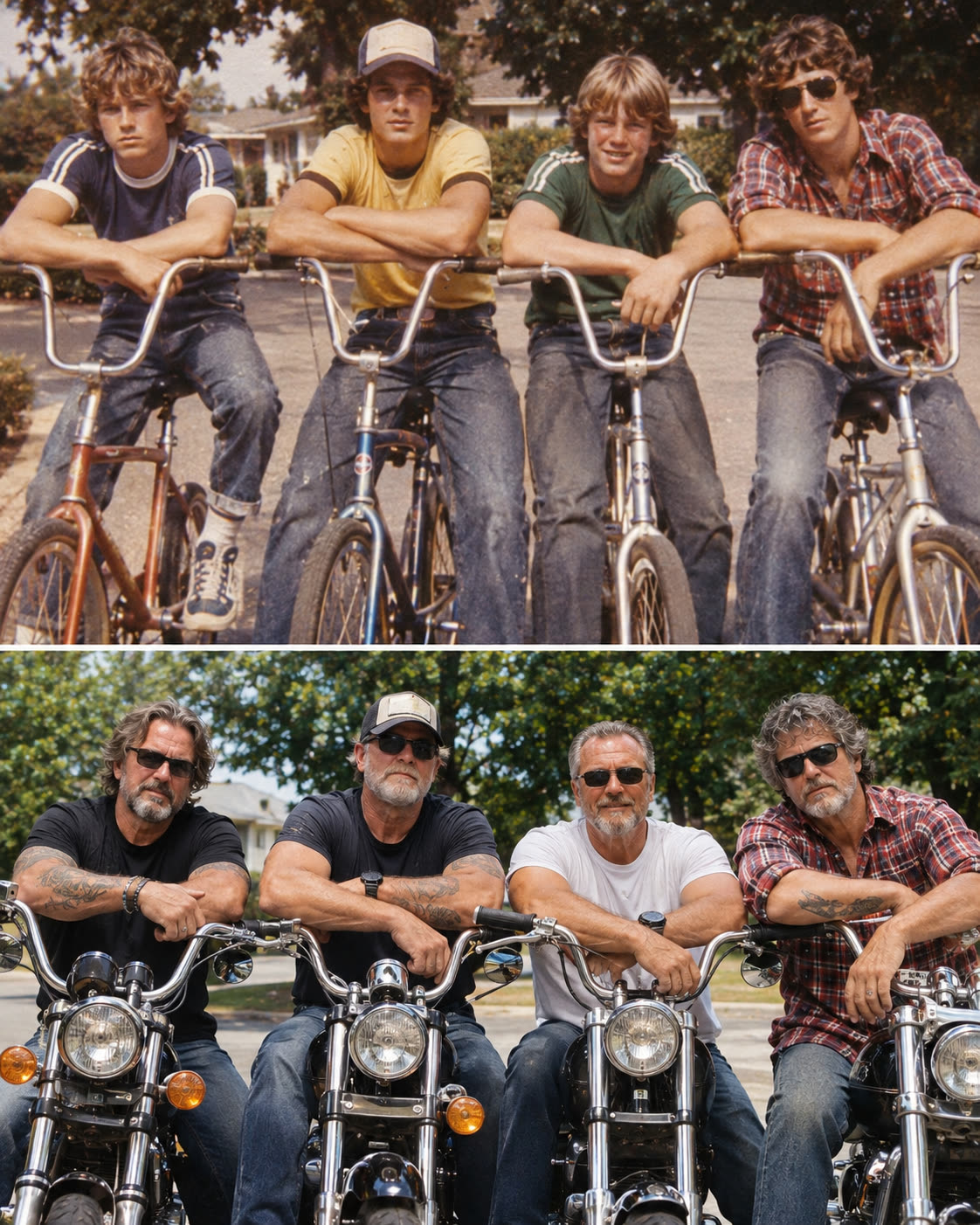
At 13, Four Friends Promised to Ride Across America—45 Years Later, I Bought Four Harleys, but One Detour Changed Everything
Part 1: Four Keys on the Workbench
“Robert, tell me you didn’t buy all four.”
Frank stood at the entrance to my garage, holding the paper plate he had carried out from my birthday dinner. Behind him, Pete stopped chewing. Walter remained on the driveway, looking past my shoulder at four Harley-Davidsons parked side by side.
I had rehearsed this moment while washing dishes, driving to work, and lying awake at night. In every version, somebody laughed first. Now nobody was laughing, and I suddenly understood the difference between buying motorcycles and asking three men to rearrange their lives.
“Do you remember what we promised when we were thirteen?” I asked.
Walter set his plate on the workbench.
That was when I knew he remembered everything.
In the summer of 1981, we lived within six blocks of one another in Wilmington, North Carolina. We rode secondhand bicycles with raised handlebars and argued about who would escape town first. Frank wanted mountains. Pete wanted a place where nobody knew his report-card history. Walter said the Pacific Ocean must look different from our stretch of Atlantic.
I wanted all three of them with me.
One afternoon, we spread my father’s road atlas across a picnic table. Frank traced a crooked line from North Carolina to Oregon with a finger stained purple from an ice pop.
“Someday we’re riding across America.”
“On Harleys,” Pete said. “Not these things.”
He kicked his bicycle’s slipping chain back into place.
Walter found a pen and wrote our names in the margin of the national map. Then he added a sentence beneath them.
We shook hands over the paper. At thirteen, we thought the difficult part would be getting permission.
Then college scattered us. Jobs moved us farther. There were weddings we attended and others we could not afford to reach, birth announcements, Christmas cards, and phone calls that began with apologies for not calling sooner. Eventually, we stopped making even those.
There was no betrayal. We simply let ordinary life become an excuse neither side questioned.
On my fifty-fifth birthday, in the summer of 2023, I found the atlas while sorting boxes after replacing a leaking closet pipe. Its cover had come loose. Inside, our four names still leaned across the margin in Walter’s careful handwriting.
I sat on the floor with it open across my knees.
My wife and I had divorced years earlier, without becoming enemies. Our daughter, Emily, had a home and a career of her own. My small appliance-repair business paid the bills, and I had a modest retirement account. There was nothing obviously wrong with my life.
But I could not remember the last time I had done something I had spent years wanting to do.
For three years, I put extra repair income into a separate savings account. I took Saturday calls, postponed replacing my pickup, and skipped the vacations I usually spent half-working anyway. I did not touch my retirement money or emergency fund. A promise was important; becoming my daughter’s financial emergency was not part of it.
Emily noticed the additional work.
“Please tell me this isn’t a boat.”
“Why does everybody assume I want a boat?”
“Because men keep announcing they’ve found themselves, and then someone has to tow them.”
I told her enough to stop her worrying, but not the whole plan. By spring 2026, I had saved thirty-four thousand dollars for four carefully inspected, pre-owned Harley-Davidsons, plus a separate reserve for training, equipment, and the trip. They were manageable midsize bikes, not the enormous touring machines we had imagined as boys.
The dealer asked whether I was opening a rental business.
“No,” I said. “I’m trying to get three people to answer their phones.”
Frank was easiest to find. He still worked in commercial construction and replied to my message with a photograph of his granddaughter wearing his hard hat. Pete, an accountant with a habit of sending terrible jokes, answered the next evening. Walter took almost a week.
His first message was short.
“Good to hear from you, Robbie.”
Nobody had called me Robbie in forty years.
We began talking regularly. I learned that all three had ridden motorcycles as adults, though Walter had not ridden since his wife became ill. I asked enough questions to establish that the idea was possible without revealing what waited in my garage.
I invited them to my fifty-eighth birthday that June and used airline miles and part of my trip fund to help with travel. They protested. I told them they could argue in person.
At dinner, the years fell away unevenly. We remembered the same stolen peaches but disagreed about whose idea stealing them had been. Pete showed us pictures of his sons. Frank admitted he had retired from climbing ladders but not from telling other people how.
Then Walter mentioned his wife, Ellen.
“She died three years ago. We were married thirty-one years.”
I had learned about her death during our calls, but hearing the number at the table made me set down my fork.
“She kept saying we should travel while we could,” he continued. “I kept saying after the next project.”
Frank raised his glass.
“To fewer next projects.”
We drank to that. After dessert, I led them outside.
Now, in the garage, I unfolded the old map on the workbench beside four sets of keys.
“The motorcycles are gifts,” I said. “No strings. If you don’t want to ride across the country, you still get to tell me I’ve lost my mind.”
Pete touched a handlebar, then looked at me.
“How long?”
“Thirty days. Late August into September. If we can make it work.”
Frank took off his glasses and wiped them with the bottom of his shirt. Walter pulled me into a hug hard enough to push the air out of my lungs.
“You ridiculous man,” he said.
By midnight, we had agreed to try. Over the following weeks, agreement became paperwork, refreshed endorsements where needed, a riding course, insurance, physical checkups, and some humbling practice with emergency stops. We arranged for the motorcycles to be shipped home from Oregon so nobody had to rush back.
On departure morning, Emily checked my helmet strap with exaggerated seriousness.
“You’re allowed to change the plan,” she said. “You’re not allowed to pretend you’re twenty.”
I promised. Then I looked toward Walter, standing apart from us with his phone pressed to his ear. He ended the call when he noticed me watching.
“Something wrong?” I asked.
“No. Just something I should’ve handled before we left.”
He put his phone away, but his hand remained over the pocket.
Part 2: The Name Behind the Phone Calls
For the first week, the road gave us back something we had not realized was missing. We took the slower roads west through North Carolina and Tennessee, stopping for short walks, long lunches, and photographs our children immediately mocked in the group chat.
We were not trying to set a mileage record. Our route included rest days, and our first morning taught us why. Frank discovered that his knees preferred a break every hour. Pete discovered that motel coffee tasted worse when you had time to notice.
Walter became our quiet practical man. He checked tire pressures before breakfast and remembered which saddlebag held the first-aid kit. When my luggage strap loosened outside Asheville, he spotted it before anything fell.
At night, we sat outside our rooms and filled in missing decades. Frank talked about missing his daughter’s school plays while chasing promotions. Pete admitted that retirement frightened him because he had built so much of his identity around being useful.
I told them how quiet my house had seemed after Emily moved out.
None of these conversations would have happened during a birthday dinner. They needed the unhurried space between one day’s riding and the next.
Then, around day nine, Walter started taking his calls farther away.
At first, I assumed they concerned his house in Colorado or his daughter, Rachel. But he would look at the screen, hesitate, and sometimes let it ring. Once, outside a diner in Kentucky, he began typing a message and erased it three times.
Pete watched him through the window.
“Either he’s buying a timeshare or there’s a woman.”
“Leave him alone,” Frank said.
But later, when Walter came back from another call without finishing his supper, even Frank looked worried.
The next morning, Walter found me checking our route beside the motorcycles.
“How attached are you to every stop?”
“Some more than others. Why?”
He pointed to Columbia, Missouri.
“Could we go through here?”
We were already traveling west, and the change would cost less than a day’s riding. I asked what was there.
“Someone I need to see.”
“Someone expecting you?”
He rubbed a thumb along the edge of the map.
“She was. Once.”
I folded my glasses and waited.
Her name was June. They had dated in college, long before Ellen. When Walter accepted a job out of state after graduation, June stayed near her parents and her younger siblings. They had both treated the other person’s decision as proof of insufficient love.
“We were twenty-two,” he said. “We thought whoever gave in would lose.”
They married other people. June’s husband died five years before our trip. Ellen died two years after that. Several months earlier, June had found Walter through an alumni page and sent a message about a professor they both remembered.
One message had become regular calls. Regular calls had become conversations about visiting, then about whether there might still be something between them.
“I was supposed to go in June,” he said.
“What happened?”
“I canceled the evening before.”
“Why?”
He looked toward the motel window, where Pete was wrestling a stuck curtain.
“Because she’d started talking about what came after the visit.”
I could hear the missing part of that sentence. Walter wanted the comfort of being wanted without the frightening work of deciding what to do about it.
“Did you explain?”
“Not well.”
“Have you told her we might come?”
“I asked yesterday. She said she would meet me for coffee, but she isn’t clearing her week.”
That sounded reasonable. Walter looked as though it had hurt.
We agreed to the detour. Frank suggested adding a rest day there; Pete asked whether Columbia had decent barbecue. Walter thanked us too quickly, then busied himself tightening a strap that was already secure.
Over the next several days, his mood shifted with every call. Once, he laughed so freely that I recognized the boy who used to race us home. An hour later, I found him alone beside the ice machine, staring at his wedding ring.
“Ellen liked road trips,” he said when I stopped beside him.
“You’ve mentioned that.”
“Feels strange, doing this without her.”
I leaned against the wall. There was nothing useful in telling him how grief ought to work.
“You can miss her here,” I said.
He nodded, but his eyes remained on the ring.
On day eighteen, we parked outside a diner opposite a flower shop. A woman with an auburn-and-silver bob stood arranging buckets beneath the shop’s awning. She looked up when Walter removed his helmet.
For a moment, neither moved.
Then June crossed the street and hugged him. Walter closed his eyes.
“You actually came,” she said.
“I told you I would.”
She stepped back far enough to look at him.
Inside, she greeted the rest of us warmly. She knew which one was the accountant and remembered a story Walter had told her about Frank falling into a creek. Whatever had happened between them, he had not kept us out of his conversations.
We ordered coffee. Walter asked about the shop, and June answered. She asked about the ride, and we gave her the pleasant version. Finally, she set down her cup.
“Walter, I can’t do another hour of pretending this is only a friendly catch-up.”
Pete looked at me. I started to rise, but June shook her head.
“You don’t have to leave. I’m not ashamed of loving him.”
Walter’s hand tightened around his mug.
“I love you, too.”
“Then I need to understand what that means when the conversation ends.”
She explained that she had arranged time off for his canceled visit. Afterward, when she tried discussing another date, he had stopped answering for days. She had wondered whether she had imagined the future they had talked about.
“I’m not asking you to forget Ellen,” she said. “I’m asking whether you can make room for me without disappearing every time it feels real.”
Walter looked down.
June reached for her bag.
“I have deliveries to finish. You know where to find me.”
After she crossed the street, Walter watched her disappear into the shop.
“If I can’t fix this,” he said, “I may need to go home early.”
For the first time since leaving Wilmington, I could see an empty space in our final photograph.
Part 3: What Another Promise Would Cost
For several minutes, nobody touched the check. Through the diner window, I could see June lifting a bucket of flowers while speaking to a customer. Her workday had continued. Walter’s declaration of love had not given her the luxury of putting everything else aside.
Pete broke the silence.
“You’ve made a mess.”
Walter let out a short laugh.
“Thank you for the assessment.”
“He’s right,” Frank said. “But that doesn’t mean it can’t be cleaned up.”
Walter turned his mug slowly between his palms. He told us that being happy with June sometimes brought a wave of guilt so sharp he would end a call early. Then he would avoid the next call because he could not explain the first.
“Ellen and I had thirty-one years,” he said. “How do I put that beside something new without making it smaller?”
I thought about my own carefully prepared journey. I had imagined four motorcycles reaching the ocean together so often that I had begun treating that photograph as something the others owed me.
Across the street was a woman who needed more than a photograph.
“You don’t have to make Ellen smaller,” I said. “But June can’t keep paying for something she hasn’t done.”
He looked up at that.
Frank asked the practical question.
“What are you actually afraid will happen?”
Walter had a house in Colorado, a daughter nearby, and a life arranged around familiar routines. June had her shop, her sister, and customers who had trusted her with weddings and funerals for years. Neither wanted another relationship built on one person waiting for the other to surrender.
“Have you discussed any arrangements?” Frank asked.
“Not properly.”
Pete pushed the sugar bowl aside.
“Then you’re arguing with a conversation you haven’t had.”
Walter looked at me.
“What about the trip?”
I wanted to say we had waited forty-five years. Instead, I unfolded the route and looked at the sightseeing stops I had circled at home.
“We can lose a scenic overlook.”
“And the barbecue place,” Frank added.
Pete sighed.
“Let’s not make promises in anger.”
Walter smiled for the first time since June left. Then he crossed the street.
He was gone nearly two hours. We moved the motorcycles out of the diner’s busiest parking spaces and ordered lunch. When he returned, his eyes were red, but he did not look defeated.
None of us disagreed.
“I told her I’d move here. She asked whether I wanted to live here or was just terrified she’d stop answering.”
“What did you say?” I asked.
“That I didn’t know how to separate those things yet.”
That answer sounded more useful than anything he had said all morning.
June had agreed to speak again the following day. Not to forgive him on a deadline, and not to approve a plan invented in panic. They would talk about the ordinary things: houses, family, work, money, and what each expected from marriage.
“Marriage?” Pete asked.
Walter reached into his jacket and brought out a small ring box.
The box sat between the ketchup bottle and my folded map. Suddenly, his fear had a shape I could see.
“Does she know?” Frank asked.
“Not about this.”
“Then don’t use it to skip the conversation,” Frank said.
Walter put it away.
That evening, he asked if I minded staying in our shared motel room while he called Rachel. He did not want to keep hiding parts of his life from the people in it.
I heard his side at first: explanations, apologies, a long silence. Then he put the phone on speaker with her permission.
“Dad, you don’t need me to authorize this,” Rachel said.
“I worry it’ll hurt you.”
“It hurts when you sound lonely and tell me you’re fine. It doesn’t hurt to hear you laugh.”
Walter covered his mouth.
Rachel wanted to meet June. She also wanted him to stop treating every decision as though it had to be approved by someone who was gone.
“Keep Mom’s photographs,” she said. “Tell stories about her. But answer the phone when June calls.”
The next morning, Walter walked across to the flower shop without taking the ring box. He left it on the dresser beside his room key.
When he returned at lunchtime, June came with him.
They had agreed that Walter would finish the trip, return to Colorado to handle responsibilities there, then come back for an extended stay. He would not sell his house immediately. June would not close her business. They would consult the appropriate advisers before combining property or changing estate plans, and they would visit Rachel together.
It was not a sweeping romantic solution. It sounded like a life people could actually live.
Walter went upstairs briefly. When he came back, he asked June to walk with him to the little courtyard beside the shop. She invited us along.
His hand shook as he opened the box.
“I bought this before the visit I canceled,” he said. “I thought wanting to ask was the same as being ready to show up.”
June’s eyes filled.
“It wasn’t.”
“I know.”
He lowered himself carefully onto one knee.
“I can’t offer you a life where I never get frightened. I can offer you one where I tell you instead of vanishing. Will you marry me?”
She made him wait one breath.
“Yes. And when you’re frightened, I expect the truth.”
Pete applauded before Walter had managed to stand.
June wanted a small wedding before we left town. Her sister, Carol, was less immediately enthusiastic. At dinner, she listened to the plans with her hands folded beside her plate.
“A canceled visit, then a proposal, then a wedding in the same week,” she said. “You understand why I’m asking questions.”
Walter did not reach for a joke.
“Yes.”
“What happens when this trip is over and nobody is cheering?”
“I come back. I help with the ordinary days. And if something changes, I tell her before I change the plan.”
Carol looked at June.
“Is this what you want?”
“Yes. Not because he arrived on a motorcycle. Because today we finally talked without either of us trying to win.”
Carol nodded slowly. Then she asked about dates and available witnesses.
We spent the next day helping them confirm the county’s marriage-license requirements, obtain the license, and arrange an authorized officiant. The community hall’s garden was available the following afternoon. Rachel booked a flight.
We could still finish our journey in thirty days if we dropped several stops and kept sensible riding days. I spread the revised route across my motel bed.
Then Walter knocked.
“I need to ask you something,” he said. “And this time I need to say it before I run.”
Part 4: The Road Beyond Someday
I moved the map aside, and Walter sat on the edge of the other bed.
“What if being afraid means I’m making a mistake?”
I had no answer polished enough for a wedding eve. Outside, Pete was asking a vending machine whether it accepted emotional appeals instead of dollar bills.
“You were afraid to get back on a motorcycle,” I said.
“That’s different.”
“It is. But you didn’t solve that by pretending the danger wasn’t there. You took a course. You practiced. You listened when somebody knew more than you.”
Walter rested his elbows on his knees.
“June isn’t a motorcycle, Robbie.”
“Fortunately. Pete would already be comparing her fuel economy.”
He laughed, then went quiet again.
I told him what I actually believed: if he wanted to slow down, he owed June that conversation tonight. Not an unexplained absence tomorrow. There was no shame in needing time, but there was harm in making somebody else guess.
He took out his phone.
“I’m going to tell her I’m nervous.”
“Good.”
He returned half an hour later with a different expression.
“She said she is, too.”
For once, that had not sent him running.
The wedding took place on day twenty-two of our trip. Rachel arrived before lunch and hugged her father for a long time in the motel parking lot. Then she went with June and Carol to help with the final preparations.
Frank borrowed a tie from the officiant. Pete tested the small speaker three times and threatened anyone who touched the playlist. I put the rings in an inside pocket and checked them so often that Carol finally told me they were unlikely to escape.
Walter wore a jacket purchased the previous afternoon. The sleeves were a little long. Nobody cared.
When June entered the garden in a simple cream dress, he began crying before the music finished.
There were fewer than twenty of us: family, a few friends from town, the woman who covered the flower shop, and three men who had expected to be several hundred miles farther west.
Walter held June’s hands.
“I spent too long believing that if I couldn’t promise certainty, I shouldn’t promise anything,” he said. “What I can promise is that you won’t have to wonder where I’ve gone when life gets difficult.”
June brushed a tear from her cheek.
“I don’t need you to be fearless. I need you beside me when we’re both afraid.”
Rachel reached for Carol’s hand. Across the garden, Pete stared upward with the fierce concentration of a man refusing to acknowledge tears.
After the ceremony, Carol photographed us beside the four motorcycles. June stood next to Walter, and Rachel adjusted his crooked collar before stepping out of the frame.
“Wait,” Walter said. “Get back in.”
We took another photograph with everyone.
At the little reception, Carol handed him a plate of food.
“I’m happy for you,” she said. “I’m also going to remember what you said at dinner.”
“So am I.”
Her smile was small but genuine. It seemed a better beginning than instant, unquestioning approval.
June joined us for the next two riding days. Walter had experience carrying a passenger, and they checked the bike’s load limits and adjusted the suspension before leaving. She bought properly fitted protective equipment and discovered that Pete’s commentary sounded exactly the same through a helmet intercom.
“I thought the wind might improve him,” she told us at lunch.
“People have tried stronger measures,” Frank said.
She flew home from our next major stop to reopen the shop. At the airport drop-off, Walter told her the date he expected to return after handling things in Colorado.
“If anything changes?” she asked.
“You hear it from me first.”
He called her that evening without being reminded.
The remaining miles were not a montage of perfect sunsets. Rain kept us off the road one morning. My shoulder ached enough that we added breaks. A wrong turn cost us nearly an hour, and Pete mentioned the abandoned barbecue restaurant with the persistence of a creditor.
But nobody treated a delay as a personal failure. We had cut the optional sightseeing rather than lengthen riding days beyond what we could manage. When someone needed to stop, we stopped.
On day thirty, we reached the Oregon coast.
We parked above the beach, removed our helmets, and stood listening to the Pacific. For a little while, nobody tried to improve the moment by speaking.
Then Frank exhaled.
“Forty-five years.”
Pete looked at the water.
“Honestly, I expected a larger welcome committee.”
Walter laughed, and I pulled the old map from its waterproof sleeve.
The paper had softened along its folds. Beneath our thirteen-year-old signatures, Walter’s sentence remained clear.
“Nobody gets left behind.”
I had once understood that to mean four motorcycles in a straight line, arriving at the same place together. Now I thought about a diner, a flower shop, and the days we had taken out of my perfect schedule.
We asked another visitor to take our photograph. This time, I did not worry whether we stood in precisely the same order as the boys in the picture Emily had found for us.
We were all there.
After the motorcycles were collected for their scheduled transport, we flew home. Emily met me at the airport and listened while I talked all the way to the parking garage.
“So,” she said when I finally paused, “was it worth three years of Saturday repair calls?”
“Ask me after my shoulder stops complaining.”
She waited.
“Yes,” I said. “Every one.”
Walter went back to Colorado, met with Rachel, arranged care for his house, and returned to June on the date he had given her. He sent us a photograph outside the flower shop: June holding a bucket of sunflowers, Walter beside her with his sleeves rolled up.
His message was short.
Pete replied almost immediately.
“Excellent. You still owe us barbecue.”
We did not let the group chat fade. Frank called on Sundays. Pete began researching a shorter ride for the following spring. Walter sometimes joined our calls from the back room of the shop, where June could be heard correcting his flower names.
I framed the ocean photograph beside the faded picture of four boys leaning over bicycle handlebars. Between them, I placed the old map.
A few months later, Emily found me studying it.
“Planning another trip?” she asked.
I looked at the names we had written before we understood how easily people could drift apart.
“Calling Frank,” I said.
Disclaimer: This story is a work of fiction inspired by real-life themes. Names, characters, places and events are fictionalized, and any resemblance to real persons is purely coincidental. Images are for illustration purposes only.

Related Posts
My son carried me onto the graduation stage because I couldn’t walk. But what he said into the microphone next left the entire audience stunned: “Mom, there’s something I’ve been keeping from you…”
My Newborn Was Screaming in the ER When a Man in a Rolex Said I Was Wasting Resources – Then the Doctor Burst Into the Room and Stunned Everyone