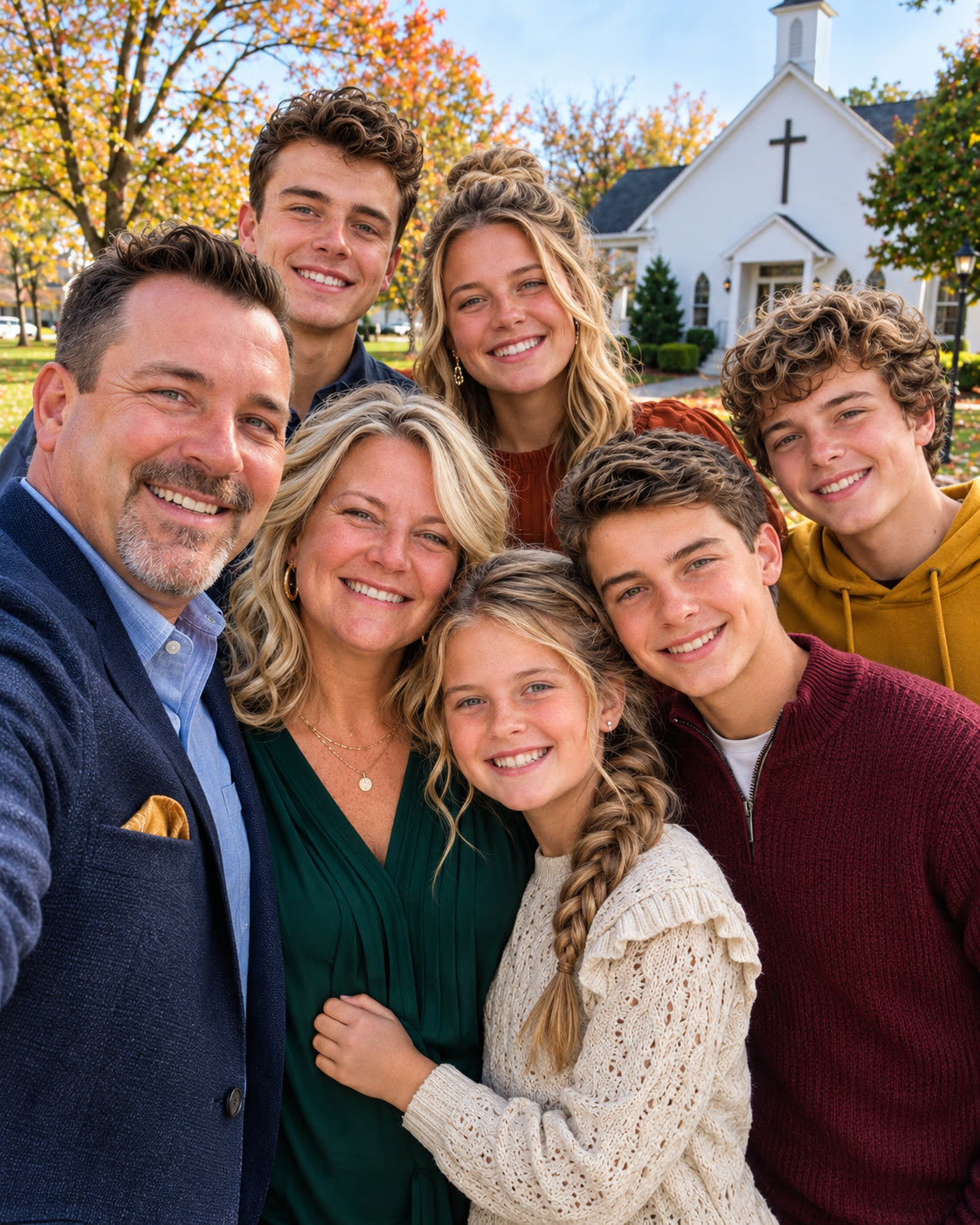
My Husband Left Me After 25 Years for a Woman From Our Church and Called It “Something New” — Then Our 12-Year-Old Walked Into His Wedding With a Box and He Went Silent
Part 1: The Lunch Container
“Of course I miss you, sweetheart.”
I was standing in the doorway of my husband’s office at Halvorsen Insurance, a container of chicken and rice still warm against my palms, when I heard him say it. His voice was low and soft, the voice he hadn’t used with me in months.
I didn’t move. The hallway carpet seemed to tilt under my shoes.
Richard swiveled his chair, saw me, and the color I must have lost was plain on his face. But he didn’t panic. He didn’t even hang up right away. He finished his sentence, said “I’ll call you back,” and set the phone face down on the blotter like a man closing a book.
Then he smiled. That was the part I couldn’t forgive later, that smile.
“Well,” he said, “now you know. It’s for the best, Mary. Yes, I’m with Patricia now.”
Patricia. Patricia Doyle, who sat two pews ahead of us every Sunday at Maple Ridge Community Church. Patricia, who had brought casseroles when I lost my hair, who had held my hands in the prayer circle and cried real tears for me.
“Twenty-five years, Richard,” I said. My voice came out thin. “Five children. And that’s your explanation?”
He shrugged, leaned back, and laced his fingers behind his head. “Listen, the problem isn’t you. I just wanted to try something new.”
“Something new? Our marriage is a hobby you’ve gotten tired of?”
“Oh, come on. Men have needs. It’s just our nature. Nobody stays with one woman his whole life. It’s boring.” He glanced at the container in my hands. “Honestly, you should be grateful I stuck around as long as I did.”
I set the lunch down on the corner of his desk, very gently, as though it might break. Then I walked out past the receptionist, who suddenly found her keyboard fascinating, and I made it all the way to the parking lot before my knees gave out against the car door.
I should tell you who I was that afternoon. I was a forty-eight-year-old school librarian in a small Ohio town, with a mortgage of $1,640 a month, a daughter in her second year at Ohio State, and a Thursday habit of cutting coupons at the kitchen table with orange-handled scissors my mother left me. I was not a woman who expected to be thrown away.
Richard and I had married young, the summer I was twenty-three. We had Daniel the next spring, then Sarah, Michael, Grace, and, when I thought our family was complete, a surprise baby named Emily. We survived two layoffs, a flooded basement, and a winter when we ate pancakes for dinner four nights in a row and called it a party.
Three years earlier, I had been diagnosed with breast cancer. Richard drove me to every chemotherapy appointment at St. Luke’s. He held my hand while the nurses found a vein. I had believed, with my whole heart, that a man who sat through that with me would never leave.
That was the thing I got wrong. I confused being present with being faithful.
The divorce took four months. Richard moved into a rented condo off Route 9, and he didn’t fight me for much, which I now understand was because he had already planned where he’d spend his energy. I kept the house. He kept his pension and his new life.
Barely a month after the judge signed the final papers, a cream-colored envelope arrived in our mailbox. Heavy paper, gold edges. Richard Sutton and Patricia Doyle request the honor of your presence at their wedding.
He had sent one invitation for each of our five children.
I laid them out on the kitchen table that evening and let the kids decide. I would not push them in either direction, and I told them so. They were old enough to carry their own hearts.
Daniel, twenty-three, read his card, set it down, and said, “I’ll pass.” Sarah folded hers in half. Michael, seventeen, tore his neatly along the gold edge. Grace, fifteen, simply left the room.
Emily, twelve, kept hers. She held it against her chest and said, quietly, “He’s still my dad.”
I did not argue. I couldn’t. Who was I to tell a child she couldn’t love her father?
On the wedding Saturday, Richard’s mother, Clarissa, pulled into our driveway at ten sharp in her silver Buick. She was seventy-four, spine straight as a ruler, a woman who had raised Richard alone after his own father died. She hugged me longer than usual at the front door.
“I’ll bring her home safe,” she told me.
Emily climbed into the car carrying a wrapped box nearly as big as her torso, tied with a satin ribbon. “It’s from me,” she said when I asked. “Just from me.”
I thought it was a toaster, or a picture frame. I went back inside and spent the morning scrubbing a bathroom grout line that was already clean.
At 12:40, my phone buzzed on the counter.
It was Clarissa. The message was short and the capital letters were not like her at all: “Please do not panic. But watch this video and COME GET HER IMMEDIATELY.”
My thumb shook as I pressed play.
Part 2: Five Envelopes
The video was shot from a few rows back, slightly crooked, with the clink of silverware in the background. A banquet hall glittered behind a small figure in a pale yellow dress.
Emily walked straight up to the head table, where Richard and Patricia sat under a canopy of white roses. She held the box in both arms.
“Dad,” she said, “congratulations. Please open my gift.”
Richard smiled for the guests. A hundred and fifty of them, I would learn later. He peeled back the paper with a showman’s flourish, lifted the lid, and looked inside.
The smile slid off his face as if someone had wiped it away.
He shot to his feet so fast his chair tipped. “How could you?” His voice cracked across the room. He jabbed a finger at our daughter. “Your mother put you up to this, didn’t she? She couldn’t stand to see me happy!”
Emily shook her head. “No, Dad. Mom doesn’t even know—”
The video cut off there.
I called Clarissa. She answered on the first ring.
“Is Emily all right?”
“She’s fine, Mary. She’s standing up better than any of us. But you need to come before my son makes this worse.”
“What was in the box?”
“Just come. Please.”

I grabbed my keys, left the stove light on, and drove the twenty minutes to the Lakeview Grand Ballroom with both hands strangling the steering wheel.
On the road, pieces of the past week rearranged themselves in my mind. Twice I had caught Emily whispering behind her bedroom door with Grace and Sarah, who had come home from Columbus on a Tuesday without saying why. One evening I’d found all five of my children around the kitchen table with our old family photo album open between them, the one with the cracked blue cover.
“What are you doing?” I had asked.
“Making something special,” Emily said, and closed the album with both palms.
I had assumed they were planning something to cheer me up. A card, maybe, or a cake. I wasn’t so sure anymore.
I parked crooked and walked fast across the lot, my heels clacking. The ballroom doors were propped open. Through them I could hear a small, steady voice.
“Dad, you haven’t even opened the first letter yet.”
I pushed through the doors and stopped.
Crystal chandeliers. Towering arrangements of white hydrangeas and roses. A five-tier cake with sugar flowers cascading down its side. The room looked like a magazine spread, and I thought of the divorce, when Richard had argued over a $38 dentist bill for Michael and called our kids’ expenses “a bottomless pit.” Apparently he had found a fortune somewhere between then and now.
Several faces turned. I recognized half of them, the same people who had signed my get-well cards. They glanced at each other and then at the floor.
Patricia saw me first. She stood, ivory satin pooling around her, and her voice rose half an octave. “What is she doing here? This is our wedding!”
“I’m here for my daughter,” I said. “Not for you.”
“Mom!”
Emily ran across the parquet floor and crashed into me. I dropped to my knees and held her, smelling the strawberry shampoo I’d bought at Kroger, feeling her small heart thump against mine.
“Sweetheart, are you hurt?”
“No.” She pulled back, eyes red but dry. “I’m okay.”
Richard strode over, the tails of his tuxedo jacket flapping. “So you decided to humiliate me through our daughter.”
“Mom didn’t know anything about my present,” Emily said, planting her feet. “I worked really hard on it.”
“Richard,” I said, “I’m here because your mother called me. That is the only reason.” I stood and took Emily’s hand. “Let’s go home, honey.”
But she held back. Her fingers tightened around mine.
“Please, Mom. I just want Dad to read all the letters. That’s all. Then we can go.”
I looked at her face, at the chin she had inherited from my side of the family, set the way mine sets when I have decided something. I understood that this was not about winning anything. She needed her father to hear her.
“All right,” I said. “But I’m standing right next to you.”
Emily nodded and walked back to the head table. The box sat open on the white linen, and inside it, laid out like a hand of cards, were five envelopes. Each bore a name in marker, in my children’s handwriting: Daniel. Sarah. Michael. Grace. Emily.
Richard dragged a hand down his face. “Fine,” he said, loud enough for the whole room. “Let’s see what my ungrateful children have to say.”
He snatched the first envelope, the one marked Daniel, and tore it open. A single photograph slid into his palm. His eyes dropped to it, and for a second I watched the performance flicker.
Then he turned it over, and read what was written on the back.
Part 3: What the Children Wrote
The photograph showed our backyard on a June afternoon, nearly twenty years ago. Daniel, five years old, a smear of sawdust across his nose, stood beside a younger Richard. Between them was a lopsided wooden birdhouse they had built together, crooked roof and all.
Richard read the handwriting on the back out loud, slowly, as though the words were in a different language. “You taught me that a real man keeps his promises. I wish you’d remembered that.”
His jaw hardened. “Daniel has no right to lecture me. I’ve spent twenty-three years providing for that boy!”
“He’s twenty-three, Dad,” Emily said quietly. “And he still remembers what you taught him.”
A woman at table four coughed into her napkin. A man near the bar studied the ceiling. Nobody laughed. Nobody clapped.
Richard grabbed the second envelope. “Sarah. Wonderful. Let’s hear her complaints too.”
Inside was a photograph from Sarah’s eighth birthday. She sat in front of a lopsided chocolate cake, cheeks puffed to blow out the candles, and Richard stood behind her with his arms wrapped around her shoulders, grinning like he’d won the lottery. A folded letter came out with it.
He started reading aloud, then slowed. His voice dropped below the level of the room. He stopped halfway down the page.
“Please finish it, Dad,” Emily said.
He exhaled through his nose and went on. “You promised we’d always have a home with you. I guess that promise expired the day you met Patricia.”
The whispers began then, a low current moving between the tables. Someone near the back murmured, “Those poor children,” and I saw Patricia’s head snap toward the sound.
She slapped her champagne flute down so hard the stem rattled. “This is ridiculous! We are not letting a pack of bitter kids ruin our wedding!”
“Patricia,” I said, as evenly as I could, “choose your next words very carefully.”
Her mouth opened. Then it closed. For the first time in the six years I had known her, Patricia Doyle had nothing sweet to say.
Emily reached for the third envelope. “Please, Dad. They all spent such a long time deciding what to give you.”
Richard rolled his eyes toward the chandelier. “One more. Then this nonsense ends.”
He ripped open the envelope marked Michael and a photograph dropped into his hand. He glanced at it casually, ready to scoff.
And then he went still.

I knew that picture before he even turned it over. I was in a hospital bed at St. Luke’s, a blue scarf tied over my bare head, my face gray from the third round of treatment. All five children crowded around the bed, Daniel’s hand on my shoulder, little Emily, nine then, perched on the mattress edge. Richard stood at the bedside holding my hand.
I remembered the day exactly. I had been too weak to sit up straight, but the kids had insisted on a family photo. A nurse named Denise had taken it with Sarah’s phone, and I had laughed for the first time in a week because Michael made rabbit ears behind his father’s head.
My eyes burned. I pressed my lips together.
Richard turned the photograph over. Michael’s writing was blunt, block capitals pressed hard into the paper. “MOM WAS FIGHTING FOR HER LIFE. WE THOUGHT YOU WERE FIGHTING BESIDE HER.”
The room had gone so quiet I could hear the refrigeration hum behind the kitchen doors.
Richard’s voice came out brittle. “I stayed with her through cancer! Doesn’t that count for something?”
I stepped forward. I hadn’t planned to.
“It counted for everything, Richard,” I said. “Until the day you told me I should be grateful you hadn’t left sooner.”
A gasp rippled through the guests. Richard looked away from me, at the cake, at his shoes, anywhere.
Emily handed him the fourth envelope without a word. Inside was a child’s drawing on construction paper: seven stick figures holding hands beneath a fat yellow sun. Two taller ones in the middle, five smaller ones around them. Across the top, in careful crooked letters, Grace had written MY FAMILY FOREVER. She had drawn it when she was seven. I knew it, because it had hung on our refrigerator for years.
A note was clipped to it. Richard read: “I kept telling everyone you were still a good father. I wish you had given me a reason to believe it.”
His fingers crushed one corner of the paper. “Unbelievable! I raised five children, I gave them everything, and this is the thanks I get?”
“You were our dad,” Emily whispered. “You weren’t doing us a favor.”
“Enough!” he shouted.
Emily flinched. I slid my arm around her shoulders, and she let me. But she did not step back. She reached into the box one last time.
“There’s still one envelope, Dad. The last one is mine.”
“Let’s get this over with.” He took it and tore it open, no doubt expecting one more photograph.
Instead, official-looking pages slid onto the white tablecloth, stapled at the corner, stamped with the seal of Fairfield County Probate Court.
“What the heck is this?” he demanded.
Emily swallowed. “It’s a name change application. I want to have Mom’s maiden name. Instead of yours.”
My heart dropped through my ribs. A few weeks earlier she had asked me, over dinner, whether kids could change their last names. I had told her yes, with a parent’s consent and a judge’s signature, and we had looked up the forms on the library computer. I had thought it was curiosity. I had not imagined she would bring them here.
“They aren’t filed,” Emily said. “But I wanted you to see them. I don’t want your name anymore.”
Richard’s face turned the color of a boiled beet. “You’re twelve years old! You don’t get to make decisions like that!”
Her chin trembled, but she held her ground. “You wanted a new family, Dad. I just wanted you to know I don’t want to be in the old one if you’re not.”
Silence. Then Richard whirled on me.
“You did this! You’ve been poisoning my children against me!”
“I never kept them from you,” I said. “Not once. They made their own choices.”
“I’m still their father! They owe me respect!”
Patricia swept forward in a rustle of satin. “That spoiled little brat has ruined our entire wedding!”
I turned to her slowly. “Don’t you dare talk about my daughter like that.”
“Somebody needs to teach her some manners!”
Richard slammed the papers on the table so the silverware jumped. “Fine! If my children want nothing to do with me, they can forget about any of my money, too!”
Emily burst into tears. I pulled her against my side. “That’s enough, Richard. We’re leaving.”
But before I could take a single step, a chair scraped hard against the floor behind us.
Clarissa, who had not said a word through the entire scene, rose from her seat at the family table. She smoothed her plum blazer. She looked straight at her son.
“Richard,” she said, “that is a very interesting thing to say about money that isn’t yours.”
Part 4: Money That Wasn’t His
No one breathed. The string quartet in the corner had stopped mid-note, their bows hovering.
Richard stared at his mother. “Mom. Stay out of this.”
“No, Richard.” Clarissa folded her arms. “I’ve stayed out of it long enough.”
“You’re embarrassing me!”
“Good. Perhaps now you’ll have some idea how your daughter feels.”
She let that settle, and then she turned to face the room, to the hundred and fifty guests who had come for cake and champagne and were now getting something else entirely.
“When my son came to me after the divorce,” she said, “he told me he wanted a fresh start. He promised he would become a better man and take responsibility for his mistakes. That’s why I agreed to help pay for this wedding.”
Patricia blinked. “Help?”
“The flowers. The chandeliers. Most of this banquet.” Clarissa gestured around at the gleaming hall. “Who did you think paid for it?”
A swell of whispers lifted off the tables. Richard’s fists tightened at his sides. “Mom, we discussed this!”
“We did. We also discussed how you would keep supporting your children. And yet here you stand, threatening to cut them off because they were brave enough to tell you the truth.”
Patricia stepped between them, smile pasted on. “Clarissa, surely we can talk about this privately.”
“How strange,” said Clarissa. “Richard didn’t seem interested in privacy when it came to his daughter’s feelings.”
Patricia’s cheeks flushed crimson. “What exactly are you saying?”
“There is something else,” Clarissa went on.
Richard looked suddenly sick. “Mom. Don’t.”
“The house on Willow Creek Lane. The one you two planned to move into after the honeymoon.” Clarissa tilted her head. “That’s mine, too.”
Patricia stared at her. “What do you mean, yours?”
“I bought it fifteen years ago. When Richard asked if the two of you could live there, I said I would consider putting it in his name. I have not done so.”
Slowly, like a woman turning a heavy door, Patricia faced her brand-new husband. “Richard. You told me that was your house.”
He swallowed. “Sweetheart, it’s complicated.”
“Complicated? You walked me through the master bedroom! You told me we would own it together!”
Richard looked desperately at his mother, but Clarissa only shook her head. It was the gentlest, most final gesture I’ve ever seen anyone make.
“I hope you enjoyed your expensive day, Richard,” she said. “Because it is the last thing I’m paying for. The remaining balance on this hall, the catering overage, the extra tomorrow night, are all yours.”
Patricia clutched his sleeve. “What about the reception we booked for tomorrow? The honeymoon suite upgrade?”
“I suggest,” Clarissa said, “that you both check your bank accounts.”
At table six, a man couldn’t quite hide a grin behind his hand.
“And as for Willow Creek Lane,” she continued, “I have changed my mind. It stays in my name.”
Richard nearly knocked over his glass. “You can’t do that!”
“It’s my house, dear. I can do precisely that.”
Patricia rounded on him, her voice climbing. “You said we would OWN it! What else have you lied about?”
“Patricia, please, not here, not now—”
“You’re choosing them over your own son!” Richard shouted, pointing at his mother. “You’re ruining my wedding!”
Clarissa did not flinch. “I’m choosing the grandchildren you seem to have forgotten.”
“I’m your only son!”
“And at your age, you still haven’t learned that love doesn’t mean getting everything you want.”
Richard opened his mouth, and nothing came out. For the second time that day, he had no words.
Clarissa walked to the head table. She gathered Emily’s scattered pages, squared the edges, slid them into their envelope, and laid it in my daughter’s hands.
“I think your gift was very thoughtful, sweetheart.”
Emily wiped her face with the heel of her hand. “You’re not mad at me, Grandma?”
Clarissa kissed her forehead. “Of course not, darling.” She turned to me. “Mary. Shall we go?”
I nodded. I did not say goodbye to Richard. Behind us, Patricia’s voice was still climbing, demanding to see deeds, to see bank statements, to see anything at all. For the first time in twenty-five years I felt no urge to jump in and smooth things over for him. I took my daughter’s other hand, and the three of us walked out through the heavy doors into the October sunlight.
In the car, Emily sat quietly in the passenger seat, the envelope in her lap.
“Mom?” she said finally. “Are you mad at me?”
I pulled over beneath a maple tree dropping red leaves on the hood. I squeezed her hand.
“No, sweetheart. I’m proud you spoke from your heart. But you don’t have to fix grown-ups’ mistakes. That is not your job.”
She leaned her head on my shoulder. “Okay.”
When we pulled into our driveway, the porch light was already on. The other four were crowded into our kitchen, pretending not to have been waiting.
“Well?” Daniel asked.
Emily grinned for the first time all day. “Grandma canceled Dad’s house.”
Daniel burst out laughing and hauled her into a bear hug that lifted her off the floor. Sarah shook her head, smiling. “Next time we plan a family gift,” she said, “we’re definitely telling Mom first.”
Clarissa arrived twenty minutes later and, to everyone’s surprise, laughed along with us. We ordered two large pizzas from Marino’s, and she stayed for dinner, sitting at my table with her purse on her knees like a guest who was not sure she was allowed.
I watched my five children tease one another over paper plates, Michael stealing crust from Grace, Emily explaining the whole scene with a slice of pepperoni for a pointer. And I understood something I could not have said on the afternoon I stood in that office doorway.
Richard had walked away from our marriage, but he had not taken our family with him. We still had our laughter, our history, our cracked blue photo album, and one another.
He had wanted to try something new. In the end, he was the only one who lost something worth keeping.
Disclaimer: This story is a work of fiction inspired by real-life themes. Names, characters, places and events are fictionalized, and any resemblance to real persons is purely coincidental. Images are for illustration purposes only.

Related Posts
I Saw a Birthmark on My Niece’s Body and Realized That My Husband’s a Cheater
After a Decade of Struggling to Conceive, a Woman Finally Welcomed Twins – But When She Awoke From Her C-Section, Her Husband Was Nowhere to Be Found, and the Doctor Asked, “You Honestly Don’t Know Why He Left?”