A Single Man in His 30s Adopted All Five of Us so We Wouldn’t Be Split Up—20 Years Later, He Called Us Home, Laid an Old Photograph on the Table, and Said, “It’s Time. I Can’t Keep This From You Any Longer.”
We grew up believing a stranger had walked into the worst week of our lives and chosen five children nobody else would take together. It was the story we told at weddings and toasted at Thanksgiving. Then Dad put a photograph in front of us, and the man standing beside our parents in it was him.
Part 1: The Phone Call
Dad had exactly one rule about our past.
It didn’t matter. What mattered was that we had each other now.
For twenty years, we accepted that. We accepted it as children, because children accept most of what the people who feed them say. We accepted it as teenagers, because no teenager wants to sit through a sentimental conversation with a parent. And we accepted it as adults, because by then, asking felt like prying into something that wasn’t ours.
Then, the week of his birthday, Dad called each of us separately and broke his own rule.
He called me on a Monday night. I was standing at the sink, scrubbing spaghetti sauce off a pot while my twins argued in the next room about whose turn it was with the tablet.
“Gia,” he said. “Don’t bring presents this year.”
“You say that every year.”
“I mean it this time. And don’t bring the kids.” He paused. “I need all five of you here. Just the five of you.”
I laughed, but it came out thin. “Dad, that sounds ominous.”
He didn’t laugh back. There was a long silence on the line, long enough that I turned off the water.
“There’s something I have to tell you,” he said. “All of you. I don’t want to. But it’s time. I can’t keep this from you any longer.”
When he hung up, I stood in my kitchen with wet hands and my heart going too fast.
I called my older brother Dorian before I’d even dried them.
He picked up on the first ring, which told me everything.
“He called you too,” I said.
“Ten minutes ago.”
“What did he say?”
Dorian repeated it back to me. Don’t bring presents. Don’t bring the kids. There’s something I have to tell you. It’s time.
Word for word.
We stayed on the phone for a while after that without saying much. Neither of us wanted to be the first to say the word we were both thinking.
By Saturday morning, all five of us were packed into Dorian’s car, driving back to the house where we’d grown up.
Nobody was talking much.
Dorian drove with both hands on the wheel, the way he always did when he was worried, as if the car might try something. Our brother Soren sat in the passenger seat and stared out the window at the strip malls sliding past. Maris was beside me in the back, chewing the edge of her thumbnail, a habit she’d supposedly quit in high school. And Elowen, the youngest of us, was squeezed into the middle seat with her knees pulled up, unusually quiet since we’d picked her up at her apartment.
It was Maris who finally broke.
“I’m telling you, he’s sick.”
“He sounded fine,” I said.
“People can sound fine, Gia. That’s how it works. They sound fine right up until they sit you down at a table.”
Dorian’s hands tightened on the wheel.
Soren didn’t turn from the window. “Let’s not do this in the car.”
“Then when?” Maris said. “In front of him?”
Nobody answered her.
Dad’s birthday was that day. On any other year, we’d have descended on his house like a small invading army. Spouses, kids, casserole dishes, balloons tied to the mailbox, and far too many gifts he’d insist he didn’t need and then use every single day. My twins would have spent the morning making him a card with more glitter than words. Dorian’s little girl would have demanded to blow out his candles for him.
Instead, I’d left the twins at home with my husband and a half-finished card on the kitchen table, and I was sitting in the back of my brother’s car with the only four people on earth who had survived the worst day of my childhood alongside me.
We lost both of our parents at the same time.
There’s no gentler way to put it, and over the years I’ve stopped looking for one. One day they were there. The next day they weren’t. And five children were left standing in a house that suddenly felt far too big.
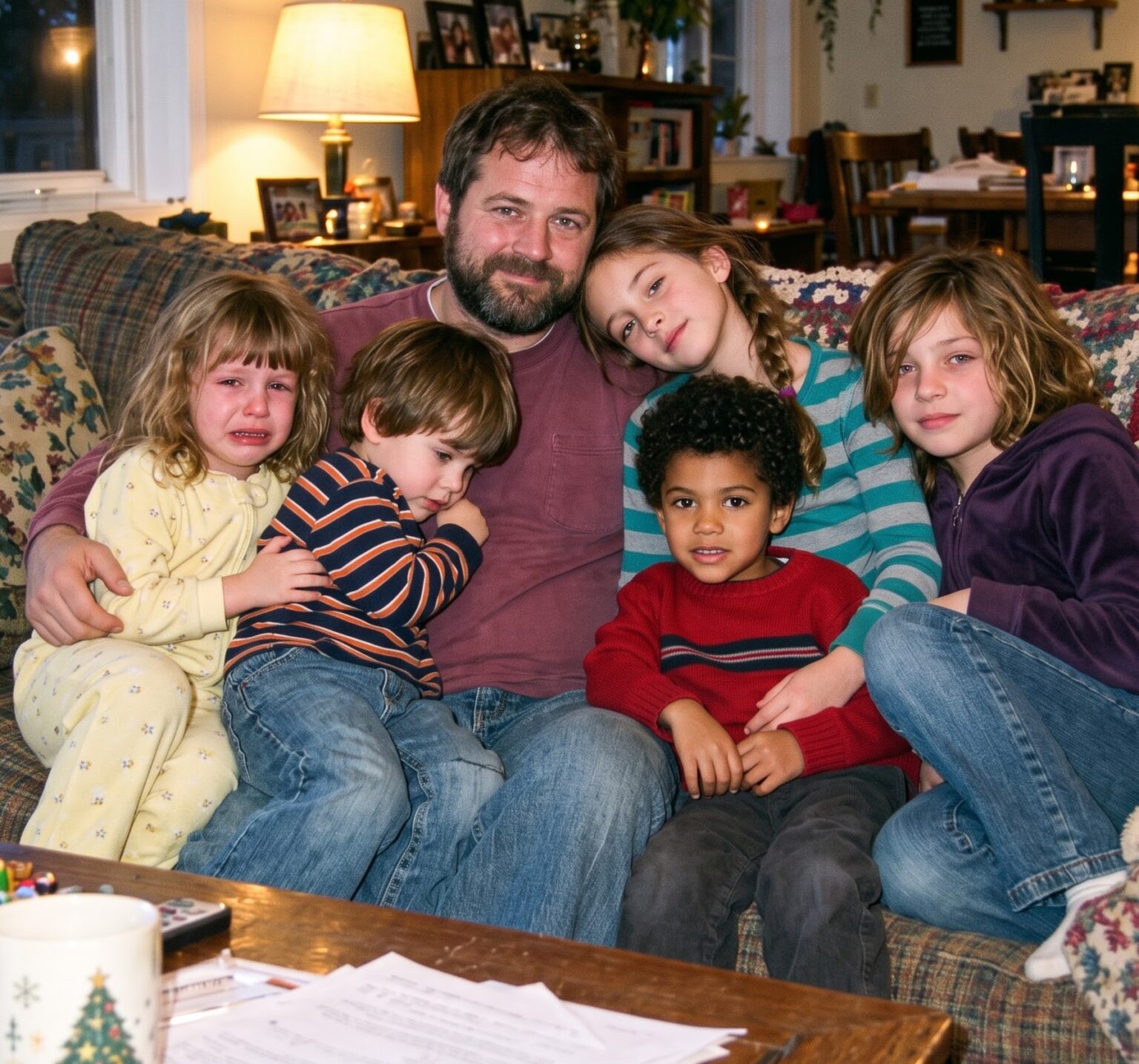
Three girls and two boys. I was the one in the middle.
I don’t remember much from those first weeks. Only fragments. Adults talking in low voices in hallways and going quiet when we walked past. Women in soft sweaters crouching down to our eye level and asking questions in voices that were far too gentle, the kind of gentle that tells a child something terrible has happened even if nobody says it out loud. Casseroles stacked on the counter. A neighbor’s dog that somebody brought over because they thought it might help.
And relatives. Relatives who loved us, I truly believe, but who couldn’t take all five.
That was the thing I understood even at that age, even without anyone explaining it.
Everybody who came to look at us wanted one.
Maybe two.
An aunt with a spare room. A couple from church who’d always wanted a daughter. A cousin who said she could manage a baby, but not a baby and a teenager.
Nobody wanted five.
And nobody could quite bring themselves to split us up, either. So for a while, we just sat there in limbo, five kids in a living room waiting for grown-ups to decide what we were.
Then he came.
Dad wasn’t married. He was in his thirties. He had a steady job, a three-bedroom house on a quiet street, and absolutely no sensible reason in the world to take on five grieving children.
He did it anyway.
I don’t remember deciding to call him Dad.
None of us do. We’ve talked about it since, more than once, usually late at night around somebody’s kitchen table after a holiday. Nobody can point to the moment. It simply happened, because that was how he behaved from the very first day. He never asked us to call him that. He never corrected us when we didn’t. He just showed up, morning after morning, and eventually the word caught up to what he already was.
He learned how to braid hair from online videos.
Badly, at first. Elowen once went to a dance recital with one side of her hair pulled so tight that one eyebrow sat noticeably higher than the other, while the opposite braid was coming undone before we even reached the parking lot. By the time she went on stage, half her head looked like a tidy rope and the other half looked like a bird’s nest.
Dad was far more upset about it than she was. He sat in the audience with his hands over his face.
He never missed a game. Not one, in all the years Dorian and Soren played. Rain, snow, the kind of cold that makes your teeth hurt, he was in the bleachers with a thermos of coffee and a folding cushion he’d bought specifically because the bleachers at Soren’s school had a crack that pinched.
He never raised his voice at us. Not once that I can remember. When we were wrong, he got quiet and sad, which was so much worse than yelling that we usually confessed within the hour.
And more than anything, he never made us feel like we’d been taken in. Not once did he make us feel like guests, or charity, or a good deed he was doing.
We were his kids.
That was the whole arrangement.
But there was one thing none of us ever asked him directly. One question that sat in the corner of our family like a piece of furniture nobody used.
Why?
Why would a single man in his thirties take on five grieving children he had never met?
Why had he never married?
Why had he barely dated, all those years? We’d noticed. Kids notice everything. There had been a woman named Patrice for a few months when I was in eighth grade, and a man at his work who kept inviting him to things, and that was more or less it.
Had there been someone before us? Someone he’d lost? Some reason?
The few times it came up, he laughed it off.
“Doesn’t matter,” he’d say, ruffling whoever’s hair was closest. “What matters is we’ve got each other. I love you lot.”
And that was the end of it.
As children, we accepted it.
As teenagers, we didn’t want the speech.
As adults, the question suddenly felt too personal, like asking to read someone’s diary.
So we never did.
Until Dad forced the question himself.

Related Posts
I Kicked My In-Laws Out of My Daughter’s First Birthday Party After They Crossed the Line
My High School Boyfriend Ch3@te333d on Me and M0c::k333d My Weight — 20 Years Later, He Hit on Me at Our Reunion without Recognizing Me, and I Used It to My Advantage