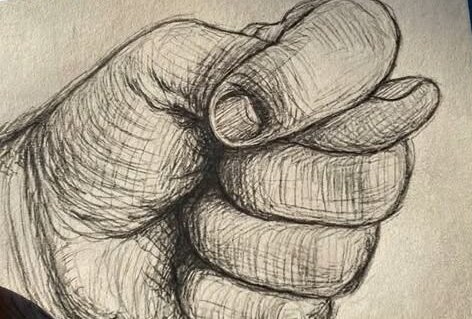
Meaning Behind One of History’s Oldest Hand Gestures
Tucked quietly between two fingers, the hidden thumb once carried a meaning far heavier than its size suggested. Known as the fig gesture, this small, almost secretive motion functioned as a kind of social armor in times when direct confrontation could come at a high cost. In societies shaped by rigid hierarchies, strict codes of honor, and constant attention to reputation, people needed ways to communicate refusal, skepticism, or protection without triggering conflict. The fig gesture became one of those tools—a silent language that allowed someone to say “no,” “I don’t accept this,” or even “I protect myself from this” without ever speaking aloud.
Its power lay in subtlety. Outwardly, it could pass unnoticed or be dismissed as meaningless fidgeting. But to those who understood it, the gesture carried a clear message. It was a way to resist without escalation, to maintain dignity while quietly drawing a line. In that sense, it wasn’t just a gesture—it was strategy. It allowed people to navigate social tension with precision, preserving both their safety and their standing.
Historically, the gesture also held associations with protection, particularly against misfortune or unwanted influence. In parts of Europe, Latin America, and the Mediterranean, it was believed to ward off harm, much like the evil eye. This layered meaning—defiance on one hand, protection on the other—gave the fig gesture a kind of dual identity. It could reject, but it could also shield. It could push something away while simultaneously guarding what mattered most.
Over time, however, the sharpness of its original intent softened. As societies changed and direct communication became more acceptable, the need for coded resistance diminished. What remained was the shape of the gesture, gradually stripped of its edge and reinterpreted through more intimate, familiar contexts. In many families, it evolved into something warmer—a playful signal, a comforting habit, even a quiet expression of affection. Grandparents might use it with children, not as a warning or a ward, but as a small ritual of connection.
This transformation says as much about human behavior as the gesture itself ever did. We don’t discard meaning—we reshape it. What was once a defensive mechanism became a shared symbol, something passed down not through formal explanation but through repetition and familiarity. Even when its origins were forgotten, its presence lingered in subtle ways, embedded in gestures of care, protection, and quiet understanding.
And that’s where its legacy still lives—not necessarily in the form itself, but in the instinct behind it. The need to set boundaries without causing harm hasn’t disappeared. The desire to protect ourselves and others without open conflict remains deeply human. We still look for ways to communicate limits gently, to signal discomfort without confrontation, to express something important without turning it into a spectacle.
The fig gesture was simply one expression of that instinct. Today, it might show up differently—in tone, in body language, in the careful choice of words—but the underlying impulse is the same. We are still balancing honesty with harmony, still trying to preserve both connection and self-respect at the same time.
That’s why something so small could carry so much weight. It wasn’t just about the fingers or the hidden thumb. It was about what it allowed people to do: to speak without speaking, to resist without breaking, and to protect without drawing attention.
The form may fade, and recognition of it may continue to slip into obscurity, but the human need it once served hasn’t gone anywhere. It simply finds new shapes, new gestures, and new languages through which to express itself.

Related Posts

Dad Never Let Me Touch His Truck, but the Day I Opened It, I Found a Note inside That Read: ’Please Come Back’ – Story of the Day

Ever Since My Son’s Friend Joined Our Family Events, Strange Things Kept Happening — Then I Saw Her Necklace and Froze