My Husband Said, “You Wanted to Be a Mother, So Act Like One”—Then Left Me Alone With Our Six-Month-Old Twins
Part 1 — The Sentence I Couldn’t Forget
“You wanted to be a mother, Evelyn. So act like one.”
My husband said those words while stuffing a sweatshirt into a duffel bag.
He didn’t yell them.
That somehow made them worse.
There was no explosion of anger, no argument that got out of control, no apology waiting behind the heat of the moment.
Julian simply said it as though he were stating a fact.
Then he zipped his bag.
Behind me, one of our six-month-old daughters was crying in the living room.
A few seconds later, her twin started too.
I could hear both of them through the bedroom door.
Two exhausted little voices.
Two babies who needed us.
Julian barely reacted.
I stood near the dresser holding a dirty bottle in one hand, staring at the man I had once believed would be beside me through anything.
“Are you serious?”
He grabbed his phone charger from the nightstand.
“I told you. The trip has been planned for weeks.”
“A four-day fishing trip.”
“Yes.”
“While we have six-month-old twins.”
His shoulders tightened.
“Evelyn, I need a break.”
For a moment, I couldn’t answer.
A break.
I almost laughed.
I couldn’t remember the last time I had finished a cup of coffee while it was still hot.
I couldn’t remember the last time I had showered without listening for a baby crying through the bathroom door.
I couldn’t remember what sleeping four uninterrupted hours felt like.
But Julian needed a break.
And apparently, that meant walking out the door.
Part 2 — The Life We Had Begged For
For years, Julian and I had wanted children more than anything.
There had been appointments.
Tests.
Hormone injections.
Procedures.
Months when hope lived inside me like a fragile little flame, followed by mornings when a single phone call extinguished it.
We went through years of fertility treatment.
Three pregnancies ended before we ever got to bring a baby home.
Each time, I grieved.
Each time, Julian held me and promised that whatever happened, we were in this together.
Then, after six years of hoping, grieving, and starting over, we saw two heartbeats on an ultrasound screen.
Twins.
Two girls.
Julian cried.
So did I.
I remember gripping his hand while the doctor moved the wand across my stomach.
“Two?” I whispered.
“Two,” she confirmed.
Julian kissed my forehead.
“We finally did it.”
We.
That word mattered to me then.
We had wanted them.
We had fought for them.
We had imagined ourselves exhausted but happy, stumbling through midnight feedings together, learning parenthood side by side.
Reality arrived differently.
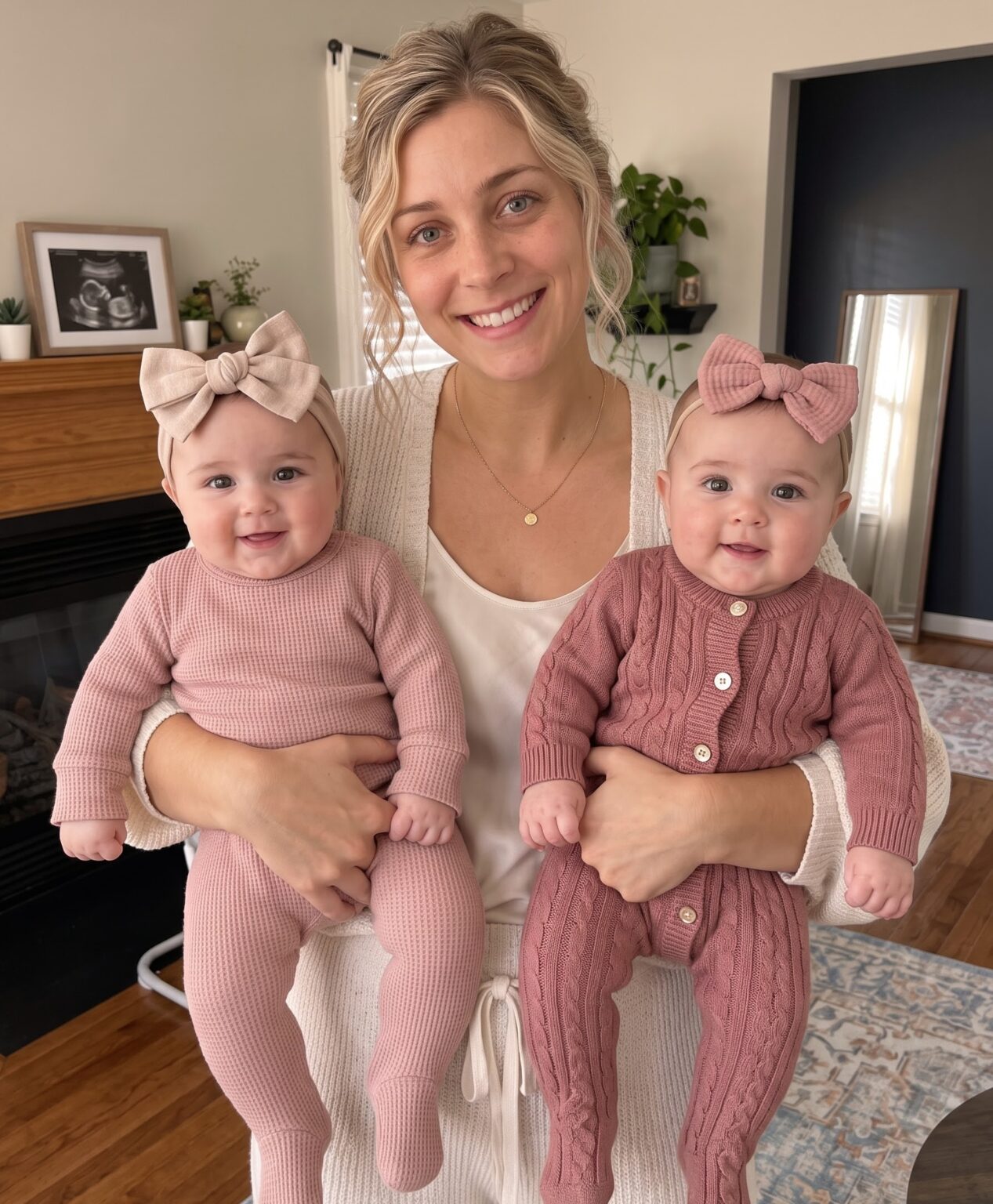
Our daughters, Maya and Clara, were perfect.
And exhausting.
The first months blurred into one endless cycle.
Feed.
Burp.
Change.
Rock.
Wash bottles.
Sterilize bottles.
Prepare formula.
Do laundry.
Clean spit-up.
Try to eat.
Try to sleep.
Start again.
Sometimes one baby woke the other.
Sometimes both cried at once.
There were nights when I stood in the nursery with Clara against my shoulder and Maya screaming from her crib, tears running down my own face because I physically could not hold everyone who needed me.
Julian helped at first.
Then gradually, his help became occasional.
Then optional.
Then something I had to request carefully enough that he wouldn’t become irritated.
He had work in the morning.
He had meetings.
He needed sleep.
He was tired.
I understood.
At least, I tried to.
So I became the default parent.
The night parent.
The morning parent.
The appointment parent.
The laundry parent.
The bottle parent.
The person who knew which baby preferred which pacifier, who needed rocking after feeding, and which cry meant hunger versus exhaustion.
And because I was already doing most of it, Julian seemed to decide that meant I could do all of it.
One evening, after an especially difficult day, I asked him for one tiny thing.
“Can you wash the bottles?”
That was it.
Not an entire night shift.
Not four hours alone with the babies.
Bottles.
He looked toward the kitchen sink.
Then toward the living room, where toys, burp cloths, laundry, and baby equipment seemed to cover every available surface.
He sighed.
A long, theatrical sigh.
“I’m exhausted, Evelyn.”
I stared at him.
“So am I.”
“I come home every day to crying babies, dirty bottles, laundry everywhere, and you looking miserable.”
The words hit me harder than I expected.
Not because the house was messy.
Because he said it as though the chaos were something I had created for him.
As though I had failed to provide a peaceful environment after spending the entire day keeping two infants alive.
“I’m looking miserable because I haven’t slept more than three hours at a time in six months.”
Julian rubbed his forehead.
“Exactly.”
I frowned.
“What does that mean?”
“It means neither of us is happy like this.”
Then he walked upstairs.
Ten minutes later, I followed him.
That was when I saw the duffel bag.

Part 3 — “I Need a Break”
“What are you doing?”
“Packing.”
“For what?”
Julian didn’t look at me.
“Fishing trip.”
I thought I had misunderstood.
“What fishing trip?”
“Ben, Connor, and Liam rented a place near the lake. Four days.”
I stared at him.
“Four days?”
“I told you they were planning something.”
“You mentioned it two months ago.”
“And now we’re going.”
“No.”
His hands stopped.
Slowly, he turned.
“No?”
“You cannot leave me alone for four days with two six-month-old babies when I’m already barely functioning.”
His expression immediately hardened.
“They’re your children too.”
The irony was so enormous I almost couldn’t process it.
“Yes. Exactly.”
He looked away.
“I haven’t had a real break since they were born.”
I felt my stomach drop.
“Neither have I.”
“You’re home all day.”
For a second, I genuinely couldn’t speak.
Then I laughed.
One short, disbelieving sound.
“You think being home with twins is a break?”
“That isn’t what I said.”
“You didn’t have to.”
He shoved another shirt into the bag.
“I work all week, Evelyn. I deal with deadlines, clients, meetings, pressure. I come home and there’s more screaming.”
“And what do you think I listen to all day?”
“Why does everything have to become a competition?”
“It isn’t a competition. I’m asking you to act like their father.”
His jaw clenched.
“I do act like their father.”
“Then stay.”
Silence.
I waited.
Some foolish part of me still expected him to look at my face and understand.
I must have looked terrible.
My hair hadn’t been washed in three days.
There was a faint milk stain on my T-shirt.
I could feel the exhaustion behind my eyes like a physical ache.
Surely the man who had once held me through miscarriages would see me.
Surely he would remember the promises we made before these babies existed.
Instead, Julian zipped his bag.
“I need this.”
My voice became quieter.
“And what do I need?”
He picked up the duffel.
“You’ll be fine.”
“I’m telling you I’m not fine.”
He headed toward the door.
I followed him into the hallway.
“Julian.”
He stopped.
“Please.”
That word humiliated me almost as soon as I said it.
Please help me care for your children.
Please notice that I am drowning.
Please choose us over a fishing trip.
He turned around.
For half a second, I thought he had changed his mind.
Then he shrugged.
“You wanted to be a mother, Evelyn.”
His eyes met mine.
“So act like one.”
And he walked out.
The front door closed.
A second later, Clara began crying again.
I stood in the hallway completely still.
Then Maya joined her.
And somewhere inside me, something changed.
Not broke.
Changed.
I stopped waiting for Julian to rescue me.
Part 4 — The First Night Without Him
That first night was terrible.
There is no glamorous version of it.
No powerful montage where I suddenly discovered hidden strength and handled everything beautifully.
I cried.
Maya refused her bottle.
Clara had been teething and screamed whenever I put her down.
At 1:40 in the morning, I finally got Maya asleep.
At 1:52, Clara woke her.
At 2:15, both babies were crying.
At 3:00, I was sitting on the nursery floor with Clara in my arms and Maya beside me on a blanket, singing the same lullaby over and over because I couldn’t remember another one.
My voice eventually cracked.
I stopped singing.
And I cried with them.
Not because I didn’t love my daughters.
I loved them so much it frightened me.
That was exactly why the situation felt unbearable.
I was terrified exhaustion would make me careless.
Terrified I would miss something.
Terrified that if I kept pushing myself like this, eventually my body would simply refuse to continue.
I thought about Julian sleeping somewhere beside a lake.
No monitor beside his pillow.
No bottles to wash.
No infant crying against his chest.
Just silence.
At 4:12 in the morning, my phone lit up.
A photograph from Julian.
A campfire.
Four beers.
The caption read:
Finally relaxing.
I stared at it.
Then I started laughing.
Quietly at first.
Then harder.
Not because it was funny.
Because something about those two words released the last bit of denial I had been holding onto.
Julian knew I was overwhelmed.
He knew I was scared.
He knew I had begged him to stay.
And he left anyway.
That meant waiting for him to suddenly become considerate was no longer a plan.
At 8:30 that morning, I called my mother.
At 9:15, I called a professional infant-care agency.
At 10:00, I called a housekeeping company.
At 11:20, I contacted an attorney.
And by noon, I had stopped crying.
Part 5 — Acting Like a Mother
For years, I had confused motherhood with endurance.
I thought a good mother absorbed exhaustion silently.
I thought asking for help meant I wasn’t coping well enough.
I thought I had to prove I could manage everything because these were the children I had wanted so desperately.
That morning, I finally understood how dangerous that thinking had become.
Loving my daughters did not require destroying myself.
Being their mother did not mean becoming the only adult responsible for them.
So I started making changes.
A certified overnight infant-care specialist arrived that evening.
When she introduced herself at the door, I nearly cried from relief.
“You’re going to sleep tonight,” she told me.
I almost apologized.
Instead, I nodded.
That first night, I slept six consecutive hours.
Six.
When I woke, the room was bright.
For a terrifying moment, I thought something was wrong.
Then I realized what had happened.
Someone else had handled the 2:00 AM feeding.
Someone else had handled the crying.
My babies were safe.
And I had slept.
I sat on the edge of my bed and cried again.
But those tears felt completely different.
Over the next three days, I hired a second overnight caregiver so we could establish a rotation.
I arranged for housekeeping twice a month.
I brought in a professional organizer to help me restructure the house around what actually worked for the twins rather than allowing baby equipment to spread into every room.
The enormous play area in the living room was condensed.
Supplies were labeled.
Feeding stations were simplified.
Laundry systems were created.
Extra furniture was moved.
The house became quieter.
Not because Maya and Clara suddenly stopped being babies.
Because I was no longer trying to run an entire household in crisis mode.
Then came the hardest part.
The money.
Julian had always talked about our savings as though they existed primarily because of him.
That wasn’t true.
Before maternity leave, I had spent more than a decade as a corporate compliance director.
I had contributed substantially to our accounts.
I had also stepped back professionally because we both agreed someone needed more flexibility once the twins arrived.
That sacrifice had somehow vanished from Julian’s version of our finances.
My attorney reviewed everything.
On her advice, I transferred a documented portion of our jointly held liquid savings into an account that could cover childcare and household support while we determined what came next.
I also created a dedicated childcare reserve.
Then I reviewed something else.
Our marriage.
By Julian’s third day away, my anger had become strangely calm.
That frightened me more than rage would have.
I didn’t want revenge.
I wanted terms.
Real ones.
If Julian wanted to remain my husband, he was going to become my partner.
If he didn’t, I was going to stop sacrificing myself to preserve the appearance of a marriage.
My attorney prepared the paperwork.
One proposal.
One divorce petition.
Two futures.
Julian could choose.

Part 6 — He Stopped Dead in the Doorway
Julian returned late Sunday afternoon.
I heard his key turn in the front lock.
For one strange second, my heart still reacted the way it always had.
He’s home.
Then I remembered.
The door opened.
Julian stepped inside carrying a cooler in one hand and fishing equipment in the other.
And stopped.
Completely.
The living room looked nothing like the room he had left.
The giant double playpen was gone.
Stacks of diaper boxes had been moved into labeled storage.
The bottle-drying racks were no longer covering half the kitchen.
The furniture had been rearranged.
The floors were clean.
Fresh air drifted through the windows.
And most unsettling of all—
the house was quiet.
“Evelyn?”
His voice echoed down the hallway.
No answer.
He set the cooler down.
“Evelyn?”
I stepped out of my office.
Julian stared at me.
I understood why.
For six months, he had mostly seen me in stained shirts, leggings, tangled hair, and exhaustion.
That afternoon, I had showered.
Actually dried my hair.
Put on cream trousers and a simple blouse.
Nothing extraordinary.
But I looked like myself again.
Or perhaps a newer version of myself.
I was holding a cup of tea.
“Where are the girls?”
“Sleeping.”
His gaze moved around the room.
“What happened?”
“I reorganized.”
“Where’s all their stuff?”
“Where it belongs.”
He frowned.
“What does that mean?”
“It means I stopped running this house as though exhaustion were a requirement of motherhood.”
He looked genuinely confused.
Then a woman stepped quietly from the nursery hallway.
“Both girls are down,” she whispered to me. “Clara took four ounces. Maya took five.”
“Thank you.”
Julian stared.
“Who is that?”
“Our overnight infant-care specialist.”
“Your what?”
“She’s finishing her shift.”
The woman politely excused herself and left.
The instant the door closed, Julian turned toward me.
“You hired a night nanny?”
“Infant-care specialist.”
“How much does that cost?”
I almost smiled.
Not How are you?
Not Did you survive?
Not Are the girls okay?
How much does it cost?
“I hired two on rotation.”
His face changed.
“Two?”
“And a housekeeping service.”
“Evelyn—”
“And I hired someone to help reorganize the house.”
His tackle box hit the floor.
“What the hell have you been doing?”
I set down my tea.
“Acting like a mother.”
He went silent.
I watched the words reach him.
His own words.
Coming home.
Part 7 — The Folder on the Counter
“You spent thousands of dollars because I went fishing?”
“No.”
My voice remained calm.
“I spent money because I finally accepted that I was doing the work of two parents while living with another adult.”
Julian’s face reddened.
“I work.”
“So did I.”
“You’re on leave.”
“From my paid profession. Not from labor.”
“That isn’t the same thing.”
“No, it isn’t.”
I stepped closer.
“My old job gave me weekends.”
He flinched.
I continued.
“It gave me lunch breaks. Sick days. Vacation. A salary. Colleagues who covered when I was overwhelmed.”
He opened his mouth.
I raised a hand.
“Motherhood has given me none of those things for six months because every time I asked you to take responsibility, you reminded me that you had work.”
“I provide for this family.”
“And I keep your daughters alive.”
“That’s not fair.”
I actually laughed.
“Neither was leaving me alone after I told you I was at my limit.”
“I was gone four days.”
“Yes.”
His shoulders loosened slightly, as though the small number somehow excused everything.
Then I said:
“And those four days taught me exactly what our marriage looks like when I stop pretending you’re participating equally.”
His face hardened.
“You’re being dramatic.”
There it was.
The old weapon.
Dismiss the emotion.
Reduce the problem.
Make me seem unreasonable.
It didn’t work anymore.
I walked into the kitchen and placed a folder on the island.
“What’s that?”
I pushed it toward him.
He didn’t touch it.
“A proposed postnuptial agreement.”
Julian stared at me.
“What?”
“It establishes equal responsibility for childcare outside your paid work hours, shared financial responsibility for hired support, and clear expectations around personal travel while the girls are this young.”
He finally opened the folder.
His eyes moved across the first page.
Then the second.
His expression darkened.
“What is this nonsense?”
“There’s another document underneath.”
He flipped the page.
Then froze.
The color drained from his face.
“Divorce?”
My pulse jumped.
But my voice did not.
“Yes.”
He stared at me.
“You would divorce me over a fishing trip?”
“No.”
I leaned both hands against the counter.
“I would divorce you because I told my husband I was drowning, and he complained that my drowning was making the house unpleasant.”
His eyes shifted away.
“You left anyway.”
Silence.
“You didn’t just leave for four days, Julian.”
My voice finally cracked.
“You looked at me after six months of barely sleeping and told me that because I wanted our daughters, raising them alone was somehow my responsibility.”
He swallowed.
“I was frustrated.”
“So was I.”
“I didn’t mean it like that.”
“You meant it enough to walk out the door.”
Part 8 — The Part He Had Never Seen
Julian pulled out a stool and sat down.
For the first time since coming home, he looked less angry than frightened.
“You emptied our savings?”
“I moved part of the joint liquid funds under legal guidance.”
“For babysitters.”
“For childcare.”
“That’s insane.”
“No.”
My voice sharpened.
“What was insane was convincing myself that collapsing from exhaustion would somehow make me a devoted mother.”
Julian rubbed both hands over his face.
“You have no idea how much pressure I’m under.”
I stared at him.
Then I felt something I hadn’t expected.
Not anger.
Grief.
Because I realized he truly believed his pressure was the only kind that counted.
“I went through six years of fertility treatment.”
His hands stopped.
“Evelyn—”
“No. You brought up pressure.”
My voice trembled now, but I kept going.
“I gave myself injections until my stomach bruised.”
He looked down.
“I lost three pregnancies.”
“Evelyn.”
“I underwent surgery to bring Maya and Clara safely into this world.”
His eyes closed.
“And six months later, I was standing in this house begging you to wash bottles while you complained that I looked tired.”
His face changed.
I had never said it like that before.
Maybe I had never allowed myself to think it that clearly.
“I wanted these babies more than anything,” I whispered.
“That does not mean I agreed to become invisible the moment they arrived.”
Julian’s eyes filled with tears.
“I love them.”
“I believe you.”
He looked surprised.
I continued.
“But loving them privately while I perform all the work publicly is not fatherhood.”
He looked toward the hallway leading to the nursery.
“I didn’t realize it had gotten that bad.”
“I told you.”
“I thought you were just overwhelmed.”
“I was overwhelmed.”
“I mean…”
He struggled.
“I thought that was normal.”
The sadness inside me hardened again.
“Normal does not mean acceptable.”
I tapped the folder.
“So now you choose.”
He looked down.
“What exactly happens if I sign?”
“You move into the guest room temporarily.”
His eyebrows lifted.
“You take responsibility for the girls from six until ten every evening after work unless we mutually agree otherwise.”
He said nothing.
“You learn every routine you currently ask me to explain.”
Another silence.
“Bottles. Formula. Laundry. Bathing. Medication. Packing the diaper bag. Doctor appointments. Bedtime.”
He looked overwhelmed already.
Good.
Not because I wanted him to suffer.
Because I wanted him to understand the scale of what he had been calling nothing.
“You contribute equally toward the hired support we agree to keep.”
“And the fishing trips?”
“Personal travel becomes something both parents discuss rather than something one person announces.”
He leaned back.
“And if I don’t sign?”
I met his eyes.
“My attorney files.”
The kitchen became silent.
Then he asked quietly:
“You’d really leave?”
“Yes.”
No hesitation.
That was the moment everything changed.
Not the threat of divorce.
The certainty in my answer.
For six months, Julian had mistaken my exhaustion for weakness.
He had forgotten that before I became the woman crying over dirty bottles at three in the morning, I had spent ten years negotiating contracts, enforcing compliance standards, and making decisions worth millions of dollars.
Motherhood had not erased that woman.
It had simply exhausted her.
And four days without Julian had given her enough sleep to come back.
He reached for the pen beside the folder.
Then stopped.
“What if I can’t do this?”
I looked toward the nursery.
“You learn.”
“And if I’m bad at it?”
“You practice.”
His mouth tightened.
“And if I’m tired?”
I held his gaze.
“Now you understand.”
He signed.

Part 9 — The First Night He Took Over
A signature did not magically fix our marriage.
I knew that.
Julian seemed to know it too.
The first evening of his new routine was almost a disaster.
At 6:20, Maya started screaming.
At 6:23, Clara joined her.
Julian was trying to prepare bottles while bouncing Clara against his shoulder.
Maya knocked over a stack of clean bibs.
The sterilizer started beeping.
Julian looked toward me.
I was sitting at the dining table with my laptop.
“Evelyn?”
I looked up.
“Yeah?”
“What does that beep mean?”
“You’ll figure it out.”
His eyes widened.
I almost laughed.
Then I saw his face.
Panic.
Real panic.
The same panic I had lived with for months.
I stood and walked toward him.
For a second, relief flooded his expression.
Then I pointed toward the sterilizer.
“That button.”
He pressed it.
The beeping stopped.
“Clara likes being held higher when she’s gassy.”
He adjusted her.
Her crying softened.
“Maya’s probably hungry.”
Julian picked up the bottle.
Within several minutes, both girls were calmer.
He looked at me.
“Thanks.”
I nodded and returned to my laptop.
I didn’t abandon him.
But I also didn’t take over.
That distinction mattered.
For the next several weeks, Julian struggled.
He mixed bottles incorrectly.
He once put Clara in Maya’s pajamas.
He forgot wipes in the diaper bag and had to buy some while out.
He learned that babies do not care how important your meeting was.
He learned that a twenty-minute bedtime routine can become ninety minutes without warning.
He learned how lonely an evening can feel when both children are crying and nobody is coming to relieve you.
And slowly—
he stopped calling it helping.
He started calling it parenting.
One night around 9:45, I walked past the nursery and found him asleep in the rocking chair with Maya against his chest.
Clara was sleeping in her crib.
There were two empty bottles on the side table.
Julian’s shirt had spit-up on the shoulder.
His hair was a mess.
He looked completely exhausted.
For six months, I had imagined that seeing him struggle would feel satisfying.
It didn’t.
I simply felt sad that we had almost destroyed our marriage because he had needed to be forced into understanding a life I had been living right beside him.
I gently lifted Maya from his chest.
Julian woke immediately.
“Sorry.”
“For what?”
“I fell asleep.”
“She’s fine.”
He rubbed his face.
Then looked at me.
“Were you this tired every night?”
I didn’t answer.
I didn’t need to.
His eyes lowered.
“I’m sorry.”
It was the first apology that mattered.
Because this time, he understood what he was apologizing for.
Part 10 — Six Months Later
Six months after the fishing trip, morning sunlight poured through our kitchen windows.
The house was not spotless.
I no longer wanted it to be.
There were toys under the coffee table.
A tiny sock sat inexplicably beside the refrigerator.
Someone had left a stuffed rabbit beneath a dining chair.
But the house felt peaceful.
Not because the work had disappeared.
Because it no longer belonged to one person.
Maya and Clara were one year old now.
Both were standing against the side of the playpen, babbling loudly at our dog.
Julian stood at the kitchen counter in dress trousers and a white shirt with the sleeves rolled up.
He tested the temperature of two bottles against his wrist.
A year earlier, he hadn’t known how much formula went into either one.
Now he could prepare them half-asleep.
He carried the bottles into the living room.
“Breakfast, ladies.”
Maya bounced excitedly.
Clara reached for him.
Julian sat on the rug and lifted Clara onto his lap.
Maya immediately crawled against his other side.
I entered wearing my coat, carrying my briefcase and coffee.
Julian looked up.
“Morning.”
“Morning.”
“They slept until six.”
“Miracle.”
“I already changed them and packed the daycare bags.”
I glanced toward the entryway.
Two bags.
Both ready.
Bottles labeled.
Extra clothes packed.
Diapers stocked.
Six months earlier, Julian wouldn’t have known what belonged inside them.
“The transport arrives at eight,” I said. “I have board meetings until four, so I’ll pick them up tonight.”
“Okay. I’ll handle baths.”
“And bedtime?”
He smiled.
“I know what ‘handle baths’ means now, Evelyn.”
I laughed.
Maya grabbed his tie.
Julian gently tried to pull it free.
She squealed and held tighter.
“Your daughter is attacking me.”
“My daughter?”
He glanced up.
“Fine. Our daughter.”
“Better.”
There had been no magical return to the marriage we had before.
I didn’t want that marriage back.
That marriage had depended too much on silence.
What we were building now was different.
There were still hard days.
There were still arguments.
There were nights when both of us were tired enough to become impatient.
But tired was no longer automatically my problem.
Parenthood was no longer something Julian stepped into when convenient.
And motherhood no longer meant proving how much I could endure.
The hired overnight care eventually decreased as the girls began sleeping longer.
We kept the housekeeping support.
Not because I was incapable of cleaning my own house.
Because we had finally learned that money could buy back something more precious than appearances.
Time.
Rest.
Patience.
The ability to enjoy our daughters instead of merely surviving them.
Julian looked toward me while Clara drank her bottle.
“I’ve been thinking.”
I raised an eyebrow.
“That’s always dangerous.”
He smiled.
Then his expression became serious.
“I still think about what I said before I left.”
So did I.
He looked down at Maya.
“I don’t know how you forgave me for that.”
I picked up my keys.
“I haven’t forgotten it.”
His eyes returned to mine.
“But forgiveness and forgetting aren’t the same thing.”
He nodded slowly.
“And staying doesn’t mean pretending it never happened.”
“I know.”
That answer mattered too.
Before opening the front door, I walked over and kissed Maya’s forehead.
Then Clara’s.
Julian was sitting between them on the floor, one hand holding a bottle while Maya tangled his silk tie between both fists.
He looked tired.
Slightly disheveled.
Completely involved.
For once, I didn’t see a man babysitting his own children.
I saw their father.
I straightened.
Julian looked up.
“Have a good day.”
“You too.”
I walked toward the door.
Then paused.
Six months earlier, I had stood in almost the same place watching Julian leave with a fishing bag over his shoulder.
I had believed being a good mother meant staying behind and somehow carrying everything.
I knew better now.
Being a mother did not mean becoming a martyr.
It did not mean surrendering every hour, every ambition, every need, and every piece of myself to prove I loved my children.
It meant protecting them.
And sometimes protecting them meant protecting the woman raising them too.
I opened the door.
Behind me, Maya burst into laughter as Julian tried to rescue his tie.
I smiled.
Then I stepped into the morning sunlight.
This time, I wasn’t walking away from my family.
I was walking into my own life knowing that when I came home, I would no longer be carrying that family alone.
Note: This story is a work of fiction inspired by real events. Names, characters, and details have been altered. Any resemblance is coincidental. The author and publisher disclaim accuracy, liability, and responsibility for interpretations or reliance. All images are for illustration purposes only.

Related Posts

Two Days After Buying Cheap Land, a Woman From the HOA Demanded $15,000
After 60 Years of Visiting Our Special Bench with My Wife, I Returned Alone—But the Person Sitting There Left Me Speechless