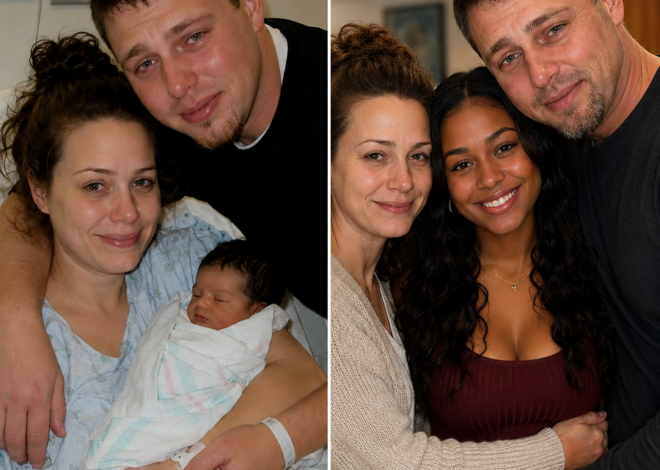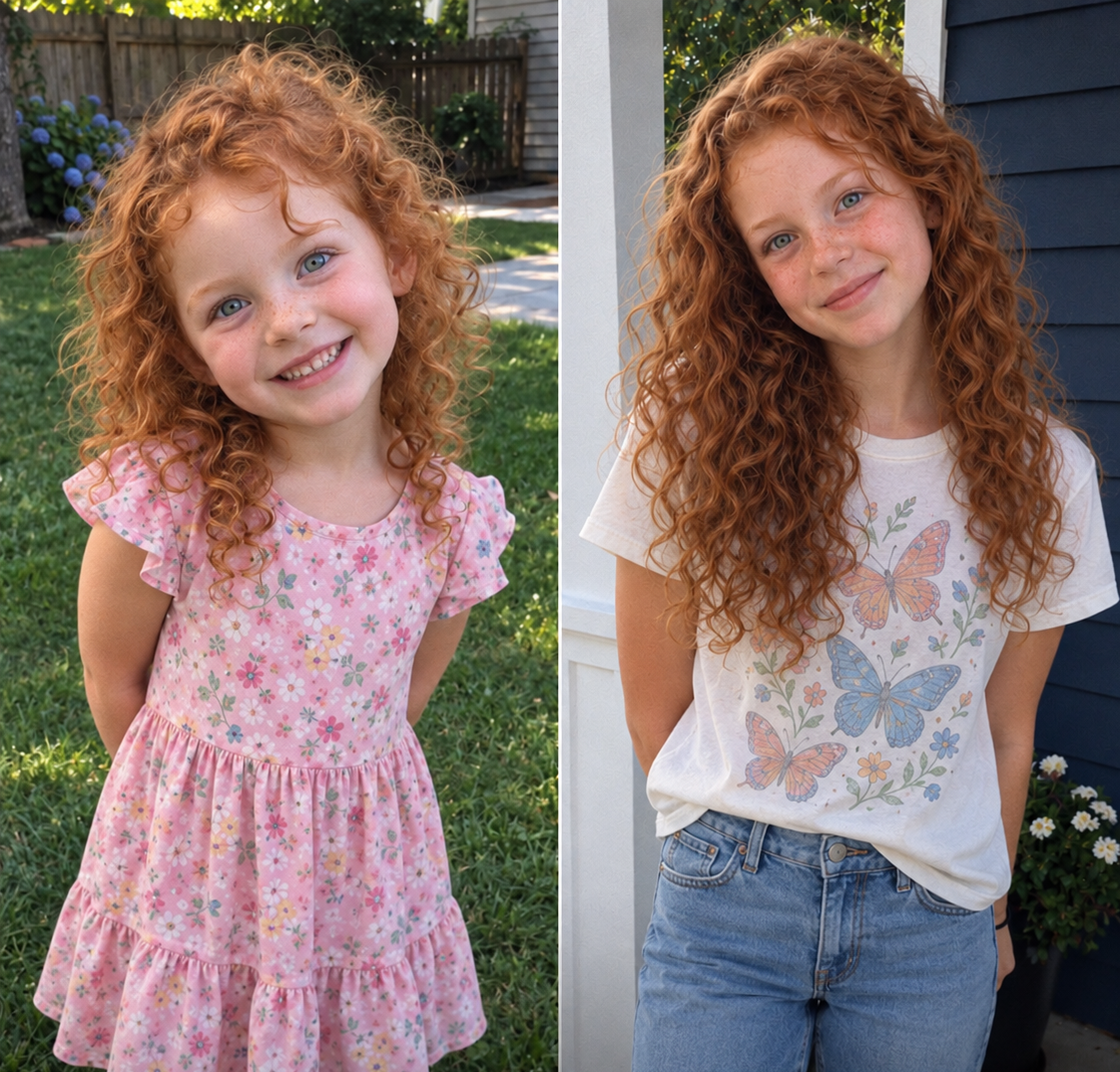
My 4-Year-Old Daughter Vanished During Hide-and-Seek—10 Years Later, One Gesture From the Girl Next Door Made My Heart Stop
For ten years, I lived with the silence left by my four-year-old daughter’s disappearance. Then a new family moved next door, and their teenage daughter carried a familiar gesture in her hands.
The Girl on the Driveway
The girl next door had been in my life for less than a minute when I said the name I had carried silently for ten years.
She was halfway up our driveway, one hand curled around the strap of a backpack, when she looked at me. She had come with her parents to introduce herself after they moved into the house beside ours. Her mother, Joan, was apologizing for the boxes still stacked in their hallway. Her father, Thomas, was explaining that his new job had brought them to town. My husband, Greg, was making the kind of polite conversation people make when they are still learning one another’s names.
Everything about the afternoon had been ordinary until Joan called toward the house. A teenage girl appeared in the doorway, clearly unhappy about being summoned away from unpacking. She was fourteen, tall and thin, with dark hair pulled into a loose ponytail. At first, I noticed her eyes. They were not an exact match for mine, but something about them made my chest tighten.
Then she moved her hand.
Mia pressed her thumbnail into the side of her index finger, rubbed the spot twice, and folded her fingers into her palm. She did it without seeming to know she was doing it.
My daughter had made that same motion whenever she was frightened or embarrassed. Margot had been four when I began gently scolding her for rubbing her finger raw. She would hide both hands behind her back and give me a guilty little smile, as if she had been caught keeping a secret.
The girl on the driveway did it again.
I heard my own voice before I had time to stop it. “Margot?”
She froze.
Greg turned toward me. “Nicole?”
I could not answer. I was staring at the girl’s hand as if that small movement had opened a door beneath my feet.
Mia took a step backward. Thomas moved in front of her at once, protective and confused. Joan’s face lost its color.
“What is happening?” Thomas asked.
“Look at her hand,” I managed to say. “She does what Margot used to do.”
Mia pulled her hands against her chest. “Do what?”
No one spoke. The silence felt too heavy for a sunny afternoon.
Then Joan looked at me and said, “We knew this day might come.”
Greg’s expression changed. “What does that mean?”
“We did not take anyone,” Joan said quickly. “We would never…”
“Then how do you know we had a child?” Greg asked.
Mia looked from him to her mother. “Mom?”
Joan swallowed. “Three weeks ago, I found a photograph of Margot online.”
The world seemed to tilt. For ten years, I had asked myself what it would feel like to hear my daughter’s name spoken by a stranger. I had imagined police officers, investigators, perhaps someone calling from a distant city. I had never imagined hearing it from the mother of the girl standing ten feet away.
The Day the Laughter Ended
Ten years earlier, our Saturday had begun with sunshine, grilled cheese sandwiches, and the sound of Margot laughing in the backyard.
I was in the kitchen cutting fruit for lunch while Greg played hide-and-seek with her. Their voices drifted through the open window. Margot’s laugh rose above his, bright and breathless.
“Eight! Nine! Ten!” Greg called.
Margot squealed, and then the game went quiet.
At first, I thought she had found a clever hiding place. She loved making us search under the patio table or behind the shed. Once, she had squeezed between two flower pots and stayed so still that Greg had walked past her twice.
A few minutes later, the back door flew open.
“Nicole,” Greg said. His voice was wrong. “Margot is gone.”
I laughed because the words did not make sense. “She is hiding. You just have not found her yet.”
“I am serious.”
We searched the house first. Then the shed, the yard, the space beneath the deck, and every place a four-year-old might crawl. We opened cabinets and checked behind furniture. Greg called her name until his voice became rough and thin.
I kept expecting her to jump out and shout that she had won.
Then I saw the back gate.
It was not standing wide open. It rested against the latch, almost closed. That small detail was worse than an open gate would have been. It meant someone had gone through it carefully enough to leave no obvious sign.
“Greg.”
He followed my stare. Across the road sat the bus stop where Margot and I had waited many times. I remembered her holding my hand there, asking questions about the passengers and whether buses ever got tired.
Within hours, the street filled with police officers, neighbors, volunteers, and people who had never met us but searched as if Margot belonged to them too. Flashlights moved through yards after dark. Strangers walked the roadside calling her name. Her photograph appeared on posters, store windows, telephone poles, and the news.
For weeks, the phone rang constantly. Then the calls became less frequent. Months passed. Hope did not disappear all at once; it wore down slowly, like a stone under running water.
People stopped saying, “They will find her.” They began saying, “You have to keep living.”
I understood what they meant, but I never learned how to do it without feeling that I was betraying her.
We moved away because the house had become impossible to breathe in. Every room held an echo of Margot. The hallway still seemed to remember her footsteps. The backyard looked unchanged, which felt cruel.
I searched anyway. I looked at children in grocery stores, airports, playgrounds, and restaurants. I counted them without meaning to. Whenever I saw a girl with dark hair, my heart reacted before my mind could catch up.
On every birthday, I wondered what Margot would look like at that age. I kept a box of her things because the objects were the only part of her life that time had not taken from me.
Now, after ten years of unanswered questions, a fourteen-year-old girl named Mia stood beside that old grief as if she had stepped out of it.

The Question We Owed Her
Joan explained that Thomas had accepted a job nearby, so she had researched the town before they moved. She read about the schools, the neighborhoods, and the local history. That was how she found the article about Margot.
“The photograph looked so much like you did when you were young,” Joan said. “The ages matched too. We told ourselves it might be a resemblance and nothing more.”
Thomas nodded. “We did not want to tell Mia she might be a missing child because two photographs seemed similar.”
“Then we moved here,” Joan said. Her eyes met mine. “And you opened the door.”
Mia’s voice cut through the adults around her. “Could everyone stop talking about me as if I am not standing here?”
Her words were sharp, but her face was frightened. I realized that we had already made the mistake of seeing her as a possible answer before seeing her as a person.
“You are right,” I said. “I am sorry. Your name is Mia.”
She watched me for a moment, measuring whether I meant it.
Greg brought me inside before the neighbors left. The moment the door closed, he said, “We need proof.”
“I know.”
“A glass, a hair, anything. We need to know.”
“We are not taking her DNA without her knowledge.”
His face tightened with panic. “Nicole, that could be our daughter standing twenty yards away.”
“It could be. We do not know yet.”
“Then let us find out.”
I understood his urgency. For ten years, the need for an answer had lived inside both of us. But I could still see Mia on the driveway, surrounded by adults who were trying to fit her into a story she had never heard.
“She is not evidence, Greg,” I said. “She is fourteen.”
He looked away.
“What if she refuses?” he asked.
The question hurt because there was only one answer that would let us keep our dignity.
“Then we wait,” I said. “If she says no, we wait until she is ready.”
I went next door before fear could make the decision for me. Joan opened the door, and I told her exactly why I had come.
“I want to ask Mia whether she wants testing,” I said. “If she does not, this ends here.”
Joan stepped aside.
Mia sat on the couch with one leg tucked beneath her. Thomas stayed close, but he did not speak for her.
I remained standing because sitting felt too familiar, too much like entering a family space that was not mine to claim.
“Do you want to know whether there is a connection between us?” I asked.
Mia studied me. “You already think I am her.”
“I think you might be Margot. But I do not know.”
“What is the difference?”
I had no easy answer. The difference was everything. It was the space between hope and fact, between a mother remembering a little girl and a teenager deciding whether to let strangers examine her life.
Mia looked down at her hands. “If I am Margot, what happens?”
My first instinct was immediate and selfish: You come home.
I wanted to pull her into my arms and recover every birthday, every school morning, and every night I had spent waiting. But I looked around the room first. Her shoes were beneath a chair. A backpack leaned against the wall. On a table sat a framed photograph of Mia and Joan laughing beside a birthday cake.
This was not a temporary place. It was the life Mia knew.
“We figure it out,” I said.
“Who decides?”
“You do. You get a say in everything.”
“Even if you do not like my decision?”
“Especially then.”
Mia was quiet for a long time. Then she agreed to proper testing.
The Paper Trail
The waiting began immediately. Every phone call made my stomach twist. Every time a car slowed near the house, I looked up. I had spent ten years afraid of bad news, only to discover that good news could be terrifying too.
The next evening, Joan brought a folder to our dining table. She held it with both hands, as if it contained something fragile.
“I have looked through these records a hundred times,” she said.
“Then we will look again,” I replied.
Mia stayed upstairs by choice. I asked no one to bring her down. If this was going to be her truth, she deserved room to approach it in her own way.
The folder contained copies of early reports, placement records, and forms from years before Mia had been old enough to understand where she came from. Most of the pages were full of incomplete descriptions and cautious language.
Halfway through, I found a report about a young girl discovered asleep near the end of a bus route on the same afternoon Margot disappeared.
My hands went cold.
The report said the child knew her first name. She called her caregivers Mommy and Daddy, but she could not give an address. When asked where she lived, she described a yellow house across from a bus stop, near a tree with a swing.
That was how a four-year-old would have described our home.
I pushed the page toward Greg. “Margot knew that bus.”
“She would not have gotten on alone,” he said, though his voice no longer sounded certain.
“She had ridden it with me. She knew the stop. She knew what buses looked like.”
Another page showed that the child’s identifying information had not been consistent in the earliest records. A mistake in one file had been repeated in another. The trail became blurred before anyone connected the girl to Margot’s disappearance.
There had been temporary care, then foster placement. Eventually Joan and Thomas became Mia’s legal parents. They had not been looking for a child to replace anyone. They had taken in a little girl who needed a home and had loved her through every year that followed.
Greg pushed his chair back so quickly that it struck the wall.
“She was there?” he asked. “While we were searching?”
His face had folded in on itself. I knew what memory had returned to him. He had been standing near the fence, counting to ten while Margot moved through the gate.
“I was counting,” he whispered. “I was right there, and I did not see her leave.”
I reached for his wrist. “You did not send her away.”
“I did not see her.”
“Neither did I.”
The records did not give us a clean explanation. They gave us a series of missed connections, incomplete descriptions, and decisions made by people who did not know they were holding pieces of the same child’s life.
No one at our table had stolen Margot. No one had hidden her from us. A failure had happened, and two families had been forced to live on opposite sides of it.
That truth did not make the lost years less painful. It only made the anger harder to place.
Two Mothers at One Table
A few nights later, Joan and I sat together while Greg and Thomas compared the records. The men spoke quietly, tracing dates and names with their fingers. Joan and I listened to the sound of paper turning between us.
“I lost ten years,” I said.
Joan lowered her eyes. “I know.”
The answer came out of me before I could soften it. “No. You do not.”
She looked up, and I immediately regretted the cruelty in my voice. But Joan did not defend herself.
“You are right,” she said. “I do not know what it is to lose ten years that way.”
She rested her hands in her lap.
“But I had them,” she continued. “I had her birthdays. I was there when she started school and when she learned to ride a bicycle. I sat beside her when she was sick. I listened when her friends hurt her feelings. She calls me Mom.”
Her eyes filled, and she wiped them with the heel of her hand.
“Please do not ask me to pretend those years were not real,” she said. “I am terrified too.”
The jealousy I had been fighting rose first. Then I saw what it was covering. Joan was afraid that finding Margot meant losing Mia.
For ten years, I had imagined the other side of this moment as a reunion. I had never imagined that someone else would be standing there with just as much to lose.
The next afternoon, Greg brought out the stuffed bear Margot had slept with as a small child. Its fur was worn, and one seam had been repaired so many times that the thread showed in a crooked line.
Mia came downstairs while he was holding it.
“Do you remember this?” Greg asked.
Mia shook her head.
“You slept with it every night. Nicole repaired the seam three times.”
Mia took a step back. “I do not remember.”
Greg turned the bear toward her. “Just look at it.”
Her thumbnail pressed into her finger. I saw the familiar motion, but I also saw the fear in her face.
“Margot, please,” Greg said.
Mia’s expression hardened. “Do not call me that.”
Greg went still. “It is your name.”
“Greg,” I said.
He looked at me, desperate. “If she is ours…”
I moved between them. “She is not taking a test for our memories.”
His mouth opened, but no words came.
“You are asking her to prove that you are allowed to remember her,” I said. “She does not owe us that.”
The sentence reached him. His face crumpled, and he sat down with the bear in his lap.
After a moment, he looked at Mia. “I am sorry.”
She did not answer right away. Then she said, “Okay.”
It was not forgiveness. It was not acceptance. It was simply a small opening, and we were learning not to force doors open.

The Answer
The test results arrived two days later.
Mia was biologically our daughter. The little girl who had vanished through our backyard gate had grown into the teenager living next door.
For a few seconds, nobody moved. The answer we had wanted for ten years sat on the page, and still it did not tell us what to do with our hands, our voices, or the years between then and now.
Mia began to cry. Joan reached for her first. Mia turned and gripped her mother’s hand.
A sharp pain went through me, and I hated myself for feeling it. Joan had been there for the scraped knees and the nightmares, for the school mornings and the birthdays. She had earned that instinctive reach.
Then Mia looked at me. After a moment, she held out her other hand.
I took it.
I did not pull her toward me. I did not ask her to choose. I only held on.
The truth did not erase Mia’s life with Joan and Thomas. My biology did not erase the people who had raised her. Finding Margot had not given me permission to pretend she had remained four years old somewhere, waiting for me to arrive.
My relatives struggled with that more than I did.
A week later, we held a small gathering at our house. People spoke carefully at first, but grief and excitement made everyone careless in the end.
One relative pulled me aside near the porch. “When is she coming home?”
“She lives next door,” I said.
“You know what I mean. When do you get her back?”
Mia was close enough to hear. So was Joan.
I looked at my relative and said, “Do not talk about her as if she was something someone borrowed.”
The relative lowered their voice. “They are not her real parents.”
“They raised my daughter.”
“But she is yours.”
“She is,” I said. Then I looked toward Joan and Thomas. “And she is theirs.”
The room behind us went quiet.
“You do not get to erase ten years of their love because I lost those years,” I said. “I will not let my pain become another thing Mia has to survive.”
Later, Mia found me alone on the porch. The evening had cooled, and the streetlights had come on one by one.
“Did you mean what you said?” she asked.
“Every word.”
She sat beside me. For a while, we watched the lighted windows of the house where she had grown up.
Then she asked, “Do you want me to live with you?”
Every selfish part of my heart answered yes. I wanted the mornings I had missed. I wanted to know what she liked for breakfast, what music she played when she was sad, and which stories made her laugh. I wanted ordinary things because ordinary things were what had been taken from me.
“I want every day I lost,” I told her.
She looked down at her hands.
“But those days are not yours to give back,” I continued. “You already have a life. You have parents, friends, memories, and a name you know. I do not want finding me to become another way you lose everything.”
Her eyes filled. “So I do not have to choose?”
“No.”
“Even if I still call Joan Mom?”
“Especially then.”
Mia rubbed her thumb against her finger. This time, I did not tell her to stop.
“What should I call you?” she asked.
I smiled through the tears in my eyes. “Nicole works until you decide otherwise.”
Learning Each Other
The months that followed were not simple, but they were honest. Mia came into our house when she wanted to. Sometimes she stayed for dinner. Sometimes she sat in the living room for an hour and left without saying much. Greg learned to ask before showing her another photograph. I learned that every question had to come with permission for her not to answer.
We began building a relationship from the present instead of trying to force the past to carry us. I learned that Mia hated crowded restaurants, loved old mystery novels, and could sleep through any alarm clock. She learned that Greg burned pancakes whenever he was nervous and that I kept too many blankets on the couch.
There were days when the difference between Margot and Mia felt like a wall. There were other days when it felt like a bridge. I stopped searching her face for the little girl who had vanished. When I looked at her, I tried to see the person who had survived ten years without knowing where she began.
Joan and I did not become close overnight. We had too much pain between us, even though neither of us had caused the original loss. But we started talking. We traded stories about Mia’s childhood. Joan told me how Mia had once hidden a birthday present so carefully that she forgot where she put it. I told Joan how Margot had laughed whenever bubbles landed on her nose.
Each story hurt. Each story also gave Mia more of herself.
The first time Joan called me to ask whether Mia could spend the afternoon with us, I stared at the phone for several seconds before answering. Her voice sounded cautious, and I understood why. She was not handing over a child. She was making room for another relationship.
I thanked her. Then I asked what Mia wanted.
That became our rule. We asked Mia.
Not the records. Not the relatives. Not the two families carrying their own versions of the past. Mia.
The Stories We Could Still Share
Several months after the test, Mia sat cross-legged on our living room floor while I opened the memory box I had kept since she disappeared.
Inside were the small things I had protected as if they were proof that she had once been real: a plastic bracelet, a picture book with bent corners, one tiny shoe, and a ruffled dress she had worn only once.
Mia picked up the shoe and turned it over in her hand.
“My foot was really that small?”
“You grew quickly.”
She held up the dress. Her face twisted with immediate disapproval. “You put me in this?”
I laughed. “You hated it.”
Mia looked at me. “You?”
The word caught me. I almost answered as if the little girl and the teenager were the same person in the same moment.
“Margot hated it,” I corrected.
Mia looked down at the dress, smoothing the fabric across her knees. “No,” she said quietly. “You were right the first time.”
I went still.
She lifted her eyes. “What happened when I wore it?”
I looked at the fourteen-year-old beside me. She was not the four-year-old I had spent a decade trying to preserve in my mind. She was not a stranger anymore either. She was my daughter, Mia, with her own history, her own loyalties, and her own way of choosing what came next.
“Do you really want to know?” I asked.
She leaned against the couch. “Tell me.”
So I told her. I described the shoes she had kicked off beneath the table. I told her how she had hidden behind Greg because she hated having her picture taken. I told her how she spilled juice on the dress twenty minutes later and looked delighted instead of embarrassed.
Mia laughed. Then she asked another question. Then another.
For ten years, I had imagined getting Margot back exactly as I had lost her: four years old, running through the gate, calling me Mom.
Life gave me something more difficult. It gave me a daughter who had grown up without me. A daughter who loved another mother. A daughter whose memories began in places I had never seen and whose name belonged to a life I had not shared.
Once I stopped trying to drag her backward, there was room for us to move forward.
Mia handed the dress back to me. “Keep going,” she said.
“With what?”
“The stories.”
I opened the box again.
And I began to tell her everything I could remember, not because I wanted to reclaim the child she had been, but because she was finally ready to meet that child for herself.
I was no longer waiting for Margot to come home.
I was getting to know Mia.
Note: This story is a work of fiction inspired by real events. Names, characters, and details have been altered. Any resemblance is coincidental. The author and publisher disclaim accuracy, liability, and responsibility for interpretations or reliance. All images are for illustration purposes only.

MyAdmin
Related Posts
Without My Permission, My Future SIL Took the Wedding Dress My Late Grandma Made for Me – So I Brought Her a Wedding Gift That Made Her Regret It

What Grandma Told My Daughter