The One-Eyed Pit Bull Was Left at a Shelter With a Suitcase — When Workers Tried to Move It, His Panic Exposed the Child Missing From His Life
Part 2 — The Man Who Could Not Explain in the Lobby
My name is Tessa Brennan, and I worked as a behavior coordinator at a Nashville animal shelter when Riley arrived. The names and organization in this fictional account are invented, but the procedures reflect realistic shelter and crisis-foster work.
The man who surrendered Riley was named Noah Carter. He was thirty-seven, exhausted, and carrying a hospital visitor badge on his jacket.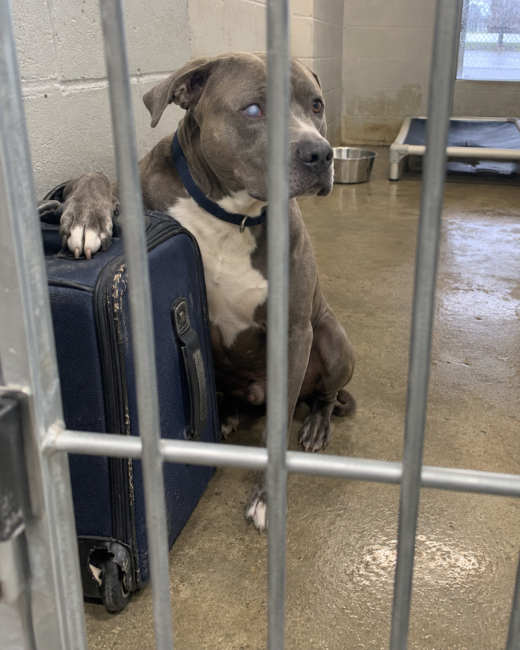
The intake recording showed him standing beside Riley with one hand resting on the suitcase. He completed the relinquishment form but left several history questions blank.
Riley leaned against his leg.
Noah never looked down.
At the time, staff interpreted the brevity as indifference. Once we spoke with him, that assumption collapsed.
Noah’s nine-year-old daughter, Emma, had been injured in a highway collision six weeks earlier. She survived but needed months of physical rehabilitation after surgery to her leg and pelvis.
Her mother had died several years before. Noah stopped working regularly so he could remain near the pediatric rehabilitation center. Medical travel, unpaid leave, and rent arrears eventually cost them their apartment.
The temporary family residence accepting Noah and Emma did not allow animals.
Noah arranged for his cousin to care for Riley. That arrangement lasted three weeks before the cousin’s landlord discovered the dog and demanded his removal.
With less than a day to find another placement, Noah brought Riley to the shelter.The suitcase belonged to Emma.
“She packed it for him herself,” Noah said. “She thought he was going to stay with my cousin until we found a place.”
Emma had folded her blanket around the toys Riley knew. The stuffed rabbit, Bunny, usually slept between them.
Noah had not told her that the second arrangement failed.
“She keeps asking when he’s coming back,” he said. “I didn’t know what to tell her.”
Our shelter had a small safety-net foster program for people facing hospitalization, displacement, or temporary crisis. Space was limited, and many residents learned about it only after reaching the surrender desk.
Because Noah had legally relinquished Riley, returning him was not automatic. Still, the case had not progressed to adoption placement, and our director could review whether the surrender could be converted into a temporary-care agreement.
The decision depended on several practical questions.
Was Noah able to remain involved? Did he have a realistic housing plan? Could Riley be placed safely in an approved foster home? How long could temporary care continue without blocking emergency resources for other animals?
Emotion could not answer those questions alone.
Noah provided contact information for Emma’s social worker, rehabilitation schedule, housing applications, and his cousin’s account of Riley’s behavior. He agreed to veterinary treatment and regular updates.
The surrender was paused for seventy-two hours while the case was reviewed.
Meanwhile, Riley remained beside the open suitcase.
His first veterinary assessment confirmed permanent vision loss in the left eye, probably caused by old trauma. The surface was cloudy but intact, and pressure testing did not indicate active glaucoma. Dr. Mara Singh found no immediate reason to remove the eye, though it would require monitoring for changes in comfort.
Riley navigated well when people announced themselves and approached from his right. Sudden movement on his left made him spin or recoil.
That explained why rolling the suitcase away on his blind side had produced such intense disorientation.
The luggage itself provided scent, predictable shape, and a physical boundary he could locate with one eye.
We stopped treating it as clutter.
The unsafe contents were removed, cleaned, and returned selectively. The purple blanket, pajama shirt, Bunny, and one book stayed with Riley. The hard plastic astronaut remained outside the kennel because chewing could break it.
When I unfolded the blanket over his cot, Riley smelled each corner before stepping onto it.
His right eye softened.
He lay with Bunny beneath his chin.
At 2:14 the next afternoon, the crisis-foster coordinator approved a temporary placement lasting eight weeks, with the possibility of review.
That solved the legal question.
It did not solve Riley’s fear.
He would have to leave the suitcase behind long enough to enter a transport vehicle, meet a stranger, and sleep in a house where nothing smelled like Emma except the objects we could carry.
Part 3 — Moving the Suitcase Six Inches at a Time
The approved foster was Denise Harper, a fifty-eight-year-old retired elementary-school librarian with a quiet single-story home and experience caring for visually impaired dogs.
She visited Riley three times before attempting transport.
During the first meeting, Denise sat outside the kennel and read aloud from one of Emma’s children’s books. She did not extend her hand through the bars or repeat Riley’s name.
Riley watched her from the cot.
Bunny remained between his front paws.
After eleven minutes, he lowered his head.
On the second visit, Denise entered from his right side. She placed a treat on the floor and sat sideways several feet away.
Riley smelled the treat but returned to the suitcase.
Denise did not move closer.
The third visit included the transport crate. We placed it inside the adjacent bay with the door secured open. Riley investigated the crate, then repeatedly checked the suitcase to ensure it remained where he had left it.
The problem was obvious.
The suitcase was too large to fit safely inside the secured transport crate. If we rolled it away, Riley panicked. If we forced him into the crate first, we risked making every future confinement more frightening.
Behavior work began with six inches of movement.
I touched the suitcase handle while Riley watched from his sighted side. Denise offered a treat. I lifted the handle and released it.
Riley stiffened but stayed in place.
Later, I tilted the suitcase without moving its base.
On the next attempt, it rolled two inches.
Riley stood immediately. We stopped until his breathing slowed, then placed Bunny beside the luggage.
Over four sessions, the suitcase traveled gradually toward the open transport crate. Riley followed without scrambling because he could see every movement.
We then removed individual objects.
The book moved first.
Bunny moved second.
The pajama top went inside the crate.
The purple blanket was last.
Riley watched Denise spread it across the crate floor. He approached, smelled the fabric, and placed one front paw inside.
He withdrew.
No one pushed him.
During the next session, Emma participated through an audio recording. On medical advice, we avoided a live video call in the kennel because sudden sounds from a device might confuse Riley.
Emma recorded herself reading the first page of the book.
Denise placed the phone beyond the crate where Riley could hear without seeing a moving object.
Emma’s voice began softly.
“Riley, this is the part where the dog finds the moon.”
Riley froze.
His clear right eye turned toward the sound. His ears lifted, then folded. He moved past the suitcase and stepped into the crate.
He smelled the phone through the bars.
Then he lay on the purple blanket.
The recording lasted thirty-eight seconds.
Riley remained inside after it ended.
We did not replay it repeatedly. Familiar recordings can support some animals, but overuse may increase searching or distress. It became one controlled tool among many.
On transport day, the suitcase traveled separately in Denise’s car. Bunny and the blanket remained with Riley inside the secured crate.
He entered voluntarily.
The drive took twenty-six minutes. Riley panted during the first ten, then rested with his head on Bunny.
At Denise’s home, we placed the transport crate in a quiet room before bringing in the suitcase. Riley emerged, inspected the wall, door, water bowl, and low bed.
When Denise rolled the luggage into the room, the broken wheel scraped once.
Riley turned sharply.
He approached and pressed his shoulder against it.For his first week, he slept beside the suitcase. He followed Denise into the yard but returned to check it after every trip. If she moved it while cleaning, he tracked the motion closely.
The suitcase was helping him settle.
It was also preventing him from exploring more than one room.
The team decided not to remove it.
Instead, Denise began making the house predictable enough that the suitcase would no longer need to hold the entire meaning of home.
Part 4 — The Voice From the Rehabilitation Room
Riley’s foster routine began at 6:30 each morning. Denise announced herself before entering from his blind side, opened the yard door, and waited for him to choose whether to follow.
He moved through the house by creating a mental map. The rug marked the bedroom doorway. A textured runner led to the kitchen. Furniture remained in consistent positions.
His cloudy left eye did not make him helpless.
It made unexpected changes more expensive.
During the first week, Riley stayed within sight of the suitcase. During the second, he followed Denise into the kitchen for breakfast. By the third, he slept on a rug in the hallway while the luggage remained in the foster room.
The veterinary team monitored his left eye. Pressure remained normal, and Riley showed no squinting, discharge, rubbing, or other sign of acute pain. His blindness was permanent, but it did not prevent a comfortable life.
The greater challenge was separation from Emma.
Noah sent a recently worn T-shirt from the rehabilitation center. Denise placed it beside Bunny without presenting it dramatically.
Riley smelled the fabric.
He carried it to his bed and slept with his muzzle resting across one sleeve.
The first live audio call took place after Riley had been in foster care for eighteen days. Emma’s therapist advised keeping it short and allowing the child to understand that Riley might search for her afterward.
Denise sat in the hallway with the phone on a table.
Emma said his name.
Riley rose so quickly that he struck the suitcase with his hip. He searched behind the phone, circled the room, and whined.
Denise ended the call after thirty seconds.
For the next hour, Riley checked the front door repeatedly.
The contact intended to comfort him had created a search he could not complete.
We paused live calls and returned to short recordings paired with calm activities. Emma continued sending drawings and fabric items, but Riley received them without a disembodied conversation.
This was not rejection.It was an adjustment based on his behavior.
Noah’s housing search continued. Two applications were denied because of income requirements. Another property accepted dogs but excluded Pit Bulls through its insurance policy.
The original eight-week foster limit approached.
The crisis program reviewed the case and extended Riley’s placement by six weeks because Noah remained engaged and had secured part-time work near Emma’s facility.
Still, an extension was not a permanent plan.
If stable housing could not be found, Noah would need to decide whether Riley should enter adoption placement. The shelter could not promise indefinite temporary care.
Emma understood only part of that pressure.
She knew Riley lived with Denise. She knew Bunny and the blanket remained with him. She did not know that a date on a case file might determine whether he ever slept beside her again.
During week nine, Emma reached a rehabilitation milestone. She could transfer from her wheelchair to a car seat with assistance and was cleared for a short outing.
The therapist proposed an in-person visit in a quiet fenced courtyard at the shelter.
We prepared carefully.
Riley visited the courtyard first. He smelled the fence, gate, bench, and ramp. Denise placed the purple blanket on the ground but left the suitcase inside.
On the day of the meeting, Noah brought Emma through a separate entrance. She wore a red coat and used a walker for the final several feet.
Riley entered from the opposite side.
He noticed Noah first.
Then Emma spoke.
Riley stopped.
His body lowered, not from fear but concentration. He turned his clear eye toward her and began walking
Emma placed both hands on the walker.
No one released Riley’s leash.
When he reached her, he smelled her shoes, coat, hands, and hair. His tail moved slowly. Emma lowered herself onto the bench with her therapist’s help.
Riley climbed only his front half beside her and pressed his white chest against her knees.
Emma held Bunny between them.
For twenty minutes, the suitcase was not in the same room and Riley never searched for it.
Then the visit ended.
When Emma left, Riley remained at the gate.
He did not panic.
But back at Denise’s house, he carried Bunny to the front door and waited there until midnight.
Part 5 — The Deadline Inside the Suitcase
After the reunion, Riley’s behavior changed in small, conflicting ways.
He explored more of Denise’s house. He spent afternoons in the living room and began sleeping several feet from the suitcase.
Yet he also became more alert when vehicles stopped outside. Every door sound brought him into the hallway.
The visit had confirmed that Emma still existed.
It could not explain why she kept leaving.
Denise maintained his routine. She avoided turning waiting into a daily event. Walks, feeding games, veterinary checks, and rest occurred at predictable times.
The suitcase moved gradually from the foster room to the hallway.
Riley followed but did not block it.
Two days later, it moved into an open closet. The door remained secured so it could not close unexpectedly.
Riley checked the luggage several times and returned to his bed.
That was the first full night he slept without touching it.
Meanwhile, Noah found a duplex owned by a retired contractor who accepted dogs individually rather than through breed restrictions. The rent was within reach only with a temporary housing subsidy.
A social worker helped complete the application. The shelter provided Riley’s veterinary records, behavior notes, licensing information, and evidence of liability coverage available through Noah’s policy.
The landlord requested a controlled meeting.
Riley arrived with Denise, wearing a secure harness and leash. Noah stood across the yard rather than taking the leash immediately.
The landlord observed Riley walking, responding to basic cues, and navigating around his blind side. He did not ask for a theatrical temperament test or provoke the dog.
After reviewing the records, he approved Riley.
The subsidy decision remained.
It would not arrive before the foster extension expired.
Our director scheduled a final review. Riley’s foster placement could continue for another fourteen days, but after that, Denise needed the room for two dogs entering the same crisis program.
Noah listened without arguing.
“If we don’t get it?” he asked.
The answer was difficult.
Riley would remain safe, receive continued care, and enter the adoption program. Noah could participate in planning, but the temporary-care agreement could not remain open indefinitely.
Emma learned of the deadline from her father.
She packed the suitcase again.
This time, she added a second pajama shirt, a drawing of Riley beneath a yellow moon, and the plastic astronaut staff had stored outside his kennel.
On the back of the drawing, she wrote, “So he knows which window is ours.”
The suitcase returned to Denise’s house.
Riley smelled each item. He carried the pajama shirt to his bed but left Bunny inside the luggage.
That surprised Denise.
Bunny had been his closest comfort object since the shelter.
The next morning, Riley removed the stuffed rabbit and placed it near the front door.
He repeated the action for three days.
No one claimed to know exactly why. The observable pattern was clear: Bunny moved to the doorway, while Riley returned to his bed.
On the twelfth day, Noah received confirmation that the housing subsidy had been approved for six months.
The duplex would be available the following week.
The crisis-foster agreement was extended through move-in.
We expected Riley’s return to be simple after the successful courtyard visit.
It was not.
The duplex smelled of paint, empty rooms, strangers, and cleaning chemicals. Emma’s familiar scent was present, but her wheelchair, walker, medical equipment, and changed movement patterns were unfamiliar inside a home.
When Riley entered, he stopped at the threshold.
The suitcase stood in Emma’s bedroom.
She sat beside it.Riley could see her with his right eye, but the narrow hallway placed her on his blind side whenever he turned toward the luggage.
He began panting.
Emma called softly.
Riley did not move.
The object that had once connected them now stood between Riley and the child he had spent months trying to find.
Bringing Riley home required one final choice: remove the suitcase he had guarded for months, or trust him to walk past it without losing Emma again.
Part 6 — Learning the Shape of Home Again
We did not roll the suitcase away.
Instead, Emma’s therapist moved her chair several feet to Riley’s sighted side. Noah sat on the floor near the wall, and Denise loosened the leash without releasing it.
Emma stopped calling.
Riley watched.
The room remained quiet long enough for him to process each object separately: suitcase, chair, walker, Noah, Emma.
Then Emma placed Bunny on the floor between them.
Riley took one step.
He smelled the toy and lifted it gently. Instead of returning to the suitcase, he carried Bunny to Emma and placed it against her shoe.
She bent only as far as her therapist allowed and touched Riley’s right shoulder.
His tail moved.
Riley crossed the remaining distance and leaned against her knees.
The first night required supervision and an exit plan. Denise stayed in the guest room. Riley’s crate and familiar bed were placed beside Emma’s doorway rather than inside her room, allowing both dog and child uninterrupted sleep.
Riley checked the suitcase four times before midnight.
Each time, he returned to the hallway bed.
At 2:10 a.m., Noah found him sleeping with his clear eye facing Emma’s open door.
The next morning, Riley followed the textured runner to the yard. He hesitated at an unfamiliar step, and Noah guided him from the right without pulling.
Emma watched from the doorway.
Nothing happened quickly.During the first week, Riley startled when her walker struck the wall. He avoided the wheelchair when it approached from his left. He searched the house whenever she left for therapy.
The family worked with a trainer experienced in visual impairment. Emma learned to speak before touching Riley. Noah placed textured mats at thresholds and kept pathways clear. The wheelchair followed consistent routes through tight rooms.
Riley learned that the rolling sound did not mean luggage was leaving.
Emma learned that affection could include giving a dog time to locate her.
The setback came during the third week.
Noah moved the suitcase into a closet while Riley was outside. When Riley returned, he searched Emma’s room, then the hallway and living room.
His breathing accelerated.
Noah immediately brought the suitcase back, but Riley did not settle. He remained beside it through dinner and refused to follow Emma into the living room.
The family contacted us.
We advised returning to gradual movement. The suitcase was not a bad habit to eliminate by surprise. It had served as Riley’s scent anchor through multiple separations.
For seven days, Noah moved it only while Riley watched. First across the room, then into the doorway, then onto the closet floor with the door open.
Emma placed one familiar object outside the luggage each time.
Bunny remained on her bed.
The purple blanket moved to Riley’s hallway bed.
The astronaut stood on a shelf.
The suitcase slowly became one container instead of the container holding his whole family.
By the sixth week, Riley no longer checked it each morning. He slept beside Emma’s bed during afternoon reading and moved to his own orthopedic mat at night.
His left eye remained cloudy and blind. Veterinary monitoring continued, and the family watched for squinting, rubbing, redness, discharge, or behavioral changes indicating discomfort.
Riley did not regain vision.
He gained a home arranged to respect the vision he still had.
Emma’s mobility also improved. She used her walker for short distances and returned to school part-time. Riley was not classified or presented as a service dog. He stayed home with Noah or rested safely during school hours.
One rainy evening, Emma read the moon story aloud.
Riley lay beside her bed with Bunny beneath one paw.
The navy suitcase remained inside the open closet.
Its broken wheel faced the wall.
Riley never looked toward it.
Part 7 — What Remained After the Suitcase Closed
Six months after Riley returned home, Emma completed the most intensive phase of rehabilitation. She still attended therapy, but she could walk from her bedroom to the kitchen using a cane and supervision.
Riley adjusted to every stage.
The walker disappeared first. The wheelchair remained for longer outings. Furniture moved only after Riley inspected the new arrangement from his sighted side.
Noah regained consistent work and assumed the full rent after the temporary subsidy ended.
The crisis-foster program closed Riley’s case only after veterinary records, licensing, housing permission, and follow-up support were confirmed.
Denise visited once.
Riley greeted her at the door, smelled her coat, and leaned against her knee. Then he returned to Emma without searching the car behind her.
The suitcase remained in the closet.
One afternoon, Emma and Noah finally emptied it.
Clothes went into drawers. The books returned to a shelf. The astronaut stood beside Emma’s window. Bunny stayed on her bed.
The purple blanket became Riley’s.
Emma spread it across his sleeping mat while he watched. Riley smelled each fold and circled twice before lying down.
Noah closed the suitcase.
The broken wheel made the same scraping sound that had once sent Riley across the shelter kennel in panic.
Riley raised his head.
He turned his clear right eye toward the sound.
Then Emma said his name from the bed.
Riley looked at her and lowered his chin onto the blanket.
The suitcase was carried into storage.
He did not follow.
Months earlier, shelter workers had believed Riley was guarding an object. In reality, every observable part of his behavior suggested that the luggage held the most stable collection of familiar scents left in a suddenly unfamiliar life.
The goal had never been to make him forget it.
The goal was to give him enough repeated safety that he could release it by choice.
That night, Riley slept with his white chest facing the bedroom door. His cloudy left eye remained closed against the blanket, while his sighted eye watched Emma turn the final page of their book.
Bunny rested between them.
Nothing else had to fit inside a suitcase.
Follow our page for more grounded dog rescue stories about patient trust, family bonds, and the quiet work required to bring vulnerable animals home.