I Left My Daughters With My Parents While My Husband Fought for His Life in Surgery—What I Found in My Daughter’s Coat Pocket Changed Everything
PART 1
“Mom, Grandma won’t let us come inside.”
I was crossing the hospital parking garage when Maddie’s voice came through the phone, thin and shaking in a way I had never heard from my eight-year-old before.
“What do you mean she won’t let you in?” I asked, already turning back toward my car.
“Grandma said we can’t stay. Grandpa told us to walk home.”
My chest went tight.
“Put Grandma on the phone, Maddie.”
“She closed the door.”
I stopped walking.
“Listen to me. Do not leave that porch. I am coming back right now.”
The line went dead.
I called my parents’ house. No answer. I called again. Nothing. By the time I reached my car, Maddie’s phone was going straight to voicemail, and the quiet on the other end of every call felt like something closing around my throat.
Twenty minutes earlier, I had knelt on that same porch and hugged both my girls before rushing back here, to the hospital where my husband, Daniel, was somewhere behind double doors having emergency surgery after a car had hit his on Route 9. My parents had agreed two days before that Maddie and three-year-old Lily could stay with them for however long Daniel needed. I had no reason to think anything was wrong. I had every reason to think they were safe.
I drove back with my hands shaking so hard I had to grip the wheel at ten and two just to keep the car straight.
The porch light was on. The porch itself was empty.
I pounded on the door until my mother opened it, still wearing the red Christmas sweater she’d had on when I dropped the girls off.
“Where are my daughters?”
She crossed her arms over the reindeer stitched across her chest.
“We told them we couldn’t watch them tonight.”
“They’re eight and three years old.”
“You should have asked before showing up with them.”
My father stepped into the doorway behind her, his jaw set the way it always got when he thought he was the reasonable one in the room.
“They said they knew the way home.”
My knees nearly buckled under me. Our house was three and a half miles away, across two intersections and a stretch of road with no sidewalk. Maddie had never walked farther than the end of our own block by herself.
I called 911 standing in my parents’ driveway, my voice coming out in pieces I didn’t recognize as my own.
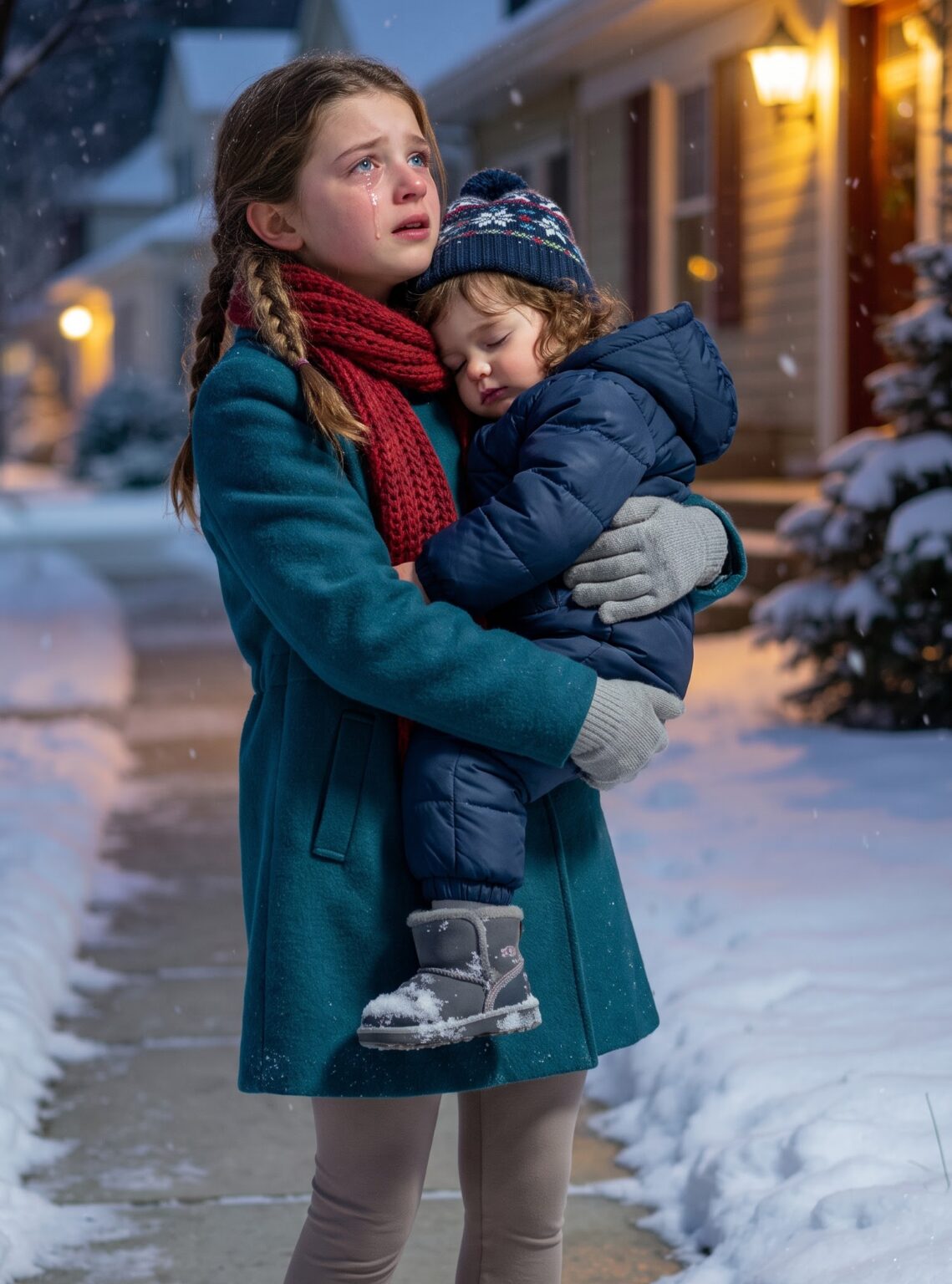
It took forty-one minutes for an officer to find them. Maddie was curled in the culvert beside Miller Road with Lily pulled tight against her chest, both of them barely responding when the flashlight found their faces.
I had believed, up until that moment, that the worst thing my parents had ever done to me was make me feel like a disappointment for most of my adult life.
I was wrong, and it took an EMT crouched over my daughters on the side of a dark road to prove it.
The paramedic working on Maddie was gentle, running warm packs along her arms while another one checked Lily’s pulse for the third time. Then his hand paused on something stiff inside Maddie’s coat, a shape that didn’t belong there, and he drew out a folded envelope with my name written across the front in handwriting I would have recognized anywhere.
I stood in the cold with my daughters wrapped in silver blankets and understood, all at once, that whatever this was, they had planned it before I had ever driven back for my children at all.
PART 2
I had grown up believing my parents were simply cold people — the kind who loved you the way you’d love a project that had turned out slightly wrong. Walter and Diane Whitfield did not hug easily. They did not say the word proud. I remembered being nine years old, bringing home a report card with five A’s on it, and watching my father set it on the counter without looking up from the newspaper. I remembered telling myself, even then, that this was simply how some people showed love — through silence, through structure, through the things they didn’t say rather than the things they did.
I had spent thirty-five years building a version of my parents I could live with. Distant, difficult, but never cruel. Never calculating. I had needed that version of them to be true, because the alternative meant admitting I had spent my whole childhood reading the wrong story.
That belief did not survive the night I found my daughters in a drainage ditch.
Daniel and I had been married for eleven years. We’d built a small, steady life — a house we were still paying off, two daughters we’d wanted badly, a marriage that had weathered the ordinary weather of two working parents raising kids during a recession. When his car was hit head-on two days before Christmas, I hadn’t thought twice about calling my mother. She had answered on the second ring.
Bring them around four, she’d texted me. We’ll keep them as long as you need. Focus on Daniel. I read that message a hundred times in the weeks that followed, looking for the moment the warmth in it had been a lie. I never found one. Whatever changed, it changed after she sent it.
Now I sat in a plastic chair in the pediatric ER while a nurse wrapped Lily in a heated blanket and checked a temperature that had dropped low enough to make the doctor’s voice change register. Maddie was pale, quiet, with raw skin across both knees and her palms from where she’d fallen while carrying her sister.
“Mommy,” she whispered when I finally reached her bed. “I tried to carry her the whole way. My arms kept giving out.”
I put my forehead against hers and didn’t trust myself to speak.
Officer Renee Castillo found me in the hallway a few minutes later, holding the envelope a paramedic had bagged as evidence without quite knowing what else to do with it. My name was written across the front in my mother’s handwriting — the same careful, slanted cursive she’d used on birthday cards my whole life, now doing something it had never done to me before.
Castillo opened it in front of me. Inside was a typed letter, unsigned but unmistakably my father’s phrasing.
“Claire, you cannot continue using your children to manipulate us. We will no longer provide childcare, financial assistance, or participate in your family emergencies. Do not bring the girls here again.”
I read it twice before the words stopped rearranging themselves.
I had never asked my parents for money. Not once, not ever, and they had agreed to watch the girls two days earlier without a single complaint. Something here did not add up, and the not-adding-up scared me more than the letter itself.
“They knew I was coming back for them,” I told Castillo. “This wasn’t a misunderstanding. They had this written already.”
She looked at the envelope, then at me, and I watched her decide to believe me before either of us had any proof.
“Do you have any idea what your parents might have meant by financial assistance?” she asked. “Had there been a request recently? A loan, anything like that?”
I told her no, truthfully, and watched her write it down anyway, the way people write down answers they suspect will matter later even when they don’t yet know why.

PART 3
Maddie coughed hard enough that a nurse came running, and for a few minutes nothing existed except the machines and the low murmur of people telling me my daughter was going to be fine, that the cold exposure hadn’t gone deep enough to cause lasting harm, that she would need warmth and rest and time.
When the doctor finally said the word “stable,” I put both hands over my face and cried in a way I hadn’t let myself cry since I was a teenager.
Castillo waited until I’d caught my breath, then asked the question I could tell she’d been holding since the envelope.
“What happened before they left your parents’ house? Did Maddie say anything?”
I asked Maddie myself, gently, once she was breathing easier.
“Grandma said we weren’t family anymore,” she said, staring at the blanket instead of at me.
I felt the floor tilt slightly.
“Why would she say something like that?”
Maddie’s mouth worked for a second before the words came out.
“She said Daddy finally did what Grandpa wanted.”
Castillo’s eyes came up to mine.
“What does that mean?”
I had no idea. Daniel was still unconscious two floors up, his surgeon having warned me he might not wake for hours. My father had never liked him — had made that clear for over a decade, mostly because Daniel had turned down a partnership in Whitfield & Sons, my father’s construction company, the year we got married. But dislike was one thing. This was something else, something with edges I couldn’t see yet.
Then Maddie said the sentence that would not leave me alone for the rest of that night.
“Grandpa said Daddy signed the papers, so you couldn’t make them watch us anymore.”
“What papers, sweetheart?”
“I don’t know. Grandpa was really mad about it.”
Castillo excused herself and called my parents’ house. This time my father picked up.
I watched her face while she talked to him, the careful blankness of someone taking notes in her head. He was telling her, apparently, that Maddie had misunderstood, that the girls had only been outside “for a minute,” that this whole thing was an overreaction.
Castillo’s voice didn’t change when she told him police already had security footage from the house across the street.
The line went dead on his end.
PART 4
The footage arrived on a patrol laptop a little after midnight, and Castillo let me watch it once, standing beside her in a corner of the ER hallway where the light was too bright and everything felt too loud.
Maddie and Lily stood on the porch for eleven minutes and forty seconds. I counted, because counting was easier than feeling it.
My mother opened the door twice. The first time, she said something to the girls I couldn’t hear and shut the door again. The second time, she reached into the doorway, tucked something into Maddie’s coat pocket, pointed toward the street, and closed the door a final time.
They watched my daughters walk away in fourteen-degree weather. They did not call me. They did not call the police. Ten minutes later, the same camera caught my father stepping outside, looking down the road in both directions, and going back inside without doing anything else.
I had to leave the hallway. I stood in a stairwell and was sick into a trash can, and Castillo waited outside the door without saying a word, which I understood later was its own kind of kindness.
When I came back out, she asked if I wanted to see it again. I said no. I have played those eleven minutes and forty seconds in my head more times than I can count since, without any help from a second viewing — the way my mother’s hand moved so casually as she tucked the envelope into my daughter’s pocket, as if she were slipping a grocery list into a coat rather than sending two children out into fourteen-degree weather. That gesture is the part I cannot unsee. Not the cold. Not the distance. Just how ordinary her hands looked doing something so deliberate.
The next morning she came back to the hospital carrying a second envelope, and this one had nothing to do with childcare.
It was from Daniel’s attorney, a man named Marcus Feld I had never heard of. Three weeks earlier, Daniel had signed documents removing my father as trustee of something called the Whitfield Family Trust.
I had never known it existed. Neither, apparently, had Daniel until recently.
The trust held four rental properties my grandfather had purchased before he died, worth just over two million dollars combined. My father had managed them as trustee since I was a child, because I’d been too young when the trust was created to hold the role myself.
According to the document Castillo handed me, that arrangement had an expiration date. Control was meant to transfer to me automatically on my thirty-fifth birthday.
My birthday had been six weeks earlier.
My father had never mentioned a word of it.

PART 5
Castillo laid one more paper in front of me before she left that morning, and it took me longer to understand than either of the others.
It was an emergency custody petition, filed by my father on December twenty-third — the same day the girls walked home in the cold — accusing Daniel and me of neglecting our children. Attached to it, photocopied and dated, was the letter that had been in Maddie’s coat pocket.
My father had described himself in the filing as a “concerned grandparent” who had “repeatedly warned” us that our household was unstable. My mother had signed a statement claiming I’d dropped the girls off unannounced and disappeared without any arrangement at all.
The security footage said otherwise. So did my phone. I handed Castillo my texts from two days before Christmas — bring them around four, we’ll keep them as long as you need — and watched her expression change as she read them.
This was not two frightened old people making a bad decision under pressure. This was a filing prepared in advance, timed to a night my father knew I would be at the hospital, built around a lie they had already written down before I’d even left the porch.
They hadn’t simply refused to watch my daughters.
They had wanted my daughters found alone.
I sat with that sentence for a long time before I could make myself believe it about people who had raised me.
Daniel woke the following afternoon, gray and weak but lucid, and when I said the words “Whitfield Family Trust” out loud, something in his face shifted before I’d finished the sentence.
“I was going to tell you after Christmas,” he said. “I didn’t want to ruin it before you knew everything.”
“Tell me what, Daniel?”
Three weeks earlier, he told me, he’d found an old tax document in a box my grandmother had left me before she passed, and something about it hadn’t sat right with him. He’d taken it to a lawyer on his lunch break, half expecting to be told it was nothing.
Marcus Feld had told him it was the opposite of nothing.
PART 6
My grandfather had set up the trust years before I was born, naming my father temporary trustee because I’d been a child at the time and someone had to manage the properties until I came of age. The document was explicit that the arrangement was never meant to be permanent. Once I turned thirty-five, everything — the properties, the accounts, the decisions — was supposed to come back to me.
My father had never told me any of this. Instead, for six weeks past my birthday, he had kept collecting management fees he was no longer entitled to and had quietly borrowed against two of the four properties using paperwork that, as far as Marcus could tell, I had never signed or seen.
Daniel had signed an acknowledgment as my spouse formalizing the transfer back to me, which was standard procedure, Marcus said, nothing that should have caused alarm. But it triggered a mandatory audit of the trust’s accounts, and the audit had turned up almost four hundred thousand dollars in withdrawals and loans that traced back to my father’s construction company.
My parents learned about the audit three days before Christmas.
“That’s why they started calling me all week,” I said slowly, the pieces sliding into place. “My mother kept asking if you’d been signing things behind her back.”
Daniel nodded, wincing as he shifted in the hospital bed. “They thought I was turning you against them. They panicked.”
What they had done with that panic was worse than I could have guessed on my own. Buried inside the trust’s original language was a clause stating that if I were ever found legally unfit to manage my children’s affairs, a court could appoint another family member to oversee any trust assets connected to my daughters’ future.
My father, Marcus explained later, believed that if he could convince a judge Daniel and I were unfit parents, he could use emergency guardianship as leverage to claw back control of the trust through the girls.
He hadn’t expected an eight-year-old to carry her sister nearly two miles. He hadn’t expected the cold to matter as much as it did.
But he had known his granddaughters were walking away from that porch alone, and he had let it happen anyway, because it served the story he needed the court to believe.
I asked Marcus, once he’d finished walking me through the clause, whether my father had understood exactly how dangerous that night could become. He was quiet for a moment before he answered.
“I think,” he said carefully, “your father convinced himself the risk was smaller than it was, because believing otherwise would have meant admitting what he was actually willing to do to get his control back. People are very good at that kind of math when the alternative is looking at themselves clearly.”
I thought about that sentence for a long time afterward. It was the closest thing to an explanation I ever got, and it was not, in any way, an excuse.
PART 7
I couldn’t make myself confront him by phone. I drove to my parents’ house four days after Christmas, once the girls were stable enough to stay with Daniel’s sister, and stood on the same porch where the security camera had caught everything.
My mother answered. She did not invite me in.
“You let them walk into traffic in the freezing cold,” I said, “so you could tell a judge we were unfit.”
“That is not what happened,” she said.
“I watched the footage, Mom.”
Her jaw tightened the exact way my father’s did. “Your father was trying to protect this family’s assets. That trust was never supposed to be yours this early.”
“It was never supposed to be his at all. Not anymore.”
She didn’t answer that. She looked past me, toward the street, the same way the camera had shown my father looking that night, and I understood in that moment that neither of them saw what they’d done as a crime. They saw it as a setback in negotiations.
“Do you understand what could have happened to them?” I asked. “Lily’s temperature was ninety-two degrees when they found her.”
“They found them,” my mother said, as if that settled something. “Nothing happened.”
“Nothing happened because Maddie carried her sister two miles in the freezing cold. That is not the same as nothing happening.”
For a moment something flickered across her face that might, in another life, have become regret. Then my father’s voice came from somewhere behind her, telling her to close the door, and she did.
I left without getting anything close to an apology.
What broke the case open completely wasn’t the confrontation. It was a set of deleted text messages Castillo’s department recovered between my parents from that same week, restored from a cloud backup neither of them had thought to clear.
My mother, ten minutes after closing the door on my daughters: They’ll get scared and call Claire.
My father, six minutes later: Let them get far enough first. We need proof she left them here without arranging anything.
Twenty-six minutes after that, my mother again: Still no call. Good.
I read those three lines once, standing in Castillo’s office with Marcus beside me, and then I never asked to see them again. Some sentences you only need to read a single time for them to live in you permanently.
The emergency custody petition was dismissed within the week. A judge issued a no-contact order protecting Maddie and Lily from both my parents. My father was removed from every remaining position tied to the trust while forensic accountants combed through eight years of his company’s books.

PART 8
I did not want revenge. Sitting in that courthouse hallway, watching my father avoid my eyes while his own attorney whispered something to him, I understood clearly that revenge was never going to feel like enough, and pursuing it would only keep me tethered to two people I needed to let go of.
What I wanted was distance, and accountability, in that order.
So I made the choice that cost me the most: I gave the prosecutors everything. The texts. The footage. The petition. My own statement, on the record, about the letter in my daughter’s coat pocket. I knew, giving it to them, that this meant there would be no quiet version of this story, no private family reckoning behind closed doors. My parents would be charged, publicly, and everyone who had ever known us as a family would eventually learn why.
I also signed off on transferring day-to-day management of the trust to an independent trustee rather than taking it on myself immediately, even though Marcus told me I was legally entitled to. I didn’t trust myself yet to separate what was best for the properties from what I still, somewhere underneath all of it, wanted to prove to a father who would probably never acknowledge it either way.
There was a version of that week where I could have quietly settled everything — taken the properties, let the custody petition die on its own, avoided the exposure of a public case. Marcus told me as much, almost as a formality, because he was required to lay out every option. I told him no before he’d finished the sentence. Quiet had already cost my daughters too much.
Months later, prosecutors charged both my parents with child endangerment and filing false statements to the court. My father faced additional charges connected to the trust — records falsification, unauthorized loans against property he no longer had the right to encumber. The criminal case moved faster than I expected. The civil proceedings over the trust took the better part of a year.
I did not attend every hearing. I attended the ones that mattered to my daughters’ safety, and let the rest happen without me in the room. My father took a plea on the financial charges rather than face trial, which meant no jury ever heard the full accounting of what he’d done, and there were nights I resented that quiet ending more than I expected to. But my mother’s charges went to trial, and I did sit through that one, three rows behind the prosecution’s table, close enough to watch her hands shake around a water glass every time the deleted messages came up on the screen. I did not feel triumphant watching her. I felt something closer to grief for a version of her that had apparently never existed.
PART 9
Maddie struggled longer than Lily did, which I understood but still ached over every single day. For weeks she wouldn’t let her sister out of sight, not even in our own living room. If Lily fell asleep in the car, Maddie would reach over and touch her arm, checking, over and over, that she was warm.
We found a therapist who specialized in childhood trauma, a woman named Priya who was patient in a way I tried to learn from. In one of the early sessions, Priya asked Maddie to draw the night on the road, and Maddie drew herself twice the size of Lily, arms wrapped all the way around her sister like a shield. When Priya asked why she’d drawn herself so big, Maddie said, “Because I had to be big enough for both of us,” and I had to step out into the hallway so she wouldn’t see me cry.
Slowly, over months, Maddie came to understand something no eight-year-old should ever have had to learn in the first place: that keeping her sister alive on a dark road had never been her job to begin with. That she had already done far more than any child should ever be asked to do, and none of it had been her fault.
Daniel and I went through our own quieter reckoning during those months. There were nights I lay awake resenting him for not telling me about the trust the moment he found it, for carrying that secret through a week that ended with our daughters in a ditch. He carried his own version of that guilt without my having to hand it to him — I watched it settle into him at the dinner table, in the long pauses before he answered simple questions. We went to two sessions with Priya ourselves, separate from Maddie’s, before either of us said out loud that we weren’t angry at each other so much as we were angry that the people who should have protected our family had instead used it as leverage. Naming that difference mattered more than I expected it to.
Daniel recovered fully from the surgery, though the scar along his ribs stayed silver and raised, a reminder every time he changed his shirt of the night that started all of this. We didn’t talk to my parents again. The no-contact order made that decision for us at first, and by the time it expired, neither of us wanted it lifted.
I kept my grandfather’s properties, eventually, once the independent trustee’s audit closed and everything came back clean under new management. I hired a property manager who had no history with my family and no opinions about what I “should” do with money that had, in a strange way, cost me more than it was worth.
PART 10
The following Christmas, we stayed home. Daniel strung lights along the porch railing himself, slower than he used to, but steady. Lily helped decorate cookies, more frosting on her hands than the tray. Maddie sat beside me on the couch with a blanket around her shoulders, watching the lights blink on the tree.
“Mom?”
“Yeah, baby?”
“If somebody says we’re not family anymore, they’re wrong. Right?”
I pulled her closer, and Lily too, until both girls were tucked against me.
“Family isn’t someone who controls you, or uses you, or shuts a door on you when you need them most,” I told her. “Family is who stays.”
She looked over at Daniel, stringing the last of the lights with careful hands.
“So we’re still a family.”
“We always were,” I said. “We just found out who wasn’t.”
That night, when I locked our front door, it felt different than it ever had before. Not like shutting someone out.
Like finally protecting the people who belonged inside.
Disclaimer: This fictional story is for entertainment only. It does not represent any person or organization and does not encourage inappropriate behavior. Created with AI assistance.

Related Posts
Couple Adopts Rescue Dog Before Even Meeting Him But When The Door Opens To Reveal Him They ‘Lose-it’

A Woman Paid Her 79-Year-Old Neighbor’s Electric Bill When She Couldn’t Afford It – The Next Day, She Opened Her Door, and What She Saw Made Her Knees Go Weak