My 8-Year-Old Gave Our Elderly Neighbor Her Old Bike—The Next Morning, Our Entire Yard Was Covered in Bicycles
Part 1 — The Morning Our Lawn Disappeared
Sunday mornings in our house were usually slow.
No alarms. No rushing. No school lunches to pack. No reason to get out of bed before the smell of coffee made it impossible to sleep any longer.
So when my husband grabbed my shoulder at exactly seven in the morning, I knew something unusual had happened.
“You need to get up.”
I opened one eye and stared at him.
“On a Sunday?”
“Just come look outside.”
Something in his voice made me sit up.
I crossed the bedroom, pulled the curtain aside—and froze.
For several seconds, my sleepy brain simply refused to understand what I was looking at.
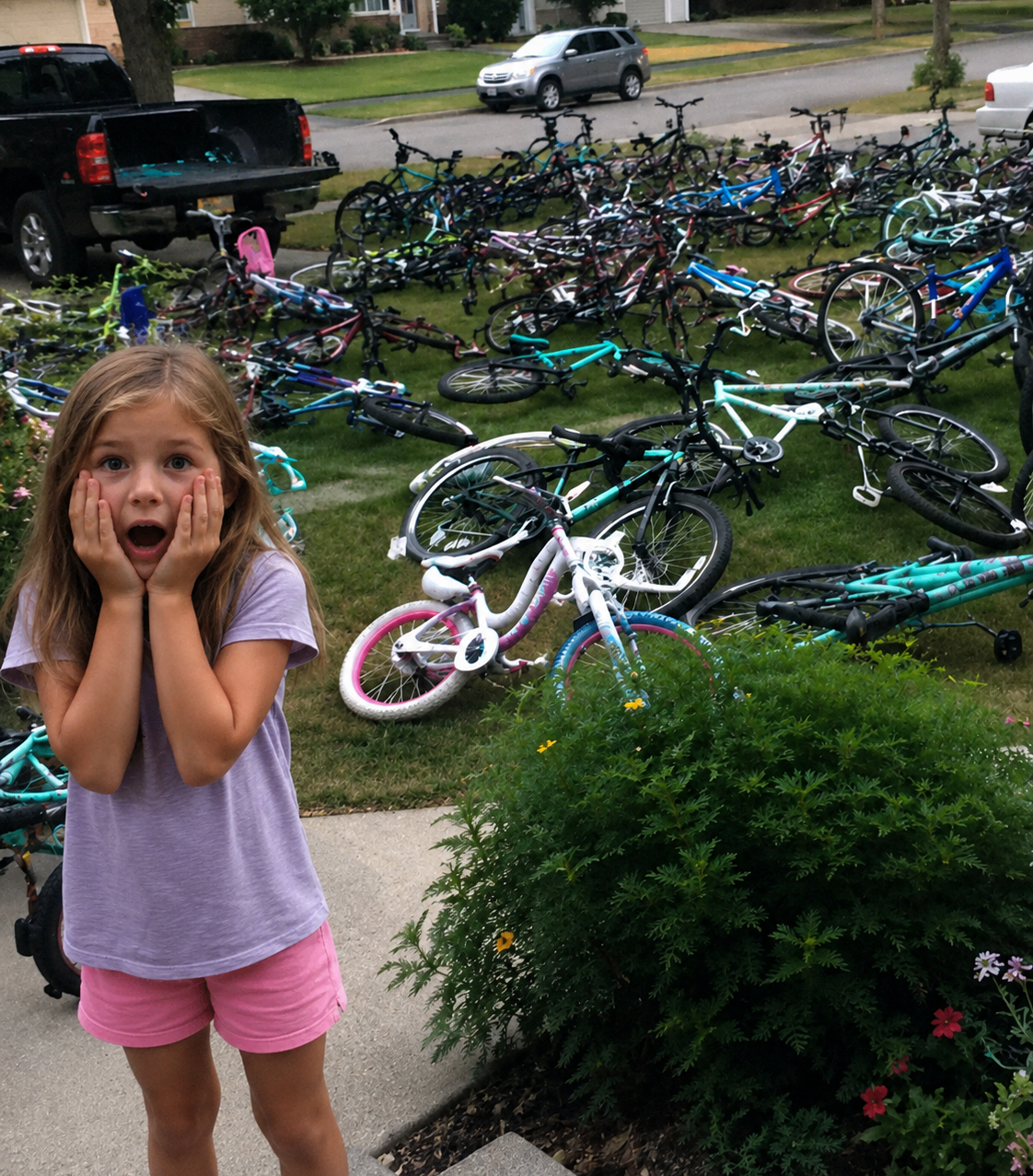
Our lawn had vanished.
In its place were bicycles.
Dozens of them.
Tiny children’s bikes with training wheels were scattered beside old mountain bikes. A faded beach cruiser rested against the porch. Several rusty bicycles stood in uneven rows across the grass, while others leaned against the fence.
One had somehow ended up beside our mailbox.
And right in the middle of this strange bicycle invasion stood Walter, our 74-year-old neighbor from across the street.
He looked up, saw me at the window, and cheerfully waved.
I slowly turned toward my husband.
“Why is Walter standing in our yard surrounded by approximately fifty bicycles?”
My husband rubbed the back of his neck.
That was when I knew he knew something.
“There’s a small detail I may have forgotten to mention.”
Whenever your spouse begins a sentence that way, prepare yourself.
“What did you do?”
“Nothing.”
I pointed toward the window.
“Our front yard looks like a used bicycle warehouse.”
“I know.”
“You know?”
He gave me an apologetic look.
“Walter asked if he could borrow a little space.”
“A little space?”
“He said he needed somewhere to put some bikes.”
I looked outside again.
At that exact moment, a minivan stopped at the curb. A woman opened the back and began unloading another bicycle.
Then another.
Then another.
I stared at my husband.
“Apparently Walter and I define ‘some’ very differently.”
He winced.
“I thought he meant maybe two or three.”
“Well, that woman just brought us bicycle number fifty-one.”
Twenty-four hours earlier, our lawn had been completely empty.
And somehow, all of this had started because of our eight-year-old daughter, Molly.
Molly had never understood the idea that adults and children were supposed to live in separate social worlds.
If someone was nearby, she talked to them.
The mail carrier knew the name of her favorite teacher.
The woman at the corner store knew Molly wanted to become either a veterinarian, an astronaut, or “someone who owns a lot of dogs.”
And Walter knew practically everything else.
Walter lived alone across the street.
He was quiet, gentle, and always seemed slightly surprised when Molly appeared beside him with another question.
If he walked outside to collect his mail, Molly found him.
If he watered the flowers beside his porch, Molly wandered over.
If he sat outside in the evening, she eventually crossed the street and started talking.
Over time, I noticed that Walter often watched Molly and the other neighborhood children ride their bicycles up and down the street.
He never joined their conversations.
He simply watched.
Sometimes from his driveway.
Sometimes from his porch.
There was always a softness in his expression that I didn’t fully understand.
A few weeks earlier, Molly had stopped her bicycle beside him.
“Walter, did you ride bikes when you were a kid?”
His face had brightened.
“Oh, I’ve had more bicycles in my life than you could imagine.”
Molly looked impressed.
“More than I’ve had?”
“Much more.”
She seemed to think about that answer for several seconds before pedaling away.
I heard the exchange from our porch and forgot about it almost immediately.
Molly didn’t.
That became obvious the following Saturday.
I looked out the window and saw her pushing her old red bicycle toward the street.
“Molly, where are you going?”
She stopped.
“Walter’s house.”
“With your bike?”
“Yes.”
“Why?”
“I’m giving it to him.”
That surprised me.
Molly had recently outgrown that bicycle, but she had refused every suggestion that we donate it.
It wasn’t worth much financially.
The red paint was scratched in several places. The rubber grips were worn smooth. The brakes barely worked, and the bell seemed to ring only when it felt cooperative.
But Molly loved that bike.
It was the bicycle on which she’d learned to balance.
The bicycle I’d run beside while holding the back of the seat.
The bicycle she’d crashed into our hedge twice before finally learning how to stop.
To her, those scratches weren’t damage.
They were memories.
“You wouldn’t let Dad and me donate it,” I reminded her.
“I know.”
“But now you want Walter to have it?”
She nodded.
“Why?”
Molly looked at me with the patient expression children sometimes give adults who are struggling to understand something painfully obvious.
“Because his garage is too empty.”
I blinked.
“What does that mean?”
Apparently, during one of their many conversations, Walter had mentioned that his garage felt too empty these days.
Molly had taken the comment literally.
An empty garage needed something inside it.
And she had something she no longer used.
Problem solved.
“Are you absolutely sure?” I asked.
She placed both hands on the handlebars.
“Yes. Walter should have it.”
So I followed her across the street.
Neither of us understood that she wasn’t simply giving away an old bicycle.
She was about to reopen a part of Walter’s life that had been closed for three years.
Part 2 — The Little Red Bicycle
Molly knocked on Walter’s front door.
When he opened it, he smiled at her automatically.
Then he noticed the bicycle.
His expression changed.
“What have you got there?”
Molly pushed the handlebars toward him.
“It’s for you.”
Walter looked from the bicycle to Molly.
“For me?”
“Yes. You said your garage was empty.”
He didn’t answer.
Molly continued matter-of-factly.
“The brakes aren’t very good, though. And the bell only works sometimes.”
Walter still said nothing.
He stared at that little red bicycle for so long that I began wondering whether we’d made a mistake.
“Walter?”
He seemed to return from somewhere far away.
Slowly, he crouched beside the bicycle and touched the chain.
“You want me to repair it?”
Molly shrugged.
“If you want to.”
I watched his face carefully.
Something had changed behind his eyes.
There was happiness there, but also something heavier. Something that looked almost like an old memory had suddenly walked through his front door without warning.
Walter stood and took the handlebars.
“Okay,” he said quietly. “I’ll take care of it.”
Molly smiled.
“Good. Now your garage won’t be empty anymore.”
Walter looked toward his open garage and then back at her.
“No,” he murmured. “I suppose it won’t.”
We went home.
I assumed the story was over.
Molly had finally parted with her old bicycle, Walter now had something to tinker with, and life would continue normally.
I could not have been more wrong.
That evening, Walter came to our house and spoke briefly with my husband.
I was upstairs helping Molly get ready for bed, so I never heard the conversation.
Apparently, my husband didn’t think the discussion was important enough to mention.
Which brought us back to Sunday morning—and our lawn disappearing beneath dozens of bicycles.
“So exactly when,” I asked while getting dressed, “did Walter ask permission to use our yard?”
“Last night.”
“And you didn’t think I should know?”
“I was going to tell you.”
“When?”
He hesitated.
I folded my arms.
He sighed.
“Fine. I forgot.”
Another vehicle stopped outside.
A man climbed out and lifted two bicycles from the back.
I pointed toward the window.
“Are more people coming?”
“I have no idea.”
“You didn’t ask?”
“Walter said he needed space for a few donated bikes.”
“A few?”
My husband looked outside.
“I think the situation developed.”
By eight o’clock, cars were still arriving.
Eventually, irritation gave way to curiosity.
I went downstairs and walked outside.
Molly ran behind me.
The second she reached the front porch, she stopped dead.
Her eyes widened.
“Whoa.”
I laughed despite myself.
“That is exactly what I said.”
The yard looked even more ridiculous from ground level.
Someone had brought four bicycles in a minivan.
A man was carrying two old mountain bikes toward the grass.
Near our porch sat a tiny purple bicycle with training wheels.
Molly slowly turned around.
“Does Walter own all these now?”
“I certainly hope he’s about to explain that.”
We found Walter examining the tire of an old bicycle.
“Walter?”
He glanced up.
“Good morning.”
I gestured broadly toward my former lawn.
“Would you mind explaining why it looks as though every bicycle within twenty miles has decided to move into my yard?”
Walter stood.
For the first time, he looked slightly embarrassed.
“I may have underestimated how many people would respond.”
“Respond to what?”
Before he could answer, another car rolled to the curb.
The driver called through an open window.
“Walter?”
Walter raised his hand.
“Over here.”
“We brought three.”
“Put them wherever you can find room.”
I stared at him.
“Three more?”
Walter gave me a helpless little smile.
“Apparently.”
Then Molly suddenly grabbed my hand.
“Mom! Look!”
Walter turned toward his house, disappeared inside his garage, and returned pushing a small red bicycle.
Molly gasped.
It was hers.
And yet it looked completely different from the tired little bike she’d delivered the day before.
The tires looked nearly new.
The chain was clean.
The brakes worked.
Even that temperamental little bell produced a bright, perfect ring when Walter pressed it.
Molly ran toward him.
“You fixed everything!”
“Couldn’t sleep much last night,” Walter said.
She squeezed one brake.
“You fixed this!”
“Yes.”
She rang the bell.
“And the bell!”
“That too.”
She spun the front wheel and watched it turn smoothly.
Then her excitement gave way to confusion.
“But I gave it to you.”
Walter nodded.
“You did.”
“Then why did you make it nice again?”
Walter rested one hand on the handlebars and looked across our crowded lawn.
Bicycles stretched almost from our porch to the street.
More neighbors were approaching with still more bikes.
Walter smiled.
“Because your bicycle brought me all of these.”
Molly stared at him.
“What do you mean?”
So did I.
Because I still had absolutely no idea what was happening.
But I was beginning to understand that Molly’s little red bicycle had touched something much deeper than an empty garage.

Part 3 — The Story Walter Had Never Told Us
“Walter,” I said gently, “I think you need to explain this from the beginning.”
He nodded.
His hand remained on Molly’s bicycle.
“I used to repair bikes.”
Molly tilted her head.
“For work?”
“Sometimes. Mostly on the side.”
Walter told us that for nearly thirty years, neighbors had brought bicycles to him.
Flat tires.
Loose chains.
Worn brake pads.
Bent handlebars.
If the problem could be fixed, Walter usually found a way.
But the repairs were only part of the story.
“Every spring,” he continued, “my wife and I used to collect bicycles people didn’t need anymore.”
His voice softened when he mentioned his wife.
“We’d ask friends. Neighbors. Parents whose children had outgrown their bikes. Anyone who had an old bicycle sitting in a garage collecting dust.”
Molly looked around our yard.
“Like these?”
Walter smiled.
“Exactly like these.”
“What did you do with them?”
“I repaired them.”
“All of them?”
“As many as I could.”
Once the bicycles were safe and working again, Walter and his wife gave them to children whose families couldn’t easily buy new ones.
Some years, they collected only a few.
Other years, Walter said his garage became so crowded he had to turn sideways just to reach his workbench.
“My wife did the talking,” he told us. “She found the bicycles, organized everything, kept track of families. I stayed in the garage and worked.”
“That sounds like you made a good team,” I said.
His smile faded.
“We did.”
Then he looked across the street at his quiet house.
“She died three years ago.”
Molly immediately became still.
Walter didn’t dramatize the sentence.
He didn’t have to.
Those five words explained everything.
After his wife died, Walter stopped repairing bicycles.
Not gradually.
Completely.
The tools remained where he’d left them.
The workbench collected dust.
The garage that had once been crowded with tires, handlebars, spare chains, voices, and laughter became almost empty.
Without his wife beside him, Walter couldn’t bring himself to continue.
“She was the reason it felt like more than fixing things,” he said.
I thought about all the times I’d seen him standing in his driveway watching Molly and the other children ride past.
Suddenly, those moments looked different.
He hadn’t simply been watching kids play.
He’d been remembering.
Molly placed one hand on her red bicycle.
“So that’s what you meant when you said the garage felt empty?”
Walter nodded.
“In more ways than one.”
She looked up at him.
“And my bike made you want to start again?”
Walter’s expression softened.
“Your bike reminded me that I still knew how.”
After Molly left the previous afternoon, Walter had rolled the bicycle into his garage.
At first, he’d planned to repair nothing more than the brakes.
Then he noticed the tires.
They needed replacing.
While changing those, he saw how dirty the chain had become.
So he cleaned it.
Then he tested the bell.
That needed fixing too.
One repair led to another.
And somewhere in the middle of it all, Walter found himself standing at his old workbench again.
The tools were back in his hands.
The familiar smell of grease and rubber surrounded him.
The quiet garage no longer felt quite so empty.
“It felt good,” he admitted.
When he finished, he stepped back and looked at Molly’s restored bicycle.
Then he took a picture.
And on impulse, he posted it in the neighborhood Facebook group.
He wrote a simple message explaining that he was thinking about repairing donated bicycles again.
If anyone had an old bike sitting unused in a garage or shed, perhaps he could fix it and find another child who needed it.
Walter expected four or five replies.
Maybe ten if he was lucky.
I looked across the packed lawn.
“How many people answered?”
He cleared his throat.
“More than sixty.”
I laughed.
My husband, who had finally joined us outside, immediately pointed at Walter.
“In my defense, he never told me there were going to be sixty bicycles.”
Walter chuckled.
“In my defense, I didn’t know either.”
Molly looked around in amazement.
“You’re going to fix every one of them?”
Walter studied the bikes.
“I’ll do my best.”
“By yourself?”
For the first time that morning, Walter looked overwhelmed.
Now that the excitement had settled, the scale of the task was impossible to ignore.
Flat tires.
Rusted chains.
Damaged seats.
Bent wheels.
Missing pedals.
There were months of work scattered across our lawn.
Then something unexpected happened.
The woman who had brought four bicycles approached Walter.
“I saw your Facebook post last night,” she said. “My husband repairs bikes sometimes. I’m sure he’d help if you need another set of hands.”
A man standing nearby overheard her.
“I can do tires.”
Another neighbor offered spare parts.
Someone else said he had tools Walter could borrow.
Within minutes, people were volunteering.
One person offered storage space.
Another offered to help organize the donated bicycles.
A third said she knew families who might need them once they were repaired.
As I listened, I realized the yard no longer looked like a pile of junk.
It looked like the beginning of something.
Walter had thought he was restarting an old hobby.
Instead, the neighborhood had decided to restart it with him.
Part 4 — Walter’s Garage Came Back to Life
Molly tugged on Walter’s shirt.
“Can I help too?”
He looked down at her.
“Do you know anything about repairing bicycles?”
She shook her head.
“No.”
Walter pretended to think seriously.
“Well, that’s a problem.”
Molly’s face fell for half a second.
Then Walter smiled.
“I guess I’ll have to teach you.”
Her entire face lit up.
“What do I do?”
He pointed toward a dirty bicycle nearby.
“Start by cleaning that frame.”
Molly ran toward it like she’d just been hired for the most important job in town.
I stood there watching Walter follow her.
I’d known him for years.
Or at least I thought I had.
The Walter I knew was the quiet man who waved from across the street.
The man who watered flowers.
The man who sat alone on his porch.
But that morning, I saw another version of him.
He moved between bicycles with confidence.
He opened old boxes of tools.
He examined wheels and adjusted seats.
He answered questions.
He laughed.
He gave instructions.
People began gathering around him as naturally as though they’d been doing it for years.
By lunchtime, part of our driveway had become an unofficial bicycle repair shop.
My husband brought out folding chairs.
I made sandwiches and lemonade.
Someone arrived with a box of spare inner tubes.
Another neighbor brought a tool kit.
Molly stayed beside Walter almost the entire time.
She asked questions constantly.
“What does that do?”
“Why does the chain fall off?”
“How do you know if the brakes are good?”
“Why is that wheel crooked?”
At one point, I walked over and apologized.
“I’m sorry. She can ask approximately seven thousand questions per hour.”
Walter shook his head.
“Don’t apologize. She asks good questions.”
A little later, I saw him showing her how a bicycle chain sat on the gears.
Molly watched his hands carefully, concentrating as if he were teaching her some secret skill adults had been hiding from children.
Then she asked something that made Walter stop.
“Did your wife know how to fix bicycles too?”
His expression softened.
“She knew enough.”
“Was she better at it than you?”
Walter laughed.
“She was definitely better at telling me when I was doing something wrong.”
Molly giggled.
Walter did too.
Then, for one brief second, I saw him glance across the street toward his house.
His smile remained, but something passed through his eyes.
And suddenly I wondered how long it had been since his garage had sounded like this.
How long since someone stood beside his workbench asking questions?
How long since neighbors had called his name from the driveway?
How long since a child had waited eagerly for him to repair something?
Grief doesn’t always announce itself with tears.
Sometimes it looks like a closed garage door.
A dusty toolbox.
A chair on a porch where someone sits alone watching other people’s lives move past.
Walter had lived across the street from us for years, and I had never understood how much silence he’d been carrying.
Molly had noticed only one thing.
His garage looked empty.
And because she was eight, her solution had been wonderfully simple.
Give him something to put inside it.
By late afternoon, we finally started seeing patches of grass again.
Neighbors had volunteered garages, sheds, and storage space for the bicycles Walter couldn’t keep immediately.
The mountain of donations gradually disappeared from our yard.
But Molly’s red bicycle remained beside Walter.
She pointed toward it.
“Are you giving mine to another kid?”
Walter shook his head.
“No.”
“But I gave it to you.”
“You did.”
“So it’s yours.”
“Yes.”
Molly frowned.
“Then what are you going to do with it?”
Walter looked down at the little red bicycle for a long moment.
“I think I’m going to keep this one.”
“Why?”
He placed his hand gently on the seat.
“Because this bicycle is special.”
Molly smiled.
I had to turn away for a moment.
Because I finally understood what Walter couldn’t quite put into words.
The bicycle itself wasn’t special because of its tires, brakes, bell, or scratched red frame.
It was special because it had found him at exactly the moment he needed to be reminded that part of his old life was still waiting for him.

Part 5 — The Bicycles Began Leaving
The huge Sunday collection could have been a one-time event.
It wasn’t.
Over the next several weeks, bicycles continued appearing outside Walter’s garage.
Never sixty at once again, thankfully.
Usually one.
Sometimes two or three.
A parent would leave an old bike beside his driveway.
A neighbor would drop off a box of parts.
Someone would call because they’d found a bicycle in the back of a shed that nobody had ridden in years.
And gradually, something even better began happening.
The bicycles started leaving.
Not as broken donations.
As working bicycles.
One afternoon, I watched a little boy walk away beside a blue bike that looked almost new.
Another day, a girl rode down the street on a purple bicycle with a basket in front.
Every time a repaired bike disappeared from his driveway, Walter seemed different.
Not dramatically.
He simply stood straighter.
Moved faster.
Smiled more easily.
The man who had spent three years watching children ride bicycles from his porch was now helping put more children on bicycles himself.
And Molly had officially become his assistant.
At least, according to Molly.
Her actual responsibilities included cleaning frames, sorting tools, carrying small parts, and testing every bell within reach approximately fourteen times.
Our neighborhood became very familiar with the sound of bicycle bells that summer.
One afternoon, I walked across the street and found Walter adjusting a set of brakes.
Molly sat nearby polishing a bicycle frame.
“I hope you understand what my daughter has dragged you into,” I teased.
Walter glanced toward her.
“I think I do.”
Then his eyes moved toward the garage.
I followed his gaze.
There, hanging carefully on the wall, was Molly’s little red bicycle.
Not buried beneath boxes.
Not leaning forgotten in a corner.
Displayed.
Safe.
Kept.
“You know,” I said, “we tried to convince her to donate that bike months ago.”
Walter smiled.
“I’m glad she waited.”
I looked at the small red frame hanging above his workbench.
“So am I.”
Because now I understood.
Molly had believed she was giving something away.
In reality, she had returned something.
Not the bike.
Something much larger.
For nearly thirty years, Walter and his wife had built a small tradition together.
They took bicycles people no longer wanted and repaired them for children who needed them.
It had been their spring ritual.
Her conversations.
His tools.
Her organizing.
His repairs.
Their shared purpose.
Then she was gone.
And without her, Walter didn’t simply lose his wife.
He lost the version of himself that had existed beside her.
So he closed the toolbox.
The bicycles stopped coming.
The workbench gathered dust.
The garage emptied.
And perhaps the hardest part was that the world continued moving anyway.
Children still raced bicycles down the street.
Parents still taught kids how to balance.
Bells still rang.
Tires still needed air.
But Walter stayed on the porch and watched.
Until one Saturday afternoon, an eight-year-old girl arrived pushing a scratched red bicycle.
She knew none of his history.
She didn’t know about the three decades of repairs.
She didn’t know about his wife.
She didn’t know what the empty garage represented.
She simply knew that Walter had said it felt too empty.
And she owned something she loved but no longer needed.
So she gave it to him.
Part 6 — What Molly Really Gave Him
I’ve thought about that Sunday many times since.
About waking up to bicycles covering every inch of our front yard.
About Walter standing among them looking both proud and slightly terrified.
About Molly racing outside and discovering her battered red bicycle transformed overnight.
At first, I believed Walter had repaired Molly’s bicycle.
That was the obvious story.
An elderly neighbor receives an old bike from a little girl and fixes it.
Sweet.
Simple.
Except that wasn’t really what happened.
Walter fixed the bicycle.
But Molly, without realizing it, helped repair something in Walter too.
She gave him an object connected to childhood, movement, and memory.
He placed it on his old workbench.
He picked up tools he’d avoided for three years.
One repair led to another.
One photograph became a Facebook post.
One Facebook post brought more than sixty donated bicycles to our lawn.
Those bicycles brought neighbors.
The neighbors brought tools.
Then volunteers.
Then children.
And suddenly, Walter’s garage wasn’t silent anymore.
There were voices again.
Questions again.
Grease on his hands again.
Children waiting for bicycles again.
There was purpose again.
Molly never planned any of that.
Children rarely understand the full weight of the kindness they offer.
She didn’t approach Walter thinking, “I’m going to help this grieving man reconnect with something he once loved.”
She simply noticed something adults had overlooked.
An empty garage.
A lonely neighbor.
A bicycle she no longer rode.
To her, the answer was obvious.
“Walter can have mine.”
Sometimes kindness begins exactly like that.
Not with money.
Not with grand speeches.
Not with perfect understanding.
Sometimes it begins because one person notices an emptiness in another person’s life and offers whatever small thing they happen to have.
Molly gave Walter a bicycle she’d outgrown.
Walter gave that bicycle new tires, working brakes, a clean chain, and a bell that finally rang properly.
But the gift didn’t end there.
That little bicycle brought his tools back out.
It brought his neighbors into his driveway.
It brought children to his garage.
It brought laughter into a space that had been quiet for three years.
And eventually, it brought Walter himself back.
Molly’s red bicycle still hangs on the wall of his garage.
He never gave it away.
I don’t think he ever will.
Because every other bicycle that enters that garage is there partly because of that one.
Every repaired bike a child rides away on carries a tiny piece of the kindness that started everything.
Walter once told Molly his garage felt empty.
She thought he meant there weren’t enough things inside it.
Maybe, in a way only an eight-year-old could understand, she was right.
Because now the garage is full again.
Full of bicycles.
Full of tools.
Full of people.
Full of memories that no longer hurt quite as sharply.
And most importantly, full of reasons for Walter to open that door every morning.
All because one little girl looked at something she loved, looked at someone who seemed lonely, and decided he needed it more than she did.
Note: This story is a work of fiction inspired by real events. Names, characters, and details have been altered. Any resemblance is coincidental. The author and publisher disclaim accuracy, liability, and responsibility for interpretations or reliance. All images are for illustration purposes only.