Can You Solve This Tricky Math Problem That Stumps Most People?
Math puzzles like this one tend to spread quickly online because they sit in a very interesting space between simplicity and confusion. At first glance, everything looks like basic arithmetic that anyone could solve in seconds, yet the moment you apply standard addition, the sequence stops making sense. That gap between expectation and reality is exactly what pulls people in and keeps them thinking long after they’ve seen the problem.
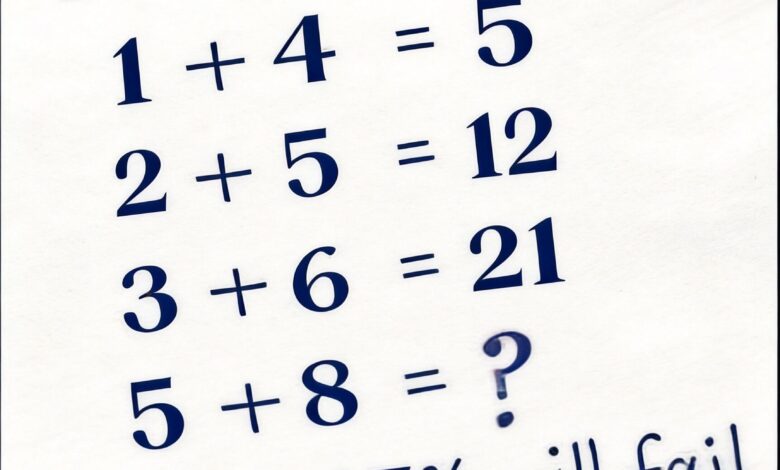
The sequence begins innocently enough with 1 + 4 = 5. Nothing unusual appears here, and most people would naturally accept it as straightforward addition. It feels like the kind of warm-up question you’d see in elementary school, designed to build confidence rather than challenge it. But that sense of comfort is intentional in puzzles like this, because it sets up a contrast with what follows.
When the next line appears, 2 + 5 = 12, the structure starts to break away from normal arithmetic. A quick mental check tells you that 2 plus 5 should be 7, not 12. That immediate contradiction forces the brain to shift gears. Instead of simply calculating, you begin searching for hidden rules or patterns that might explain the unexpected result. This is where the puzzle stops being about math in the traditional sense and starts becoming a test of reasoning and adaptability.
The third line, 3 + 6 = 21, deepens the confusion even further. Again, basic addition gives 9, not 21. At this point, most people realize that each equation is not independent. Instead, they are likely connected through some evolving rule, meaning the answer to each step may depend on previous results or a hidden operation that modifies the standard rules of arithmetic.
This is where different interpretations begin to emerge. One common approach is to assume that the puzzle is cumulative, meaning each new line builds upon the result of the previous one. Under this idea, the numbers are not just being added together but are interacting with earlier answers in a chain-like progression. For example, someone might notice that the second line could be interpreted as 2 + 5 × 1, if the first result is used as a multiplier. That leads to a growing pattern where each step depends on what came before it, creating a recursive structure rather than isolated calculations.
Another popular interpretation is that the puzzle hides a pattern involving multiplication combined with addition. In this view, each result is generated by multiplying the two numbers and then adding one of them again. So 1 + 4 becomes 1 × 4 + 1, which equals 5. Then 2 + 5 becomes 2 × 5 + 2, which equals 12. Then 3 + 6 becomes 3 × 6 + 3, which equals 21. This pattern feels satisfying to many solvers because it is consistent and simple once discovered, and it avoids needing any reference to previous lines.
Following that same logic, the final expression 5 + 8 would be calculated as 5 × 8 + 5, which results in 45. For many people, this becomes the “cleanest” solution because it maintains a consistent rule across every step without requiring memory of earlier results or more complex recursion. It also feels intuitive once revealed, which is a key feature of many viral puzzles: the solution should feel obvious in hindsight, even if it was difficult to see initially.
However, not everyone agrees on this interpretation. Some people argue that the puzzle is designed to encourage cumulative thinking rather than isolated formulas. In that version, each new line incorporates the previous result into the next calculation. For example, after reaching 21, the final equation might be interpreted as 5 + 8 + 21, which leads to 34. This approach emphasizes progression and accumulation, treating the puzzle more like a growing sequence than a fixed rule.
Others take even more creative liberties, suggesting entirely different mathematical frameworks. Some attempt to apply exponentiation, factorials, or alternative base systems. In online discussions, it’s not unusual to see answers like 32, 45, 110, or even binary interpretations such as 1101. While these answers may not always align with the simplest intended pattern, they highlight something important: puzzles like this often reflect how flexible human thinking can be when faced with ambiguity.
What makes this type of problem so engaging is not just the numbers themselves, but the way they force people to question assumptions. Most of us are trained from early education to apply fixed rules: addition means combining quantities in a straightforward way. But puzzles like this deliberately break that expectation. They remind us that rules can change depending on context, and that solving a problem sometimes requires stepping outside of the obvious interpretation.
There is also a psychological aspect to why these puzzles spread so widely online. People enjoy the feeling of being challenged just enough to be curious, but not so much that the problem becomes impossible. When someone eventually discovers a pattern, it creates a small moment of reward, almost like solving a mystery. That satisfaction is powerful enough that people often share the puzzle with others, hoping to recreate that same experience of discovery.
At the same time, disagreements over the “correct” answer fuel even more engagement. In comment sections and forums, users debate different solutions, explain their reasoning step by step, and sometimes defend their interpretation quite passionately. This transforms a simple arithmetic sequence into a social experience, where the value lies not only in the solution but in the discussion around it.
From a learning perspective, puzzles like this are useful because they encourage flexible thinking. Instead of applying a single method mechanically, you are forced to test different hypotheses, compare outcomes, and adjust your understanding based on new information. This mirrors real problem-solving in fields like science, engineering, and even everyday decision-making, where the correct approach is not always immediately obvious.
It also highlights how important assumptions are in mathematics. A small change in interpretation can lead to completely different answers, all of which may be logically consistent within their own framework. That is why clarity in problem statements is so important, especially in formal settings. Without clear rules, multiple solutions can exist at the same time, each valid from a different perspective.
In the end, the real appeal of this puzzle is not the final number, whether it is 45, 34, or something else entirely. The appeal lies in the process of getting there. It is about noticing patterns, questioning initial instincts, and exploring alternative ways of thinking. It turns a simple-looking arithmetic problem into a deeper exercise in logic, creativity, and perception.
That is why puzzles like this continue to circulate widely online. They are easy to understand at first glance, but rich enough to support multiple layers of interpretation. And in a world filled with fast-scrolling content, anything that makes people stop, think, and debate naturally stands out.
So while the equation 5 + 8 may look simple, the discussion around it shows something much more interesting: that even basic numbers can become a doorway into complex thinking, and that sometimes the most engaging problems are the ones that don’t have just one agreed-upon answer.