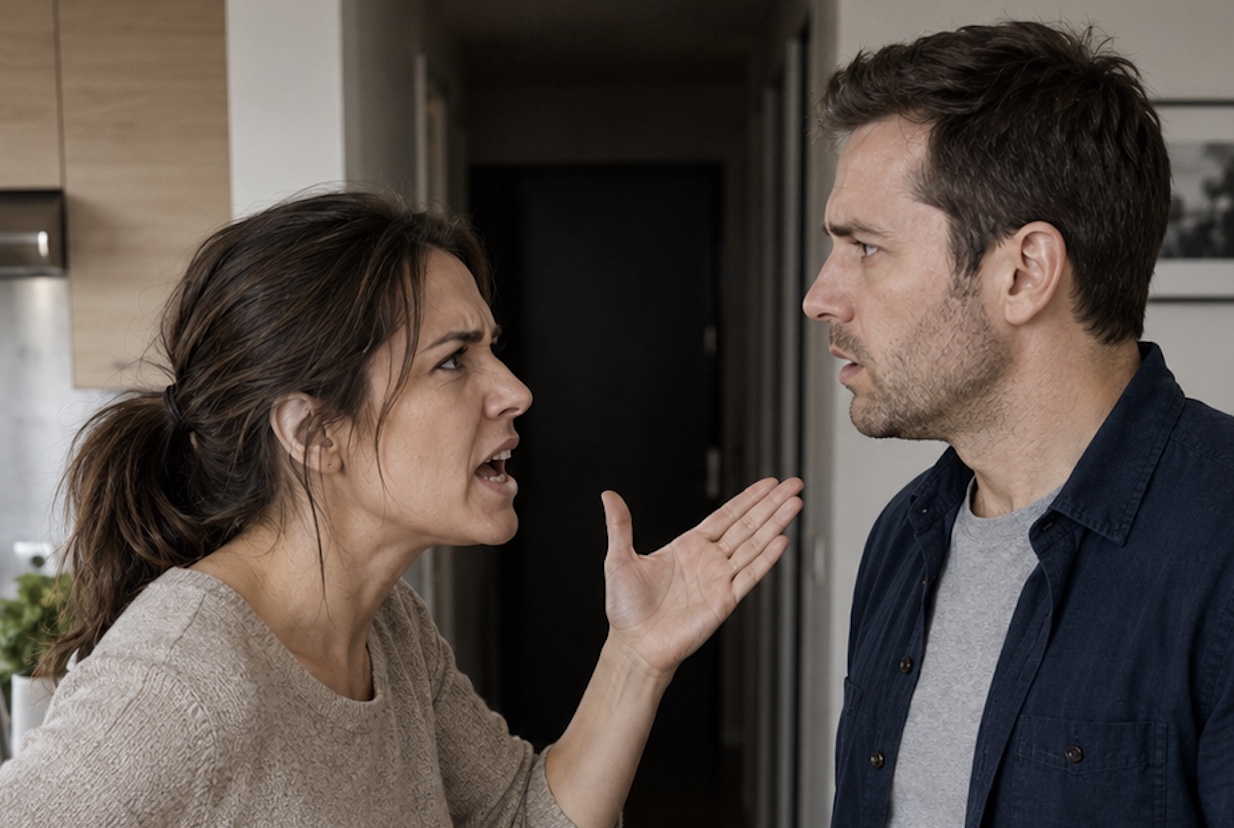
“When exactly did I promise your mother I’d drive her to the dacha every single day? She can take the bus like everyone else instead of climbing onto my back!”
“Why did you refuse my mother?”
The words fell into the warm silence of the kitchen like a lump of ice dropped into hot coffee. Oleg did not simply enter the apartment—he burst inside, bringing with him a cold draft from the stairwell and the damp smell of wet asphalt. He did not even remove his heavy autumn coat. Instead, he flung his keys onto the shelf with such force that the little porcelain dog standing there jumped and tilted dangerously to one side.
Marina, who was standing at the stove, did not turn around. She slowly stirred the rising foam in the cezve, breathing in the spicy scent of cardamom.
The entire past week had felt just like this to her—slow, rich, and comforting, like the coffee she was making. It had been a week of pure, undisturbed happiness.
Her first car, her cherry-red beauty, was parked beneath the windows. She had earned it herself, saving every spare kopeck for three long years. This week of freedom, when she could simply get behind the wheel and drive wherever she pleased, had been the greatest reward of all. The smell of new plastic inside the car seemed more precious to her than the finest perfume, and the smooth leather of the steering wheel felt softer than silk.
She carefully removed the cezve from the heat, poured the coffee into her favorite cup, and only then slowly turned toward her husband.
His face was crimson, twisted by angry, unjustified resentment. He looked like a child whose borrowed toy had been taken away after someone had promised it would belong to him.
“Oleg, I didn’t refuse her. I said I couldn’t do it today,” Marina replied evenly, almost calmly.
The echo of her happy week still lingered in her voice, and she did not want to let the harsh, rattling notes of an argument enter it.
“You couldn’t?” He gave a crooked sneer. “And what urgent business suddenly appeared the moment that car showed up outside? You never had anything important to do on Saturdays before.”
He leaned his shoulder against the doorframe and folded his arms across his chest. The pose was openly hostile and obstructive. He had not come to talk. He had come to carry out a sentence that someone else had already passed.
“I have work, Oleg. A report I was supposed to finish yesterday.” She took a small sip and burned her lips. “I brought it home specifically so I could complete it over the weekend and submit it on Monday. We discussed it on Thursday. You simply forgot.”
She was trying to appeal to logic, to their shared plans, to the idea that they were two adults capable of reaching an agreement.
She still believed this was nothing more than a misunderstanding, a brief flare of anger that could be extinguished with a few calm sentences.
But Oleg stared at her as though she were speaking a foreign language. Her work and her reports meant nothing to him. They were merely irritating obstacles standing in the way of something far more important.
“What work?” He pushed himself away from the doorframe and stepped forward, invading the comfort of her kitchen. “You sit at home in front of a computer. You could have gotten up two hours earlier, driven Mom there, and then gone back to your work. The country house isn’t on the other side of the world. But no, you had to make a point. You bought a car and suddenly started looking down on everyone. Now you’re some kind of queen nobody can approach.”
Those were not his words.
Marina recognized the expressions and the poisonous tone. It was his mother’s voice, Ludmila Petrovna’s voice, passing through Oleg like sound through a cheap speaker—distorted, but still perfectly clear in meaning.
“Stop talking nonsense. Nobody is looking down on anyone. I just—”
He did not let her finish. He sliced his hand through the air, cutting her off mid-sentence. His eyes burned with a cold, alien fire.
“No, you listen to what my mother said. She said you’re obligated to drive her now.”
Obligated.
The word did not merely enter the room. It drilled into Marina’s mind like a rusty screw.
Her calmness, which had been as warm and rich as her morning coffee, shattered. It did not fade or evaporate. It broke into thousands of icy fragments.
She placed her cup on the table. The sound of porcelain touching the tabletop was dry and sharp, like the click of a gun being cocked.
She lifted her eyes to her husband. There was no trace of sleepy contentment left in them. In its place burned a cold, furious flame.
“Obligated?” she repeated.
The word was quiet, but there was more danger in that quietness than in any scream.
She took a step toward him, closing the distance between them. Her voice suddenly gained a metallic hardness and struck him with full force.
“When exactly did I promise your mother that I would drive her to the country house every day? She can take the bus like everyone else instead of climbing onto my back!”
She shouted the words not as a victim, but as an accuser. Every syllable was filled not with wounded resentment, but with contempt for his absurd secondhand demands.
For a second, Oleg was taken aback by the directness of her attack. He had expected excuses, persuasion, perhaps even tears.
Instead, he received pure, undiluted rage.
It confused him, but only for a moment. He quickly regrouped, and his anger found a new foundation.
“How dare you speak like that? She’s my mother! She’s an elderly woman, and you—you’re behaving like a complete egoist! She only asked you for a favor!”
“She didn’t ask, Oleg. She demanded, and you came here to deliver an ultimatum. ‘Obligated’ is not a request!”
Marina jabbed a finger toward the window, beyond which her car stood.
“That is mine. I ate plain buckwheat for lunch for three years so I could buy it. I didn’t take vacations so I could buy it. I went without new clothes so I could buy it. And I didn’t do all that so your mother could act like a noblewoman while I became her servant!”
Oleg finally tore off his coat and threw it onto a chair. He was freeing himself for battle.
His face had gone from crimson to pale, a sure sign that he had reached the highest level of fury.
“Is it really that difficult for you? Are you too stingy to spend a little fuel on my mother? She expected you to help her like a normal daughter-in-law. She expected you to drive her to the country house on Saturdays and take her to the market for groceries on Wednesdays. She already told all her friends what a wonderful daughter-in-law she has now that you own a car. And this is what you do?”
He spat it all out in a single breath.
By the time he finished, Marina understood everything.
This was not a one-time whim. It was a carefully designed plan to appropriate her property and her time.
In someone else’s plans, her car had already been scheduled weeks ahead like a public bus. Her role had also been clearly assigned: a silent driver with no opinions of her own.
That realization destroyed the last traces of hope that he might understand her.
She gave a short, soundless laugh.
It frightened Oleg more than her shouting had.
“She told her friends? Wonderful. Then she’ll have to tell them that her wonderful daughter-in-law has suddenly learned how to read a public transportation schedule. And that her personal free taxi service has closed before it even opened.”
“So that’s what you’re really like,” he hissed.
There was no longer simple anger in his voice. Something worse had appeared—disgusted disappointment, as though he had suddenly seen a hideous face beneath a familiar mask.
“You simply hate her. You always have. The car is only an excuse to finally let it all out.”
Marina stared at him, her face completely unreadable.
Even the cold, bitter laughter had disappeared. She suddenly seemed older than her years, exhausted by a battle that had begun long before this morning.
“Hate her? No. That would be too strong a feeling, Oleg. She hasn’t earned that much from me. I simply remember.”
She spoke quietly, almost casually, and that was more frightening than anything else.
She was no longer accusing him. She was stating facts, pulling them from her memory one by one like a surgeon removing old fragments of metal from a wound.
“I remember when we planned to go to the seaside for our anniversary. We saved money, chose a hotel, and I had already packed my suitcase. Then your mother called because her blood pressure had supposedly risen on the exact evening we were meant to leave. And you said, ‘Marisha, you understand, it’s Mom.’ We never went anywhere. The next day, she was cheerfully digging around in the neighbor’s garden.”
Oleg flinched as though she had slapped him.
“That happened once! She really wasn’t feeling well!”
“I remember when we were saving for a new refrigerator because ours howled like a wounded animal,” Marina continued, ignoring him. “Then your mother saw an advertisement on television for some miracle massager, and you gave her nearly half of our savings because ‘Mom needed it more for her health.’ We spent another six months listening to that refrigerator scream at night.”
“You’re blaming me over a piece of metal? I helped my mother!”
“I remember coming home from vacation and discovering that the furniture in our bedroom had been rearranged. Your mother had come to water the plants and decided the new arrangement had better energy. Our wedding photograph had been pushed into the far corner of the dresser, and in its place she had put a portrait of herself when she was young.”
Every time Marina said, “I remember,” it was another nail slowly and methodically hammered into the coffin of their marriage.
These were not simply memories. They were charges in an indictment she had been silently compiling for years, swallowing one humiliation after another.
The car was not the cause.
It was merely the final seal on the document.
“This isn’t about the car, Oleg. It isn’t about the fuel either. It’s about the fact that, in your world, there is always you and your mother. And I’m only a function. Convenient, useful, sometimes necessary—but still only a function. The ‘wife’ function. The ‘housekeeper’ function. And now you wanted to add the ‘personal driver’ function as well. Unfortunately for you, this function turned out to have an opinion of her own. How inconvenient.”
He stared at her, his face twisting.
He did not see her pain. He did not hear her arguments.
All he saw was rebellion and unforgivable ingratitude.
He could not and would not admit that he was wrong, because doing so would mean admitting that his entire way of living, his relationship with his mother, and his understanding of family had all been built on a mistake.
So he chose the easiest path.
He attacked.
“You’ve been saving all this up? Writing it down in some little black notebook? You really are vicious and vindictive. And Mom—Mom always wanted what was best for us. She was only trying to help! You see malicious intent everywhere because that’s what you’re like yourself. You never wanted to be part of my family. You were always an outsider. And that stupid car of yours proves it. You bought yourself a toy and shut everyone else out.”
There seemed to be nothing left to argue about. Every word had been spoken, every accusation dumped onto the table like the contents of a garbage bin.
But Oleg could not stop.
He stepped so close that his face was unpleasantly near hers. He smelled of sour irritation.
He no longer saw the woman with whom he had shared a bed and a life. He saw an enemy, a saboteur who was destroying the comfortable world he was accustomed to—a world with his mother at its center.
“Here’s what’s going to happen,” he said in a tone that permitted no objection, the tone of a commander addressing a slow-witted soldier. “You’re going to stop this performance right now. You’ll take the keys, and we’ll go to Mom’s place. You’ll apologize to her for your behavior and quietly drive her to the country house. And I don’t want to hear another word about it. Do you understand?”
He waited for her answer.
He expected her to break. He believed this rough, uncompromising pressure would finally work.
He expected her to shrink, surrender, and obey, because that was what she had always done.
In the end, she had always given in.
But Marina remained silent.
She was no longer looking at him, but through him. In her eyes was an absolute, ringing emptiness.
All the anger and fury had burned away, leaving behind only cold, solid ash.
Without a single unnecessary movement, she slowly turned and walked toward the door.
For a moment, Oleg believed he had won.
He even smirked inwardly. He had finally forced her into submission. Now she would put on her shoes, take her bag, and they would leave.
The plan had worked.
His mother would be pleased.
But Marina did not reach for her shoes.
Silently, she took her light jacket from the hook and slipped it over her shoulders. Then she reached toward the shelf, where the key fob to her car hung from its own hook, separate from the apartment keys.
Her fingers closed around the cold plastic.
“Where are you going?” Oleg asked.
For the first time, a trace of anxiety entered his voice. Something about her silent determination felt wrong.
It frightened him.
“I’m going to settle this matter,” she said without turning around.
Her voice was flat and colorless, like a newsreader announcing the weather.
“Once and for all.”
She opened the front door and stepped onto the landing.
Oleg rushed after her, no longer understanding what was happening, but sensing that something important was collapsing before his eyes.
“Marina! Stop! What are you planning? Marina!”
His shouts bounced off the stairwell walls, but she did not hear them.
She walked down the stairs with the same mechanical inevitability as the hand of a clock moving toward the next hour.
When she stepped outside, she did not turn toward the parking area. Instead, she stopped beside the entrance and waited for him to run out after her.
There it was.
Her cherry-red beauty.
Even beneath the gray sky of that Saturday afternoon, it gleamed, its polished surface reflecting the heavy clouds.
It was perfect.
A symbol of her small, personal victory.
Oleg ran toward her, breathing heavily.
“What are you doing? That’s enough! Let’s go!”
Marina looked at him.
Then she looked at the car.
Then back at him.
She held the key fob in her hand. She pressed the button, and the car obediently flashed its headlights as the alarm disengaged.
Then, right in front of him, she separated the plain metal ignition key from the fob.
She walked toward the driver’s door.
Oleg froze, expecting her to get behind the wheel.
But she did not reach for the handle.
Instead, she clenched the key tightly in her fist, leaving the pointed metal end exposed.
She looked directly into his eyes, and he saw something resembling regret in them.
But it was the regret of a surgeon who knew there was no choice but to amputate a limb destroyed by gangrene.
Then she did it.
With a cold, focused expression, she pressed the sharp point of the key against the flawless, glossy surface of the door near the front of the car.
Using strength he would never have believed she possessed, she dragged it across the metal from one end to the other.
A piercing, nauseating screech tore through the silence of the courtyard.
Behind the key remained a deep, ugly white scar that had sliced through the cherry-colored lacquer, the paint, and the primer, all the way down to the bare, vulnerable metal.
She did not stop.
She walked around the car and, with the same merciless precision, carved lines into the rear fender.
Then the hood.
Oleg stood frozen, unable to move.
He could not believe what he was seeing.
This was not simply damage to property.
It was a public ritual of destruction.
She was not merely scratching a car.
She was crossing out their shared past, present, and future.
She was killing a dream—hers and everyone else’s.
When she finished, the car was mutilated.
It no longer gleamed.
It looked wounded and betrayed.
Marina opened her hand, and the key fell onto the asphalt with a metallic ring.
“That’s it,” she said quietly, looking at Oleg. “Now there’s nothing left to argue about. Nobody is going anywhere. Your mother can keep telling her friends what a wonderful daughter-in-law she has. She’ll just have to add that her daughter-in-law has lost her mind.”
Then Marina turned and walked away from him, from the apartment building, and from her ravaged car.
She did not look back.
She simply kept walking, leaving him alone in the middle of the courtyard beside the ruined symbol of a conflict that had just ended.
For good.