At 68, I Adopted a Little Girl Five Families Rejected—Then My Attorney Slid a Folder Across His Desk and Wouldn’t Look Up
Part 1: The Call About Five Families
“There’s something about those five families you need to know.”
Martin Hale’s voice came through the phone flat and careful, the way a doctor’s does before bad news. I was standing at my kitchen counter with a jar of peanut butter in one hand and a butter knife in the other.
Behind me, three-year-old Lily sat at the table, lining up her yellow socks like a row of tiny soldiers. It was a quarter past four on a gray Thursday in February.
“What about them?” I asked.
“Not on the phone, Rosemary. Can you come to my office today?”
I said yes. Then I stood very still, because I had spent four months being happier than I’d been in eleven years, and some old animal instinct in me knew that happiness was about to be billed.
Eleven years earlier, a truck had crossed a wet highway median outside Dayton and taken my husband Peter and our daughter Rebecca in a single afternoon. Peter was 61. Rebecca was 22 and three weeks away from her first apartment lease.
After that, the house went silent in a way I can’t explain to anyone who hasn’t lived inside it. I kept the television on all day just to hear someone say my name, even if it was only a weatherman reading a forecast.
Then my pastor, Helen Brooks, asked me to help sort donated coats at Maple Street Community Church one Saturday morning. I went because I couldn’t face another afternoon with the clock in the hallway. I kept going because the coats needed me, and so, it turned out, did the books, the mittens, and the board games we carried to the children’s group homes around the county.
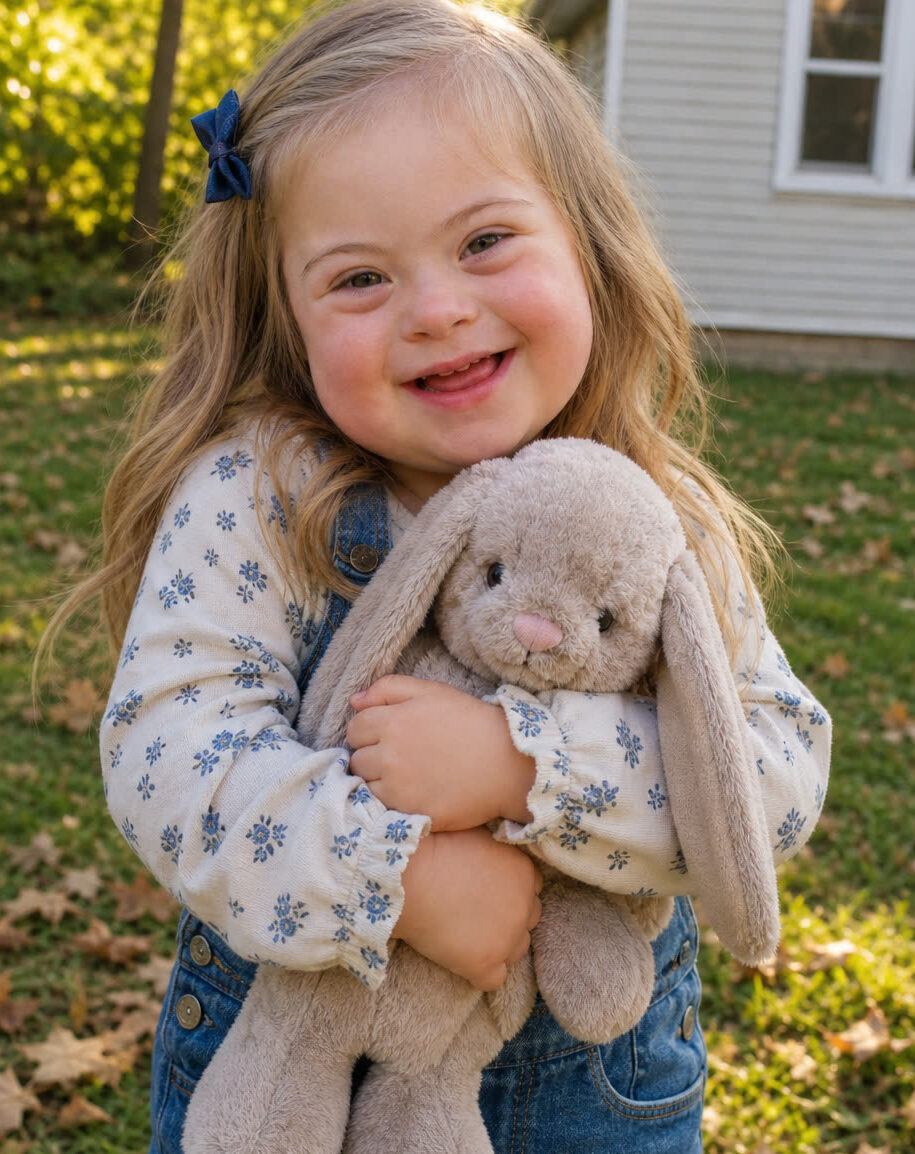
Last spring, we visited Willow Creek Home. While the other children swarmed our toy boxes, one little girl sat alone beside the window, holding a gray stuffed rabbit with one ear half gone.
“That’s Lily,” a caseworker told me quietly. “She’s three.”
I lowered myself to the floor beside her, knees complaining. “Does your rabbit have a name?”
Lily gave me a long, serious look, the kind a judge might give a witness. “Bunny.”
“That’s a very good name.”
She held up the damaged ear. “He’s broken.”
“I think he’s still the handsomest rabbit in this room.”
And she smiled, a small, startled smile, as though it had slipped out without her permission.
On my way out, the caseworker told me that five families had come to meet Lily over the past year. Each one had started the process, and each one had stopped. She couldn’t tell me why. All she could say was that Lily grew quieter every time a car pulled out of the driveway for the last time.
Before I reached the door, Lily crossed the room and pressed Bunny into my hands.
“Can you fix him?”
I promised I’d try. That night I sat at my sewing table with a magnifying lamp and stitched a neat patch over the torn seam. I couldn’t give Bunny back his ear, but I could make sure nothing else came loose.
I was 68, I lived alone, and I hadn’t packed a lunchbox since the first Bush administration. Still, I couldn’t stop seeing that girl at the window. I called the agency the next Monday.
What followed was months of interviews, medical exams, home inspections, bank statements, and politely worded questions about my age. One evaluator asked, with a straight face, whether I planned to “remain active.” I told her I’d outlasted a husband’s funeral, a daughter’s funeral, and a kitchen remodel, and I intended to keep going.
I named my niece Claire, 32, who lived ten minutes away, as Lily’s backup guardian if my health ever failed. Claire signed every form without hesitating.
“I don’t want a child losing another home,” I told the social worker.
“Neither do we,” she said.
The adoption was finalized in October. On our first evening in the house, Lily walked from room to room, touching doorframes.
“Mine?”
“Your room,” I told her. “Your books. Your bed.”
She tugged at my sleeve. “And I’ll never leave?”
“Not unless you want to.”
I sat on the edge of her bed until her breathing slowed. Over the next weeks, the house filled with scattered blocks, cartoons at six in the morning, and a fierce little opinion on everything. She refused cereal, worshipped yellow socks, and sometimes tilted her head while she thought in a way that made my heart skip, because Rebecca used to do the same.
Now, on this gray February afternoon, Claire arrived to sit with Lily, and I drove downtown with both hands tight on the wheel.
Martin was waiting behind his desk with a manila folder squared in front of him. He didn’t say hello. He didn’t look at me at all.
“Sit down, Rosemary.”
I sat. He turned the folder around and slid it toward me.
The first page was a cover sheet from the agency, stamped with a date from before my adoption. The second was a list of five names, each crossed through. On the third, in bold type, was a name I had never heard before: Victor Dunne.
And beneath it, clipped together, were five written statements, and the top one began with the words, “We are withdrawing because we are afraid.”
Part 2: The Gray Sedan
Martin’s office smelled of burnt coffee and old paper. He had pulled the chair out for me before I arrived, as if he’d known my knees would give.
“Read first,” he said. “Then ask me anything.”
I read. Five statements, five different families, one thread running through all of them.
A couple named Okafor had found an envelope in their mailbox containing photographs of their own front porch, taken at night. Another pair, the Brennans, had received a phone call telling them their own children would “pay for this” if they went through with the adoption.
The fifth statement came from a retired couple who had walked out of a caseworker’s office one afternoon and noticed the same man behind them on the sidewalk, then in the parking lot, then three miles down Route 9 in a rearview mirror. They had driven straight to a police station.
“Oh my God,” I whispered. “Who is Victor Dunne?”
“Lily’s biological uncle,” Martin said. “Her father’s older brother.”
He explained it slowly. After Lily’s parents died, Victor had applied to take her in. The agency had done a home assessment and documented violent incidents and unsafe conditions at his residence, and the application was denied.
“The summary you received before the adoption said there were no suitable or interested relatives,” Martin said. “That sentence left out years of contact attempts. It left out everything in this folder.”
My hands were flat on the desk, and I noticed they were trembling. “Those families didn’t reject Lily.”
“Based on these statements, it looks like they were afraid for their safety.”
For months I had told myself a story, a quiet and shameful one: that five sets of eyes had looked at a three-year-old and found her too much trouble. I had even felt a flicker of rescuing pride about it. The shame of that landed all at once.
I thought of how Lily flinched when a stranger raised his voice in a store. I thought of the afternoon she had wedged herself behind my armchair when a delivery driver knocked.
“Does Victor know where she lives?” I asked.
Martin rubbed his forehead. “We don’t know yet.”
And that was when I remembered the gray sedan.
It had been parked across from my house three or four times in the past month. Once I’d watched it pull away the second I stepped out onto the porch. I had told myself it belonged to a neighbor’s visitor.
I told Martin. He was already reaching for the phone.
Within the hour, we had spoken to the agency’s safeguarding supervisor and filed a police report. Martin was careful to stress that nothing in the folder proved who owned that car or whether any crime had been committed, but he said the documents would give investigators somewhere to start.
The drive home felt twice as long as the drive there. At a red light on Fifth Street, I caught myself studying every car in my mirror, and I hated that fear had found a way into my life again. I had spent eleven years rebuilding it brick by brick.
Claire was sprawled on the living room rug, helping Lily build a crooked tower of blocks. The moment the door opened, Lily shot to her feet.
“Mama!”
She had started calling me that during our visits at Willow Creek, long before the papers were signed. Somewhere along the way she’d added my name, and now I was “Mama Rose.” My name is Rosemary, and I treasured both.
I scooped her up and held on harder than I meant to.
“Too much, Mama!” she squealed.
“Sorry, sweetheart.” I loosened my arms but didn’t let go.
That night I checked the windows three times. Then I sat in Lily’s doorway, watching her sleep with Bunny tucked beneath her chin and the hallway light painting a stripe across her blanket.
Part of me wanted to find Victor Dunne and ask him how a grown man could frighten strangers who’d only offered a child a home. Another part knew that the woman who confronted him would be the one who’d put Lily at risk.
So instead, at six the next morning, I called my niece. “We need a plan.”
Claire arrived with her laptop and a legal pad. By noon, we had rewritten the preschool pickup rules so that only four named adults could collect Lily. We chose a password, “marigold,” that any emergency pickup would have to say aloud.
We ordered a video doorbell and motion lights for the porch. I met privately with Lily’s teacher and told her there might be an unauthorized visitor, giving only the facts she needed and none of the details that might frighten a room full of children.
The agency assigned a worker named Denise Carver to review what had happened. At our first meeting, she kept straightening papers that were already straight.
“Those reports should have been considered and disclosed during your assessment,” she said.
“Then why weren’t they?”
“An internal review has begun. I don’t want to give you an answer that hasn’t been established.”
It wasn’t what I wanted, but at least she didn’t call it a clerical hiccup.
She told me Victor had kept asking about Lily’s placement, even after the adoption was finalized. The agency was checking whether anyone on staff had shared information they shouldn’t have.
“Could he take her away from me?” I asked.
“His denied application gives him no authority to collect her,” Denise said. “Your adoption is final. If he wants to raise a legal issue, he has to go through the courts.”
Two days later, an officer named James Ortiz came by with printouts from a neighbor’s security camera. The images showed a gray sedan stopping near my house on two afternoons, a man sitting motionless behind the wheel.
The picture was too grainy for him to name anyone. The license plate, however, had given police a thread to pull.
“We don’t want you to confront anyone,” he said. “If the car comes back, call us. Keep your doors locked and follow the preschool’s safety procedures.”
I nodded, though every muscle in my body wanted to do something bigger.
That Saturday, Helen brought a pot of chicken soup and stayed while Lily colored at the kitchen table. When Lily left the room for more paper, I finally said it out loud.
“I think I’ve made a terrible mistake.”
Helen set her spoon down. “By adopting her?”
“I’m old enough to be her grandmother. What if I can’t protect her?”
“You asked yourself those questions before you adopted her. You built a support system. You picked up the phone the minute something changed.” She looked toward the table. “Rosemary, that is protecting her.”
I wanted to believe it. Then Lily returned and proudly held up a drawing of a giant purple cat.
“That’s you,” she announced.
“Why am I purple?”
“Because you’re pretty.”
Helen laughed until she had to wipe her eyes, and for one warm hour I nearly forgot there was a folder in my drawer.
The following Wednesday, I reached the preschool ten minutes early. Lily’s class had been cutting paper snowflakes, and I’d promised to hang hers in our kitchen window.
I was halfway across the parking lot when a man stepped out from behind a parked pickup truck and said, “Are you the woman who adopted Lily?”

Part 3: What He Wanted Her to Remember
I stopped walking. My fingers closed around my car keys so hard the teeth bit into my palm.
He looked about forty, with short dark stubble, tired eyes, and a faded green work jacket. He kept his hands where I could see them, and somehow that made it worse.
“Who are you?”
“Victor. Lily’s uncle.”
He glanced toward the school entrance and back at me. “I only want to see my niece.”
“You need to contact the agency.”
“I’ve been contacting them for months. Nobody listens.”
He took a step forward. I took one back, angling toward the front doors where other parents were arriving with coffee cups and car seats.
“Please keep your distance.”
His jaw tightened. “She’s my brother’s daughter. She’s all I have left of him.”
I heard the grief in it. I won’t pretend I didn’t. But I also heard the five statements in that folder, and the photographs of a porch taken at night.
“If you cared about Lily’s safety,” I said, “you wouldn’t have threatened the people trying to give her a home.”
His eyes flashed. “They were going to take her away from her family.”
“They were trying to give her a family.”
“You don’t understand. I promised my brother I’d look after her.”
“Then you should have gone through the process instead of terrifying strangers.”
He let out a short, cold laugh. “You’re almost seventy. What happens when you die?”
The question went in like a splinter, because I had asked it myself at three in the morning more than once.
“I have made plans for Lily,” I said. “And you will not pick her up from this school.”
He started toward the doors. I didn’t try to block him with my body, because I knew better. I walked inside ahead of him, told the receptionist that an unauthorized man was in the parking lot, and asked her to follow our safety plan.
The receptionist alerted the director, and the teachers quietly moved the children to the back classrooms. I called the police from beside the front desk, my thumb shaking so badly I dialed the last digit twice.
Outside, Victor stood at the glass, shouting that he had a right to see her. I could hear every word.
“Tell her I didn’t forget her!”
Officers arrived before dismissal. They spoke with him in the lot for a long while, and then Officer Ortiz came in and took my statement.
“We’ve documented everything,” he said. “We’ll review it alongside the earlier reports and the camera footage.”
“Will he be arrested?”
“That depends on the evidence and what offenses can be established.” He lowered his voice. “For now, don’t engage with him. Your attorney can advise you about a protective order.”
When Lily finally came out holding her snowflake, she stared at the patrol car by the curb.
“Are we in trouble, Mama?”
“No, sweetheart.”
She slid her hand into mine. “Can we go home?”
“Yes.”
That evening she wouldn’t let me leave her room. I sat on the carpet beside her bed and read the same story three times, until the words started to blur.
On the fourth reading, she interrupted. “People go?”
I lowered the book. “What do you mean, honey?”
“People go away.”
My throat closed. I wanted to say, Never, not me, not ever. I had said exactly that to Rebecca once, years ago, over a scraped knee, and life had made a liar of me.
“Sometimes people do go away,” I said carefully. “But tonight you’re safe with me. And Claire and Helen are here for you, too. You can always tell us when you’re scared.”
She studied my face the way she had at Willow Creek. “You stay?”
“I’ll do my best to always be here.”
It wasn’t the answer a three-year-old wants. It was the only honest one. She fell asleep holding two of my fingers, and I stayed there until my hand went numb.
The next morning, I asked Denise for a referral to a therapist who worked with young children in foster care and adoption. I didn’t want Lily carrying fears she couldn’t even name.
We started play therapy the following week. The therapist used dolls, toy houses, and drawing games, and I learned to answer Lily’s questions without making promises that nobody could keep. Some sessions were hard. Others looked like ordinary play.
Slowly, Lily began telling us when she felt scared instead of hiding behind the armchair.
Meanwhile, Martin helped me file a formal complaint about the missing reports. The agency opened a records review and offered corrected disclosures, including the five families’ accounts and every safety document that had been left out.
“Did someone hide them on purpose?” I asked him.
“I don’t know,” he said. “An omission this serious needs an investigation, not a guess.”
Weeks later, police told us the gray sedan was registered to someone connected to Victor. They were still working out who had been driving it on the afternoons it appeared outside my home, and they had interviewed Victor about the threats the five families had reported.
I didn’t need every detail. I needed his behavior to be examined, and it finally was. The preschool now had written instructions about him, and Lily’s pickup list had never been tighter.
Then, one evening, Martin forwarded a letter.
It was from Victor. He wrote that his brother had been his best friend, and that losing him had left him angry at everyone. He claimed the system judged him for mistakes he’d made years ago.
Near the end he wrote, “I only wanted Lily to remember where she came from.”
I read that line five or six times. A part of me understood wanting to keep a thread to a lost brother. But I couldn’t forgive a thread pulled through fear.
I didn’t answer. After asking Martin what was appropriate to preserve, I put the letter in a file of records Lily might one day want to read. She deserved an honest account of her beginning, not one shaped by my fear or by his anger.
Months passed. Victor stopped appearing near our house and the school, and I began, carefully, to breathe again.
Then, on an ordinary Tuesday morning, my phone buzzed with Denise Carver’s name, and her voice was tight when I answered.
“Mrs. Walsh, the review is finished. We found out exactly where those reports went, and you’re not going to like it.”
Part 4: The Rabbit With One Ear
I met Denise in the same conference room as before, but this time she didn’t straighten any papers. She just set a single sheet in front of me and let me read.
The five reports hadn’t been thrown out or shredded. They had been kept in a separate internal file marked for restricted contact, and nobody had ever transferred that file into the disclosure packet that came to me.
“It was a procedural gap,” Denise said. “Not a plot. But the result is the same, and I won’t dress it up.”
I thought of the months Lily had waited. I thought of the Okafors and the Brennans, who had gone home frightened and silent, with no one telling them their fear had been justified.
The agency issued a written apology. Denise read it aloud, and I let her finish.
“I appreciate it,” I told her. “And it isn’t enough.”
She didn’t argue. I listed it out as plainly as I could: five families had been frightened, Lily had lost extra months, and I had been denied information I needed in order to protect her.
I asked that my complaint stay open until the agency’s new record procedures had been independently checked. Denise wrote that down, and she underlined it twice.
As the weeks went on, the legal restrictions Martin had requested took hold. Victor stayed away from our street and from the school, and no gray sedan returned. I never learned every detail of the investigation, and I came to accept that.
Spring arrived slowly. The doorbell camera caught only squirrels and the mail carrier, and I finally stopped checking the mirror at red lights.
On a bright Saturday in early April, Claire and I took Lily to the park. She ran straight for the swings with Bunny tucked tight under her arm.
“Push me, Mama!”
I gave her a gentle push.
“Higher!”
“Not too high.”
She giggled so hard Bunny almost fell. Then she noticed another little girl waiting nearby, shifting from foot to foot.
“She can have a turn,” Lily announced, and she climbed down and offered up the seat.
I watched her run back across the grass and leap into Claire’s arms. Something in my chest, a room I’d kept locked for eleven years, opened a little wider.
After Peter and Rebecca, I had decided that loving someone again meant inviting the same terrible loss. Maybe it does. But love had also put laughter back in my kitchen, and it had given a frightened child somewhere to leave her toys.
That night I took the folder out of its drawer one last time. Five families. Five statements. Five chances Lily almost had.
For months, I had believed those families looked at her and decided she wasn’t worth the trouble. Now I knew they had been terrified by a man who said he loved her but couldn’t accept that her safety mattered more than his wishes.
I didn’t blame them for being afraid. I only wished someone had protected them, too.
Lily climbed onto my lap while I was sliding the papers away.
“Story?”
“Which one?”
“The bunny one.”
I picked up her favorite book. She leaned against me, warm and heavy with sleep, her cheek on my sleeve. Halfway through, she tilted her head the way Rebecca used to.
“Mama Rose?”
“Yes?”
“I love our home.”
I kissed her hair. “I love our home, too.”
As she turned the page with her small, careful fingers, I understood what I hadn’t on the day I first knelt beside that window. I had never rescued a girl five families didn’t want.
I had welcomed a child caught in a fight she never chose. My job wasn’t to win it. My job was to make sure she grew up without ever having to fight it herself.
Was Victor’s grief enough to explain why he fought so hard to get Lily back, or do you think his threats made his actions impossible to defend?
Disclaimer: This story is a work of fiction inspired by real-life themes. Names, characters, places and events are fictionalized, and any resemblance to real persons is purely coincidental. Images are for illustration purposes only.

Related Posts

My Fiancé’s Parents Didn’t Know I Speak French & Blurted out a Secret, Revealing a Startling Family Drama

Why Our Brains Crave the Challenge of Visual Spot-the-Difference Puzzles