My Stepfather Threw My 16-Year-Old Brother Out Over $200 He Swore He Never Took—Ten Years Later, He Walked Into Their Anniversary Party Holding Mom’s Letter
Part 1: The Big Pancake
Mom said it before she told me the date, before the venue, before she even asked how I was. I was sitting in my Corolla behind the Brookside Animal Clinic at 6:40 on a Thursday, still in scrubs that smelled like flea shampoo, while the check-engine light glowed at me like it had opinions.
“I didn’t ask,” I said.
“I know, honey. I just didn’t want you to worry about it.”
That should have warned me. For ten years my mother had stepped around Rick’s name the way you step around a soft spot in a floor. Now she was offering it up unprompted, along with the news that she and Howard were celebrating their tenth anniversary on March fourteenth in the Harbor Room at the Lakeview Club.
“Just come for an hour,” she said. “Please, Maddie. Your aunt Carol will be there. Jenna’s bringing the baby.”
I told her I’d think about it. Then I hung up, rested my forehead on the steering wheel, and thought about my brother instead.
Rick is six years older than me. Our dad died of a brain aneurysm when I was eleven months old. After that, Mom worked days doing billing for a dental office and nights waiting tables at a Bob Evans off Route 4. Somebody had to raise me in between, and that somebody was a skinny kid with a cowlick he could never flatten.
He walked me to Lincoln Elementary every morning. He checked my spelling homework with a red pen he’d “borrowed” from Mom’s office, and when thunderstorms rolled through, he dragged a couch cushion into my room and slept on the floor beside my bed. Not once did he act like I was the reason he couldn’t go to his friends’ houses.
Saturdays were pancake days. Rick made them in a dented skillet with a wobbly handle, chocolate chips pressed into the batter in the shape of my initial. The biggest one always went onto my chipped yellow plate.
“Why do I always get the big one?” I asked him once. I was seven, sitting on the counter in my pajamas, which was strictly against the rules.
“Because you’re growing,” he said, flipping the next one without looking.
“So are you.”
“I’m already too handsome, bug. Can’t risk growing more.”
That was the same year he crashed his bike on Fairview Hill and came home with blood running into one eye. He let Mom think it was nothing and let me cover the cut with a SpongeBob bandage. It left a thin pale scar above his left eyebrow, and for months he told everyone it was a shark bite.
When I was ten, Mom married Howard Kessler. Howard owned Kessler Plumbing & Drain, had his name painted on three white vans, and drove a silver F-250 that always smelled like it had just left the lot. At the reception, Mom squeezed both our hands under the table so hard her rings dug in.
“We won’t have to struggle anymore,” she whispered.
Rick smiled for her. He was sixteen, wearing a borrowed tie, and he smiled exactly as long as she was looking. Then he leaned down to me.
“Still want me to make breakfast tomorrow?”
“Obviously.”
At first, Howard was easy to like. He bought me a purple bike with streamers, took us to a steakhouse where the menus didn’t list prices, and called Mom “Di” in a voice that made her laugh like a girl. I remember thinking the house finally felt warm.
Then the rules started. No shoes past the front mat. No food upstairs. No talking while Howard watched the Bengals, or the news, or anything else. A list went up on the fridge in his blocky handwriting, and every week it grew another line.
Rick tried. I watched him try. But whatever he did, Howard always found the one thing he hadn’t done.
“Feet off my couch.”
“My shoes are off,” Rick said once, without looking up from his chemistry book.
“Did I ask about your shoes? Quit talking back.”
From the kitchen, Mom let out the long sigh I’d come to dread. “Rick. Just listen to him, okay?”
He shrugged. He shrugged at everything that fall, and I hated it. Rick had never been a shrugger. He was the kid who once argued with the crossing guard about what counted as a full stop.
By Thanksgiving, he’d stopped coming to family dinners. He took a job stocking shelves at Fairway Market four nights a week, bought his own groceries, and kept them in a mini-fridge in his room like a tenant.
“You don’t have to do that,” I told him one night. I was sitting on his floor while he counted his paycheck into an envelope.
“Sure I do. I’m sixteen. Time to act grown.”
“Howard says that?”
He shrugged again.
On the last normal Saturday, he made pancakes at six in the morning so the kitchen wouldn’t be “occupied” when Howard came down. He put the big one on my yellow plate and ate his own standing at the sink.
Three days later, on a Tuesday in early November, I climbed off the school bus and found my brother’s clothes scattered across the front lawn.
Part 2: Two Hundred Dollars
His gray hoodie hung off the boxwood hedge. A pair of jeans lay facedown on the front walk, and his chemistry textbook sat splayed open in the mulch, pages lifting in the wind.
Through the open front door, I could hear Howard.
“Two hundred dollars does not just walk out of a drawer!”
“I didn’t take it!” Rick’s voice cracked on the last word, something it hadn’t done in a year.
I dropped my backpack on the porch and went in. Howard stood in the middle of the kitchen with his face the color of raw ham, and Rick was by the back door. Mom was pressed against the sink, twisting a dish towel so tightly her knuckles had gone white.
“You knew exactly where I kept my cash,” Howard said, jabbing a finger at him. “Who else in this house goes in that drawer?”
Rick turned to Mom. “Tell him. Please.”
She barely lifted her eyes. “If you took it, Rick, just return it. We can settle this.”
I’ll never forget his face. It wasn’t anger. It was the look of someone who has just put his weight on a step and felt it give way.
“You think I stole from him?” he said quietly.
“Nobody wants a fight,” Mom whispered.
“Then he can leave.” Howard yanked Rick’s backpack off its hook and flung it out the front door.
I ran past them and threw my whole body across the doorframe. “He’s my brother! He lives here!”
Howard took me by the shoulders, not roughly, the way you’d move a chair, and set me to one side. I looked at Mom. She didn’t leave the sink.
Rick came over and knelt in front of me in the hallway while Howard waited on the porch with his arms folded. Up close, I could see the shark-bite scar and the way his chin was shaking.
“Listen, bug. I didn’t steal anything.”
“I know.”
“I love you. Don’t forget it.”
He hugged me so hard my ribs hurt. Then he stood and looked past me at our mother.
He walked down the driveway with his backpack over one shoulder and a black garbage bag of clothes in his other hand. I watched from the porch until he turned the corner at Maple and Ninth. Then I kept watching the corner.
For weeks, I believed he’d come back. Every Saturday I got up early, burned pancakes in the dented skillet, and left the biggest one on my yellow plate under a paper towel. In January, Mom scraped it into the trash and said, “Maddie, you have to stop wasting food.”
I called his flip phone until a recording said the number was no longer in service. I wrote letters to his high school in careful cursive, and after he transferred they came back stamped RETURN TO SENDER. Nobody would tell a ten-year-old where he’d gone.
From overheard phone calls, I pieced together that he’d slept on a friend’s couch for a while. Then he’d moved in with the friend’s aunt in Toledo, three hours north, and changed his number so Howard couldn’t find him.
“I’ve tried to reach him,” Mom told me more than once. “He won’t answer me, honey.”
Howard couldn’t stand hearing Rick’s name. If I said it at dinner, he set his fork down with a sharp click.
“That boy made his choice.”
“He didn’t steal your money,” I said once. I was twelve.
“Oh, so you know everything now, do you?”
Mom ended those conversations the same way every time: “Upstairs, Maddie.” By sixteen, I’d learned that silence was the price of a quiet dinner, and I paid it. I’m not proud of how easily I paid it.
I worked weekends at a Dairy Queen and later at the clinic. Two weeks after my eighteenth birthday, I moved into a one-bedroom over a laundromat on Crestview Avenue for $940 a month. The only thing I took from Mom’s kitchen was the chipped yellow plate.
“You’re punishing me for something that happened years ago,” Mom said, crying while I taped boxes.
“I’m leaving because nothing has changed.”
She called every Sunday after that. We talked about the weather, my car, her bad knee. Then she’d slip it in: “Howard’s mellowed, you know. People deserve second chances.”
“So does Rick,” I’d say, and she’d go quiet.
For years, I believed my brother had simply chosen to start over without me. I searched his name online and found a dentist in Arizona, a pastor in Georgia, and a teenager in a lacrosse photo. None of them were him.
Then last October, Mom dropped by with a casserole I hadn’t asked for. She stood at my fridge studying the photos under the magnets, and without turning around she said, “Your brother’s doing fine, you know.”
I set the dish down. “How would you know? You said you couldn’t reach him.”
She straightened a magnet that was already straight. “I heard something from someone.”
“From who?”
“Don’t start, Maddie.” She picked up her purse and left.
That night, I found a staff page for Delgado’s Auto Repair in Toledo: Richard Brennan, ASE-certified technician. There was no photo, only the shop’s number. I stared at it for over an hour, then put my phone facedown on the nightstand. What if he didn’t recognize my voice? What if he did?
So when Mom called in February about the party, I surprised myself. “Will Howard behave?”
“He wants a fresh start.”
I laughed. “Then he can start by admitting what he did.”
The Harbor Room had gold balloons tied to every chair and a projector throwing photos onto a white screen: Mom and Howard on a cruise ship, at a wedding, on the dock of the lake house he’d bought in 2021.
Mom hurried over the second I walked in. “You came!”
“For an hour.”
She touched my hair the way she used to when I was little. “You look so much like your father.”
Howard appeared at her shoulder holding a whiskey. “Well. Look who decided to join the family.” He held out his hand. “No hard feelings, I hope.”
I looked at his hand until he put it back in his pocket.
Aunt Carol saved me with a hug that smelled like White Diamonds and towed me to her table. My cousin Jenna passed around pictures of her six-week-old son. For forty minutes it was easy, and I realized how much I’d missed a table full of relatives arguing over who had ruined which Thanksgiving.
Then the slideshow reached the wedding.
There I was, ten years old in a yellow dress, grinning around a gap where a tooth had just come out. Behind me stood Rick in his borrowed tie, one hand resting on my shoulder.
“Who picked these?” I asked Jenna.
“Howard did, I think. Why?”
Up front, Howard tapped the microphone. “Ten years with this beautiful woman. We’ve built a wonderful family.” People clapped, and I wondered whether Mom had ever noticed that after that photo, the boy vanished from every picture on the screen.
Howard raised his glass. “Here’s to loyalty.”
I was reaching for my coat when the banquet room door swung open.
Part 3: The Man in the Dark Jacket
A man in a dark jacket stepped inside and stopped a few feet from my table. He was broad through the shoulders, with a short beard and a cowlick he’d obviously stopped fighting. When he smiled, one side went higher than the other.
Then I saw the thin pale line above his left eyebrow.
His eyes moved across the room, table by table, until they landed on me. He winked.
My chair hit the floor behind me. “Rick?”
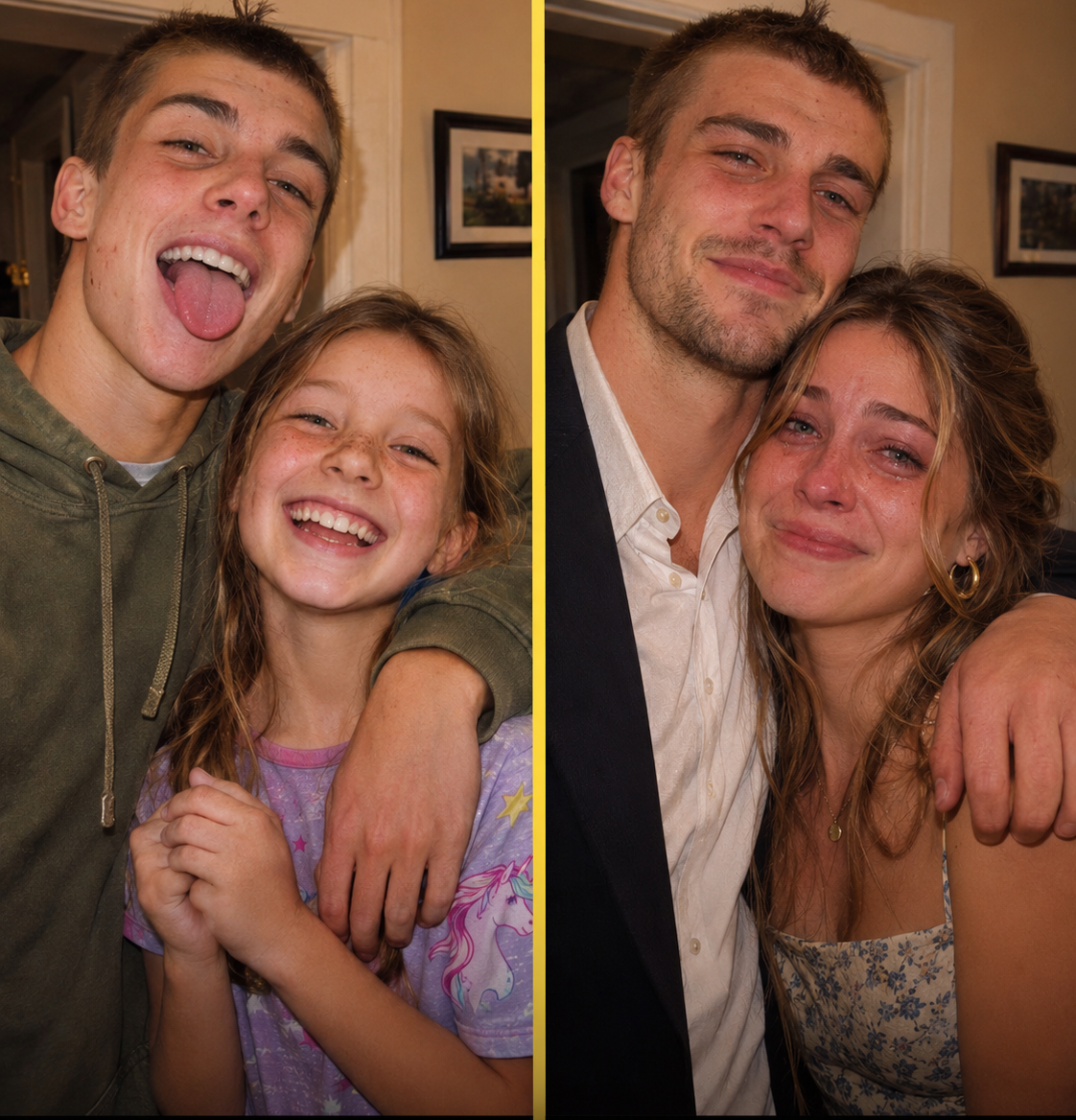
He opened his arms, and I ran. I was crying before I reached him, the ugly hiccuping kind, and he caught me the way he used to catch me off the monkey bars.
“Hey, bug.”
“Where have you been?” I said into his jacket. “Are you okay? Are you married? How did you find us?”
He laughed, unsteady. “One question at a time.” Then, lower: “I’m sorry. I’m so sorry.”
Somewhere a fork clattered against a plate, and Jenna’s husband stopped mid-sentence. At the head table, Howard turned around. I watched the color drain from his face and then rush back twice as dark.

“What are you doing here?”
Rick let go of me but kept a hand on my back. “Nice party, Howard.”
“You’re not welcome here!”
Mom shot up so fast her chair screeched across the parquet. “Rick? You came?”
He looked at her steadily. “You invited me.”
I’d stopped crying. “You knew he was coming?”
Her smile wobbled. “I sent invitations to everybody.”
“You told me he wouldn’t be here.”
“I didn’t think he’d come,” she said, and her voice went small.
Rick pulled a cream envelope with gold lettering from his jacket. It was the same invitation sitting on my kitchen counter at home. “She mailed this to the garage where I work. I almost tossed it in the bin with the parts invoices.”
“Why didn’t you?” I asked.
“Because I called Aunt Carol. First time we’d talked since I was sixteen. I asked her one thing: whether you’d be here.”
At her table, Carol pressed a hand to her chest. “Your mother told me you’d said yes, Maddie. I didn’t have your number to give him, or I would have.”
My eyes filled again. “You came to see me?”
“I wasn’t going to miss another chance.”
Howard was crossing the room now, his whiskey abandoned. “Get out. Now. Before I call security.”
Rick didn’t move. “I came to congratulate you both. And to finish a conversation we started in your kitchen ten years ago.”
He walked to the DJ booth. The kid running the music took one look at his face and handed over the microphone, and the song cut off mid-chorus. Eighty people turned in their chairs.
“Some of you don’t know me,” Rick said. His voice was calm, as if he’d practiced on the drive down. “I’m Diane’s son. When I was sixteen, Howard accused me of stealing two hundred dollars from his drawer. My mother let him put me out on the lawn, and I lost my home.”
Howard reached for the mic. “That’s enough.”
Rick stepped out of reach. “For three months, I thought Mom honestly believed I’d taken it. I figured maybe she was confused, maybe she just didn’t know.” He reached into his inside pocket. “Then she sent me a letter.”
Mom put her hand over her mouth.
The paper he unfolded had gone soft at the creases. It was the lined stationery that used to sit in our junk drawer next to the takeout menus, and I could see Mom’s looping handwriting from twenty feet away.
“She mailed it to Holloway’s Grocery in Toledo, where my buddy’s aunt worked the deli counter,” Rick said. “I was living with her by then. My buddy gave Mom the address so she could reach me if she wanted to.”
Howard folded his arms. “A private letter from ten years ago doesn’t prove anything.”
Rick looked down at the page.
“‘I know Howard took the two hundred dollars from the drawer for the electric bill. He told me the night before the argument, but I think he forgot. I should have spoken up, but he was so angry. Please come home, apologize for shouting, and let us put this behind us.’”
Nobody spoke. Behind him the projector kept cycling, and Mom and Howard smiled enormous beach smiles in Cancún at no one.
Howard’s face had gone the color of the tablecloth. He opened his mouth, then closed it.
I turned to my mother. “You knew before he threw Rick out?”
She dabbed under her eyes with a cocktail napkin. “I didn’t know how to stop the fighting.”
“You could have told the truth.”
Howard found his voice. “The money was a misunderstanding. His attitude was the real problem. It always was.”
Rick lowered the letter. “You accused me of stealing money you’d already spent on the light bill. Help me understand which part of that was a misunderstanding.”
Howard didn’t answer.
“All these years,” I said to Mom, “you let me think you weren’t sure. You let me wonder if maybe he did it.”
“I thought he’d come home once everyone calmed down.” Her voice was cracking. “I was so scared of being alone again, Maddie. After your dad, I just—”
“You wanted him to come home and apologize,” I said, “to the man who threw him out.”
She stared at the floor.
Rick folded the letter along its old crease. He wasn’t looking at Mom anymore. He was looking at me, and his face had changed, like a man who’d just spotted a crack spreading across a windshield.
“There’s something else,” he said. “Bug, I wrote to you after I left. For over a year. Every single letter went to the house.”
Part 4: The Yellow Plate
The room tilted.
“I never got any letters,” I said.
Rick went very still. “Not one?”
I shook my head. “I wrote to you, at your school. They all came back.”
“I never saw those either.” He let out a breath that was almost a laugh and wasn’t. “We were both writing. Neither of us knew.”
He turned toward the head table. “When you turned eighteen, I called Mom again. I figured you were old enough to decide for yourself whether you wanted to see me.” His jaw tightened. “She told me you’d moved out, but she wouldn’t give me your address. She said you didn’t want to hear from me, and that I should leave you alone.”
Mom closed her eyes.
“After a year of letters with no answer, I believed her,” Rick said quietly. “I looked for you anyway, but I never found a number I knew was yours. I should have kept trying.”
I turned to my mother. “You told me you couldn’t reach Rick. And you told him I didn’t want him?”
“I was trying to keep the fighting from starting again.”
“Did you keep his letters from me?”
She didn’t answer.
“Mom.”
Her shoulders sagged. “I thought seeing them would only upset you.”
I thought about the Saturdays. The paper towel over the yellow plate. Every night I’d fallen asleep certain my brother had looked at his new life and decided I didn’t fit in it.
“I never said that,” Rick told me.
“I know.”
Howard pushed toward the DJ booth. “This party is over.”
I stepped between him and my brother. My hands were shaking, but for once I didn’t wait for anyone to tell me to go upstairs.
“Mom, look at me.” She lifted her head. “You didn’t just let Howard throw Rick out. You kept us apart afterward. Are you really going to let all these people go home believing he’s the one who broke this family?”
“I can’t change what happened,” she whispered.
“No. But you can stop lying about it.”
Aunt Carol stood up at her table. “Diane. You told me Rick stole from Howard.”
Mom looked at her sister. “I know.”
“And you knew he didn’t?”
Mom stared at the letter in Rick’s hand for a long moment. I thought she was going to sit back down. Then she crossed the floor, took the microphone from him with both hands, and held it like it weighed fifty pounds.
Her voice shook through the speakers. “I knew Howard used the money, and I let him throw my son out anyway. I kept Rick’s letters from his sister. Later, I told him she didn’t want contact. I told myself I was keeping the peace.” She looked at the two of us. “I chose my marriage over both of you.”
Howard snatched his coat off the back of his chair. “I’m not staying here for this.”
He walked out, and the door swung shut behind him. A few of his golf friends gathered their things and followed. Nobody tried to stop them.
Mom came to Rick with her hands clasped at her chest. “Please forgive me.”
He folded her letter and slid it back into his pocket. “I heard your apology. That’s all I can give you tonight.”
She turned to me, eyes swimming, waiting. I didn’t tell her it was okay. “I need time, Mom,” I said. “A lot of it.” She nodded and stepped aside.
Rick looked at me. “Ready?”
I took his hand. “Let’s go.”
We sat in his truck in the Lakeview parking lot with the heater running until midnight. He’d been at Delgado’s for six years. He’d married a third-grade teacher named Leah, and they had a three-year-old daughter named June who refused to wear socks.
“I wish I’d found you sooner,” he said.
“So do I.” I wiped my face on his sleeve, the way I used to. “I still have the yellow plate, you know. It’s the only thing I took when I moved out.”
He was quiet for a second. Then he reached across the console and squeezed my hand. “June loves pancakes, by the way.”
I laughed through the last of my tears. “Then she gets the big one. She’s growing.”
“And you?”
“I’m already too handsome, bug,” I said. “Can’t risk growing more.”
He laughed so hard he had to rest his head on the steering wheel, and for the first time in ten years, the person on the other side of the table was the one I’d been saving the big pancake for.
If someone you trusted had kept your sibling’s letters from you for years, could you ever forgive them?
Disclaimer: This story is a work of fiction inspired by real-life themes. Names, characters, places and events are fictionalized, and any resemblance to real persons is purely coincidental. Images are for illustration purposes only.

Related Posts

My In-Laws Funded Homes for All Three of My Husband’s Siblings but Left Us Empty-Handed—So We Saved Every Penny and Bought a Forgotten Farmhouse That Changed Our Lives Forever.
My MIL Found Out Her Son Was Cheating On Me — So She Hatched a Plan to Teach Him a Lesson He’d Never Forget