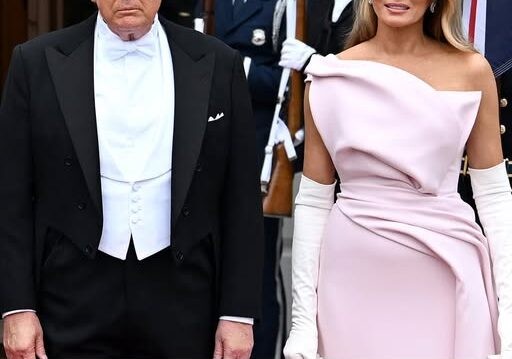
The one detail critics can’t stop talking about in Melania’s pink dress
Under the glittering chandeliers and rigid expectations of a royal state dinner, Melania Trump chose not to disappear into the quiet uniformity that such occasions often demand. Instead, she stepped into the room with deliberate contrast—her sculpted, strapless pink Dior gown catching the light in a way that made subtlety impossible. In a setting where tradition typically favors covered shoulders, muted tones, and deference to established codes of appearance, her look read less like a misstep and more like a calculated decision. It was a reminder that fashion, especially at the highest levels of public life, is never just about clothing—it is about signaling presence, identity, and intent.
Standing beside King Charles III and Queen Camilla, whose attire adhered closely to the longstanding expectations of royal formality, the contrast became even more pronounced. Where their choices reflected continuity and restraint, hers suggested autonomy and control. Critics were quick to frame the moment as a breach of etiquette, pointing to the exposed neckline, the bold silhouette, and the unmistakable luxury of the design as evidence of disregard for tradition. To them, it was a visual disruption in a space built on consistency, where even the smallest deviations can feel amplified.
Yet for others, the same details told a different story. The gown was not chaotic or careless; it was precise, tailored, and intentional. Supporters saw confidence in the choice—a refusal to be visually diminished in a room where symbolism carries weight. They argued that modern public figures, even in historically rigid environments, are not bound to replicate the past exactly as it was. Instead, they can reinterpret it, bringing contemporary identity into spaces that often resist change. In that sense, her appearance became less about defiance and more about authorship: the ability to control one’s image in a setting where every detail is scrutinized.
What followed revealed as much about public perception as it did about the event itself. Social media quickly fractured into competing interpretations. Some viewed the gown as disrespectful, a moment where personal expression overstepped institutional boundaries. Others saw it as a refreshing break from predictability, a reminder that individuality can exist even within the most formal frameworks. And then there were those who simply watched, captivated by the spectacle, less concerned with rules and more interested in the visual drama unfolding before them.
This divide highlights a broader tension that extends far beyond a single evening or a single outfit. Royal events, by their nature, are built on continuity—on the preservation of symbols that connect the present to the past. But the people who attend them exist in the present, shaped by evolving cultural norms and expectations. When those two forces meet, friction is almost inevitable. The question then becomes not whether change should occur, but how visible that change is allowed to be.
In the end, the dinner itself proceeded without disruption. Protocol was followed, speeches were made, and the ceremonial aspects remained intact. Yet the images that circulated afterward told their own story. The gown lingered in public memory, not because it altered the event, but because it reframed how the event was seen. It shifted attention from ritual alone to the individuals participating in it, reminding audiences that even the most structured environments are inhabited by people making choices—some quiet, some impossible to ignore.
Long after the evening ended, the discussion remained. Was it a misalignment with tradition, or a modern interpretation of it? Was it a statement of independence, or simply a different reading of formality? Perhaps the more interesting question is why such moments resonate so strongly. In a world that often demands adherence to unspoken rules, visible deviation can feel either unsettling or liberating, depending on where one stands.
Ultimately, the moment underscores a simple but persistent truth: visibility carries risk. To stand out is to invite judgment, but also to assert presence. In environments defined by expectation, blending in may feel safer, but it also means surrendering the opportunity to shape the narrative. By choosing not to fade into the background, Melania Trump ensured that her presence would be remembered—not just for how she looked, but for what that choice represented in a space where every detail is watched, interpreted, and debated.