I Received 100 Yellow Roses While My Husband Was Supposedly Out of Town—Then I Found Three Marked in Red and Called the Police
I thought my husband had sent me a hundred yellow roses to say he missed me. Then I counted them, found three flowers marked in red, and called the police instead of thanking him.
PART 1 — A BOUQUET WITH NO NAME ON IT
The doorbell rang a little after noon, and I still had soap on my hands from the coffee cup I’d just rinsed.
Daniel wasn’t due back for a week. He’d left for a business trip four days earlier, so whoever was standing on my porch, it wasn’t him.
I opened the door to a wall of gold.
The delivery man could barely see over the bouquet he was holding.
“Amber?”
“That’s me.”
“These are yours.”
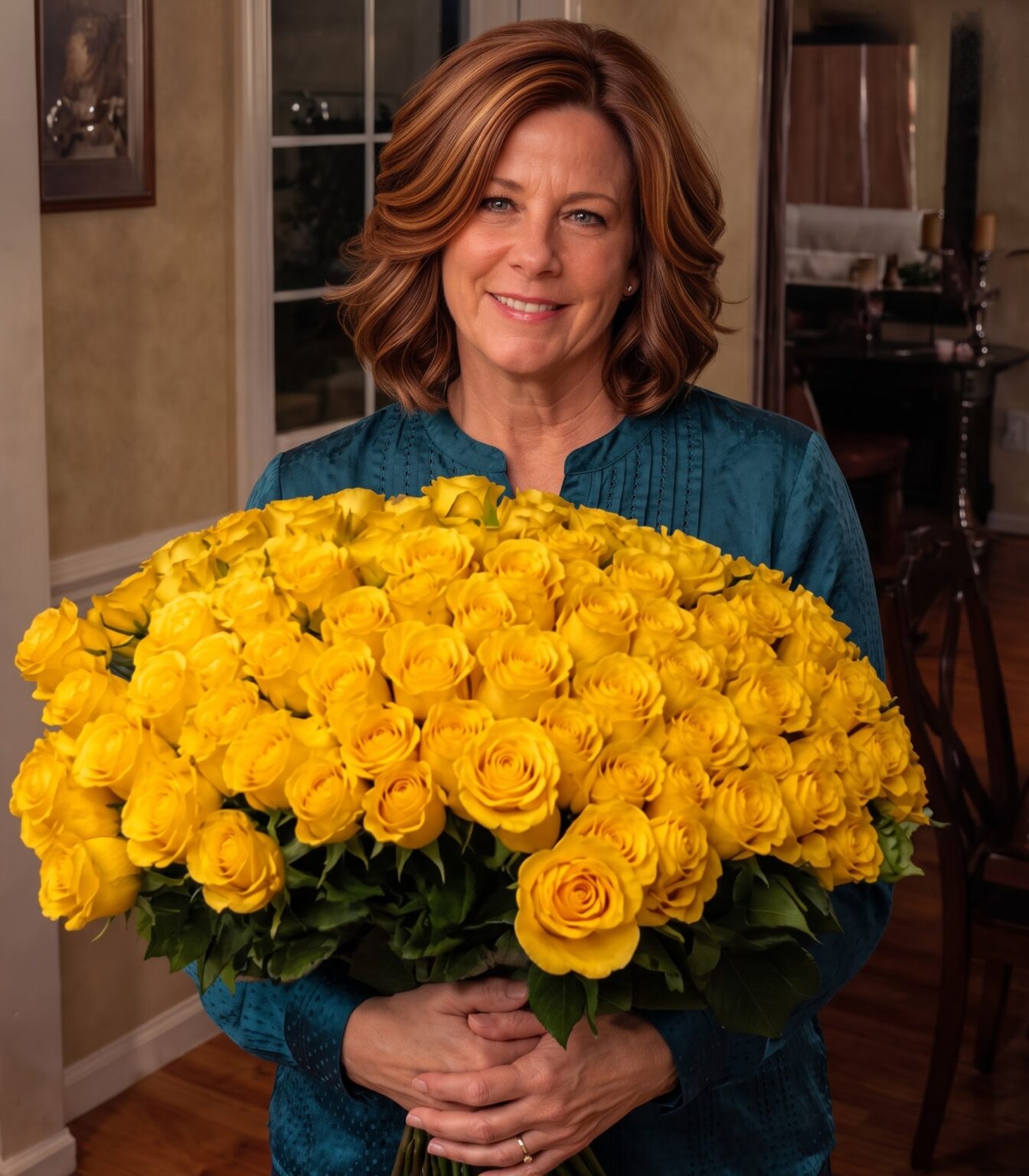
I took the flowers in both arms because there was no other way to hold them. A hundred yellow roses, every petal open and perfect, catching the afternoon light like something lit from inside.
“Somebody’s trying hard to impress you,” he said, already walking back to his van.
I looked for a card. There wasn’t one.
“No note?”
He glanced at the florist’s tag stapled to the wrapping.
“Just your name.”
For a second, I let myself smile. Daniel had never been a note-writer. Once he gave me a necklace with nothing attached to it and told me, completely straight-faced, that the necklace spoke for itself. Eighteen years in, I’d learned to read him in gestures instead of words.
I set the roses in the center of the dining table, and for a moment the whole room felt different — warmer, softer, like something out of an anniversary card.
Then the feeling curdled.
Daniel knew I loved white roses. I’d carried them at our wedding. He’d bought them the week my mother died, without me having to ask. They’d sat on this same table on our fifteenth anniversary.
He would never choose yellow. Not for me.
I looked again at the tag, and this time I read the number printed under my name.
100.
Not ninety-nine. Not a hundred and one.
Daniel was generous, but he wasn’t a man who did things in round, deliberate numbers like that. And there was no anniversary. No birthday. No reason.
I called him. It rang out to voicemail.
I texted: Did you send me flowers?
Nothing came back. Ten minutes. Then twenty. The roses stopped looking like a gift and started looking like something that had been placed in my house on purpose.
I walked the length of the table, really looking now. The roses weren’t just piled together — they’d been set out in ten rows of ten, each one exact, like a grid someone had checked twice.
Near the middle, a few blooms sat lower than the rest, and I bent to see why.
One rose had a small red stain tucked under a petal, and I told myself it was just a bruise on the flower. Then I found a second one. Then a third.
Three roses, and only three, marked in red.
My hands wouldn’t stop shaking.
I’d seen a pattern like this described before — not in person, but in my father’s voice. He’d been a homicide detective, and there was one case he never talked about except once, late on the porch, staring at nothing.
“Some monsters don’t leave fingerprints,” he’d told me. “They leave symbols.”
I picked up the phone again. This time I dialed the police.
The dispatcher asked if I was in immediate danger.
“I don’t know,” I said. “But I have a hundred yellow roses on my table, and three of them are marked.”
Two officers showed up within the hour, polite and a little skeptical, the kind of look that says this is probably nothing. Then a dark sedan pulled into my driveway, and a silver-haired detective named Kellan walked through my front door like he already knew what he’d find.
I told him my father’s name, and something shifted in his face.
“I worked with him,” he said.
He crossed to the table. The moment his eyes landed on the three red marks, the color went out of his skin.
“Secure the house,” he said.
One of the officers hesitated. “Sir?”
“Now.”
I gripped the back of a chair to stay standing.
“You know what this is.”
Kellan looked at me the way you look at someone you’re about to hand bad news to.
“Twenty-two years ago, three women disappeared,” he said. “Every one of them received exactly a hundred yellow roses first.”

PART 2 — TWENTY-TWO YEARS LATER
“And the red marks?” I asked, though some part of me already didn’t want the answer.
“Three, every time. Always the same three flowers, always hidden the same way.”
My stomach dropped.
Kellan explained that my father had spent years turning this over — the number, the pattern, the precision of it. He’d believed it meant something specific: not a threat exactly, but an ending. A closing of a circle.
“He used to say it was the killer’s version of a goodbye,” Kellan said. “A final cycle.”
I looked at the roses differently now. Not a gift. Not even a warning aimed loosely at whoever answered the door.
A signature.
“Those women,” I said. “Were they ever found?”
Kellan’s jaw tightened. “No. Your father worked that case until the day he retired, and it never closed. He carried it the rest of his life.”
I thought about all the nights growing up when I’d find him at the kitchen table with the lamp on and a folder he’d quickly close when I walked in. I’d always assumed it was just the job. I never knew it had a shape. A count. A ritual with my own front door in it, decades later.
“Why now?” I asked. “Why me?”
“That,” Kellan said quietly, “is what worries me.”
He asked for photographs of the tag, the wrapping, the receipt if one existed. He asked me to walk him through every second since the doorbell rang, and I did, twice, my voice steadier the second time only because repeating it gave my hands something to do besides shake.
An officer came down from upstairs to say the house was clear. No one hiding in a closet, no forced entry, nothing out of place except a hundred flowers that had never been ordered by anyone I loved.
Kellan crouched by the table again, studying the grid of roses the way you’d study a note left in code.
“Your father used to say something else,” he told me. “That whoever did this wanted to be understood, eventually. Just not yet. Not until it was too late to stop them.”
I sat down because my legs had stopped being reliable.
“So what do I do?”
“Tonight, we keep officers here,” Kellan said. “And I need you to think hard about anyone new in your life. Anyone who’s shown unusual interest in your husband. Your father’s old case files. Anything.”
I couldn’t think of a single name. My life was ordinary — a husband on a business trip, a job I liked, a father three years in the ground. Nothing about it belonged in a story with a body count.
I didn’t yet know that the ordinary part was the first thing about to come apart.
PART 3 — THE TRIP THAT NEVER HAPPENED
Officers tried Daniel’s phone every twenty minutes through the evening. It never once rang through to him — straight to voicemail, every time, like the phone itself had been switched off and left somewhere quiet.
Kellan called Daniel’s company directly. I watched his face while he listened, and I knew before he hung up that the news wasn’t going to be the kind that helped.
“Daniel was never sent on a business trip,” he said.
“That’s not possible,” I said. “I watched him pack. He told me the hotel, the city, everything.”
“There’s no flight in his name. No hotel reservation. His office hasn’t seen him in four days.”
Four days earlier, he’d kissed my forehead in the driveway, picked up a suitcase I now realized might have held nothing important at all, and told me he’d call once he landed in Chicago.
He never called from Chicago. He was never going to Chicago.
I sat in my own living room, wrapped in a blanket that had stopped doing anything for the cold that had settled into me, and listened to strangers open my drawers. Footsteps overhead. Voices low behind the bedroom door, the specific hush people use when they don’t want the person downstairs to hear exactly what they’re finding.
Near midnight, Kellan came down holding a small metal box that I recognized — Daniel’s, from the back of his office closet, the one place I’d never had a reason to look.
Inside were newspaper clippings. Dozens of them, yellowed and folded and refolded so many times the creases had gone soft.
Every article was about the same three missing women. Photographs I hadn’t known existed. Old theories from investigators who’d since retired or died. And in the margins, in handwriting I would know anywhere after eighteen years of grocery lists and birthday cards —
Daniel’s handwriting.
Notes. Questions. Underlined names.
I thought of the man who burned pancakes every single Sunday and never once stopped making them. The man who remembered exactly how much cream I liked in my coffee. The man who’d held me upright at my father’s funeral when my knees genuinely would not hold me on their own.
Had he been studying these murders?
Or had he been part of them?
By midnight, I heard someone in the kitchen say the word suspect, and it wasn’t about a stranger.
I didn’t sleep that night. I sat on the stairs where I could see the roses and the box of clippings both at once, and I tried to hold two versions of my husband in my head at the same time, and neither one of them fit.

PART 4 — WHOSE FINGERPRINTS
Kellan came back the next morning with results from the florist’s order, and for the first time since the doorbell rang, I saw something in his face that wasn’t dread.
“The fingerprints on the wrapping aren’t Daniel’s,” he said.
Relief hit me first, fast and physical. Then, right behind it, confusion.
“Then whose are they?”
He hesitated in a way that told me the name was going to matter.
“Amos.”
I didn’t recognize it.
“He was a detective,” Kellan said. “He worked your father’s original case. His partner.”
My father’s partner. A man who must have sat at our kitchen table at some point, who I might have poured coffee for as a teenager and never once remembered his face.
“Your father suspected him, near the end,” Kellan said. “He never had enough to prove it. He died still trying.”
“Why would his old partner send flowers to me?”
“We don’t think they were ever meant for you.”
“Then who—”
“Bait,” Kellan said. “For Daniel.”
It took him twenty minutes to lay it out, and every sentence rearranged something I thought I understood. Daniel had found my father’s old files while clearing out the attic — files my father must have kept off the books, files that pointed at his own partner and that he never lived to use. Daniel had been quietly working through them. Building something. Getting close.
Amos had noticed.
The fake business trip wasn’t a lie meant to hurt me. It was Daniel trying to chase down the truth without dragging me into the same danger my father had circled for twenty-two years.
Amos got to him first.
And the bouquet — the exact count, the three marked roses, my name on the tag instead of Daniel’s — was built to do two things at once: frighten me into calling attention to the house, and quietly point every investigator in the room toward Daniel as the man who’d recreated an old killer’s signature and then vanished.
The newspaper clippings weren’t trophies.
They were Daniel’s evidence.
I put my face in my hands and didn’t move for a long moment, because I had spent an entire night suspecting the one person who had spent four days trying to protect me.
Police traced Amos to an old hunting cabin outside the county line by early afternoon. I was taken to the station and told to wait, and waiting turned out to be its own kind of unbearable — every clock in that building seemed to have slowed down on purpose.
I sat under fluorescent light holding Daniel’s wedding ring, which he’d left on our dresser before he left. I understood now why. If Amos had caught him, the ring could have been the one thing that gave him away.
Hours passed like that. Then Kellan walked in, and his eyes were wet in a way I hadn’t seen on him yet.
“He’s alive.”
I was on my feet before I’d decided to stand.
“Daniel?”
“Yes.”
Whatever sound came out of me wasn’t quite a sob and wasn’t quite a prayer, but it was made of both.
He came home two days later with bruising along one side of his face and a bandage wound tight around his wrist. The second he was through the door, I was in his arms before either of us said a word.
“I thought you were dead,” I said into his shoulder.
He held on like he was the one who needed steadying.
“I’m sorry, Amber.”

PART 5 — THE MESSAGE THAT WAS NEVER MINE
Investigators found what they needed inside Amos’s cabin within days — personal items that had belonged to the three missing women, old photographs, records of every rose order he’d placed over two decades, and paperwork proving he’d spent twenty-two years quietly steering the original case away from himself.
Three families finally got an answer they’d waited half a lifetime for.
Amos was arrested. The bouquet stayed in an evidence locker somewhere, and I never once asked to see it again. For weeks afterward, I couldn’t look at a yellow rose without picturing the delivery man on my porch, or the three dark stains hidden under those perfect petals.
Daniel and I had harder conversations than we’d ever had in eighteen years of marriage.
I understood, in the abstract, why he’d wanted to shield me from what he was doing. I still couldn’t fully forgive the shape that protection took — a fake trip, four silent days, a wife left alone inside a mystery she didn’t know she was part of.
“I thought I could finish what your father started,” he said one night, not quite meeting my eyes.
“You nearly became the fourth victim,” I said.
“I know.”
“And you let me spend a night wondering if you were the one responsible.”
He looked down at his hands. “I never imagined he’d send anything to the house. I thought I was the only one he’d come after.”
He’d planned to follow Amos quietly, gather what he needed, and be home before I noticed anything was wrong. Instead, Amos had found him first and taken him to that cabin, and the roses had arrived at my door not long after — while Daniel was already gone, already in danger, already past the point where either of us had a say in what happened next.
For a long time, I believed those flowers had been about me, because my name was the one printed on the tag.
They weren’t.
A hundred roses for the final cycle. Three red-marked ones for three women who never got to come home. Amos wanted Daniel to know, wherever he was being held, that his pursuer understood exactly what Daniel had uncovered — and that he intended to make Daniel disappear the same way.
The bouquet had a second purpose, too, one that very nearly worked. If police found a husband with a box of obsessive newspaper clippings, a fabricated trip, and a sudden disappearance, the easiest story to believe was the ugly one. Amos hadn’t just tried to silence the man investigating him.
He’d tried to hand police a ready-made suspect wearing Daniel’s face.
For weeks after, neither of us slept well. I flinched at cars slowing down outside the house. Daniel started seeing a counselor — not because of anything he’d done, but because surviving what he’d survived had left something in him that needed tending. He carried guilt for the danger he’d put me in and for believing, the way my father once had, that he could carry a threat like this alone.
I carried my own weight of anger that didn’t dissolve just because he’d come home alive. Love didn’t erase the four days I’d spent afraid of him. Relief didn’t hand trust back all at once; it had to be rebuilt, slowly, in ordinary moments — a shared dinner, a hand on my back in the dark, small proof that he was choosing honesty now when it would have been easier not to.
Weeks later, we sat together on the porch as the sky went the color of a bruise healing. No officers in the driveway. No phone ringing in the next room. No flowers waiting by the door.
I finally said the thing I’d been circling for days.
“Those flowers were never meant for me.”
Daniel’s fingers found mine.
“No,” he said. “They weren’t.”
“They were meant for you.”
He nodded, and for the first time I understood the whole shape of it — not a romantic gesture misread, not simply a scare tactic aimed at a detective’s daughter, but a message written in a code only two men in the world could have read: the one who sent it, and the one it was sent to warn.
My father had spent years trying to expose the partner sitting across the desk from him. He died before he ever got the chance, but the notes he left behind found their way to exactly the right person, long after he was gone.
Those notes led Daniel to Amos.
They led the police to that cabin in time.
And after twenty-two years, they finally brought three families the answer my father never lived to give them himself.
Daniel tightened his hand around mine as the last light went out of the yard.
“I’m sorry I lied to you,” he said.
“I know.”
“I thought protecting you meant keeping you outside of it.”
“And now?”
He was quiet for a moment before he answered.
“Now I know it means facing it together. Both of us. No matter what it costs.”
I rested my head against his shoulder and let the porch go quiet around us.
The roses had come into our house as fear disguised as romance — a hundred perfect blooms hiding three small, deliberate wounds. Amos had believed that secrets were a kind of power, that what stayed buried couldn’t be used against him.
He was wrong.
The very secrets he’d spent twenty-two years protecting were the ones that led straight back to his door. And somehow, even from the other side of his own death, my father had still found a way to walk us home.
Note: This story is a work of fiction inspired by real events. Names, characters, and details have been altered. Any resemblance is coincidental. The author and publisher disclaim accuracy, liability, and responsibility for interpretations or reliance. All images are for illustration purposes only.

Related Posts
My Whole Life Mom Told Me My Dad Was Dead — When I Turned 16, He Showed up at My Door, Pointing Straight at My Mom
I gave up my wealthy family to marry the mechanic they warned me about — on our wedding night, he said, “There’s something you don’t know about me”