I Came Home with a Prosthetic Leg to Find My Wife Had Left Me with Our Newborn Twins – But Karma Gave Me a Chance to Meet Her Again Three Years Later
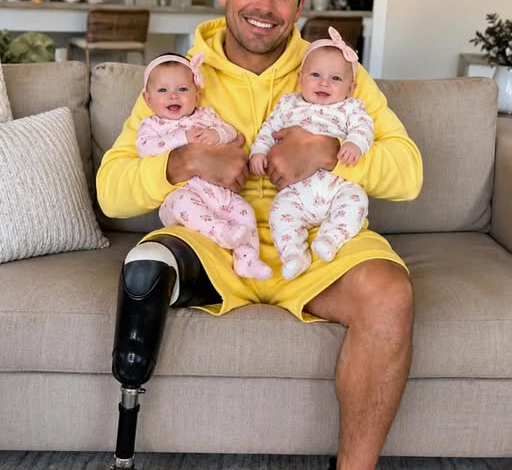
I arrived back from my deployment with a prosthetic leg hidden beneath my pants, something I hadn’t shared with anyone—least of all with my wife, Emma. I was eager to surprise her. I had gifts for her and our two daughters, who I had never met in person. A picture of them had been pinned to the wall of my barracks, their smiling faces keeping me going through each grueling day. I’d spent days looking for just the right presents for them, imagining the moment when I’d be holding them for the first time. But when I walked through the door, I wasn’t met with joy or laughter. Instead, I was greeted by silence—and the sound of my babies crying in the next room.
I wasn’t prepared for what I found.
The house was empty, save for a few remnants of our life together. There were no pictures on the walls, no scent of Emma’s perfume lingering in the air. I stood frozen at the doorway, flowers in hand, a soft, knitted sweater for each of the girls tucked under my arm. I called out, hoping for a response. No one came. The room was bare—just a few scattered pieces of furniture left behind. It didn’t take long before I heard the crying coming from upstairs.
I moved quickly, the pain in my leg shooting up every time I stepped, but I ignored it, focusing on the sound of my daughters. Reaching the nursery, I opened the door to find my mother there. She held one baby in her arms, the other lying alone in the crib. I froze, taking in the sight of her, her eyes brimming with tears as they landed on my leg.
“Mom, what happened?” I asked, trying to make sense of the scene in front of me.
She could hardly look at me. She muttered the words I didn’t want to hear: “Emma… she left, son. She said she needed to take the girls to church. She never came back.”
I knew the answer before she said it. But it still hit me like a punch to the stomach when I saw the note on the dresser, written in Emma’s handwriting. One sentence stood out above all: “I can’t be with a man who’s broken. Mark can give me more. I won’t waste my life on this.”
My best friend. Mark. The one person I’d confided in, the only person who knew about my injury—he had told Emma. And she left me. Left us.
The tears that I had been holding back broke free. I sat down on the floor, pulling Katie into my lap as she continued to cry. My mother placed Mia in my other arm. We sat together, in a room that should’ve been filled with happiness, and just let the grief wash over us.
I remember feeling like I wasn’t alone, despite the emotional weight pressing down on me. My mother’s hand over mine was the only comfort I had in that moment.
I didn’t say anything for a while. I couldn’t. All I could do was hold my daughters and promise them—though they couldn’t understand—that I wouldn’t let them go. That I wouldn’t give up.
The next few years were the hardest of my life, but they also defined me in ways I didn’t expect. My mother moved in for a time to help, and as I adjusted to my new reality, I focused on making sure my girls grew up with a strong father figure. I also began to focus on the work I had been avoiding—fixing my prosthesis.
It wasn’t enough for me just to wear it. I wanted it to work better, to feel more like the leg I had lost. I started designing improvements late at night after the twins had gone to sleep. What started as sketches on scraps of paper turned into a fully realized idea. I filed a patent. I worked with a small company to produce a prototype, and after refining it, I signed a deal that would change everything.
My focus shifted, and slowly, everything started to come together. By the time the girls were old enough for preschool, I had moved us to a new city. I had a business and a future for my daughters. But my past had a way of catching up with me.
One day at work, my assistant handed me an envelope that had my name on it. Inside was a property document—a house that my company was considering for a new project. As I read the names of the former owners, my heart sank. It was the same house Emma and I had once lived in—the one that had been left behind. I could hardly believe it.
I drove to the house that afternoon, and as I approached, I saw movers unloading boxes from the driveway. A pile of furniture sat on the lawn, bathed in the warm glow of the late afternoon sun. Then I saw them. Emma and Mark.
They stood on the porch, arguing. Emma’s face was flushed, her voice rising in frustration. Mark looked smaller somehow, the man who had once been my best friend now nothing more than a shell of the person I had trusted.
I sat in my truck, watching them for a long moment. I wasn’t angry. Not yet. I knew they were both in pain, but it was a different kind of pain—one born of their own choices.
I got out of the truck and walked up to the house. When Emma opened the door, her face went pale, like she had seen a ghost. I couldn’t blame her for that. I knew what she was thinking.
Mark turned and saw me standing there, but his reaction was different than hers. He didn’t look surprised. He just looked defeated.
Emma was the first to speak, her voice trembling. “Arnie, I—I’m so sorry. I made a mistake. Can I see the girls? Just once?”
I looked at her, at the woman who had walked away from us, and I didn’t raise my voice. I didn’t have to. “They stopped waiting for you. I made sure they didn’t have to.”
Behind me, I could hear the movers still working, packing up the last of the items. Mark spoke next, his voice cracking. “Things just… didn’t work out. I thought I could fix it.”
I didn’t respond. There was nothing left to say.
I didn’t need to explain everything to them—how I had taken what happened to me and turned it into something meaningful. How I had built a business that could make a difference in the lives of others like me. I just told them what I had built—sketches turned into a patent, a company, and a future.
“Is this house yours now?” Emma asked.
I nodded. “My company identified it for a project. I didn’t know it belonged to you until I saw the document.”
She looked at me, eyes filled with regret. “I was wrong, Arnie. I was wrong about everything.”
I didn’t flinch. “You’re right. But it doesn’t matter anymore.”
There was nothing left for me to say, and I turned to leave. Mark stepped forward, desperation in his eyes. “Please, just… don’t do this. We can fix this. Just give us time.”
But I didn’t answer. I got into my truck, started the engine, and drove away.
When I got home, I found my girls sitting with my mother, coloring at the kitchen table. They looked up at me, giggling. The house was filled with warmth and light. It was everything I had fought for.
My mother looked up and smiled. “How was your day, Arnie?”
I smiled back. “Never better, Mom.”
That was three weeks ago.
The house that once belonged to Emma and Mark is now a retreat center for veterans who’ve experienced the same kind of loss and pain I have. It’s not a monument to me, but to anyone who feels broken, anyone who needs to see that they can still rebuild their lives.
As for Emma and Mark, their story unfolded as I expected. I don’t need to know how it ends. I’ve already found my peace.
And that’s enough for me.