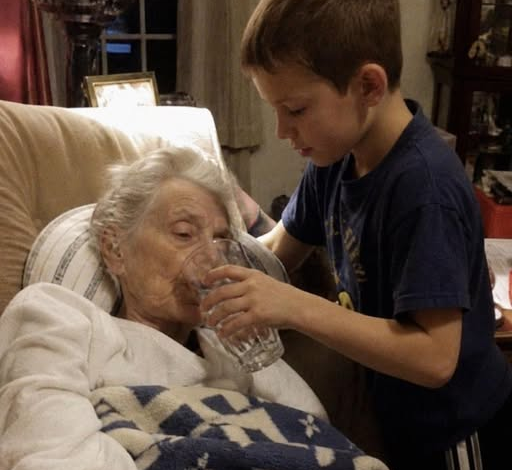
A Little Boy Took Care of His Sick Elderly Neighbor for 3 Years – One Day, He Found a Box from Her in His Yard
For three years, Harry believed he was only being a good neighbor to an elderly woman who lived alone. But after Grace’s house fell silent for good, a sealed wooden box appeared on his lawn—and everything he thought he understood about kindness, loneliness, and family quietly shifted.
At first, it was just small moments.
Harry was ten when he first saw Grace struggling outside her faded blue house at the end of the street.
He had always noticed her.
Everyone did—the elderly woman with silver hair pulled into a neat bun, soft cardigans no matter the weather, and steps that seemed to grow heavier each season.
Her curtains were always half drawn. Her porch flowers were always watered, even when her hands trembled too much to hold the watering can steady.
One afternoon, Harry was riding his bike in slow loops near his driveway when a taxi dropped Grace off at the curb. The driver set down three grocery bags and left before she could properly steady herself.
She bent down carefully, wincing, as though even the air hurt.
Harry stopped.
For a moment, he just watched. He was quiet by nature, the kind of boy who avoided speaking unless spoken to. But something about the way her fingers shook around the plastic handles made him move before he could think.
He dropped his bike and ran over.
“Let me help,” he said, lifting the bags from her hands.
Grace blinked at him, surprised. Then her expression softened.
“That’s very kind of you,” she said gently.
Harry shrugged, suddenly unsure of himself. “They looked heavy.”
“They are,” she replied, leaning slightly on the gate. “Heavier every year.”
He carried them inside her home, where the smell of lemon cleaner and old paper filled the air. Everything was neat, but the house felt hollow, as if sound had forgotten how to stay inside it.
“Where should I put these?” he asked.
“Just the table, dear. Thank you.”
When he turned to leave, he noticed her grip tighten on a chair, just for balance.
He didn’t forget that.
The next day, he came back.
Not because he planned to—just because he did.
After school, he knocked and asked if she needed anything from the shop. Grace looked surprised at first. Then relieved.
That became a pattern.
He brought food from home when there was extra. Soup when she was unwell. Bread when his mother baked too much. Sometimes just small groceries from the corner store.
Other days, he helped around the house without being asked.
Grace always tried to stop him.
“You don’t need to do all this,” she would say.
Harry would just smile. “It’s fine. I don’t mind.”
And somehow, it was.
Weeks turned into months. Months into years.
Grace became part of Harry’s routine without either of them naming it. After school, he would stop by. On weekends, he would help in the garden. On quiet evenings, they sat together while the television murmured softly in the background.
He learned her habits: how she liked her tea, what noises she disliked, the way she kept peppermints in a bowl no one ever touched.
One evening, she looked at him for a long time and said quietly, “You remind me of my grandson.”
Harry didn’t ask who he was or where he had gone.
Something in her voice told him the answers were heavy.
So he just stayed.
Years passed like that.
Harry grew taller, older, quieter in a different way. Grace grew slower. Weaker. The world seemed to move faster around her while she stayed still.
Eventually, she stopped coming to the door at all. Harry began letting himself in.
Then one morning, her house stayed dark.
No light. No television. No movement.
Just silence.
His parents told him gently what he already felt before they said it.
“She’s gone.”
Harry didn’t respond much. He couldn’t.
A week later, he woke to find a box in the middle of the yard.
Old. Weathered. Sealed carefully.
And his name written on it.
His hands shook before he even touched it.
He opened it slowly.
Inside were a folded sweater, a worn photo album, and an envelope written in handwriting he recognized instantly.
Grace’s.
His breath caught.
Inside the envelope was a letter.
“My dear Harry…”
He read it standing in the morning air, barely blinking, the words blurring as he went.
She wrote about how he arrived when she had stopped expecting company. How he came back again and again without asking for anything. How his presence had made the silence in her home feel less sharp.
Then came the truth.
She had once had a grandson. She had lost him—not through death, but through distance, pride, and words that couldn’t be taken back. She had waited for him to return.
He never did.
Harry swallowed hard, gripping the paper tighter.
She had never told him that part.
The sweater, she wrote, belonged to that grandson. She had made it long ago, kept it all these years, unable to let go.
Now she wanted Harry to have it.
Not as a replacement.
But as proof that he had given her something she thought was gone forever.
Family.
Harry held the sweater against his chest and broke.
“I should have done more,” he whispered.
But his mother, standing beside him, shook her head.
“You were there. That matters more than you think.”
Inside the box, he found a photo album. Pages of a younger Grace. A boy growing up. Then one final photo he didn’t remember ever seeing—him and Grace sitting together on her porch, caught in an ordinary moment that now felt like something much larger.
On the back, she had written:
“My chosen grandson.”
Harry couldn’t stop staring at it.
At her funeral, he wore the sweater.
A man stood apart from everyone else—older now, unfamiliar, but somehow not.
Harry knew immediately.
The grandson.
After the service, the man approached him quietly.
“She wrote about you,” he said. “She said you were there when I wasn’t.”
Harry nodded slowly. “She missed you.”
The man closed his eyes. “I know.”
Later, standing near the grave, Harry understood something he hadn’t before.
He had never just been helping an old woman.
And she had never just been waiting.
They had been saving each other in ways neither fully understood at the time.
And after that, Harry never passed a door that looked lonely without wondering who might need it opened.