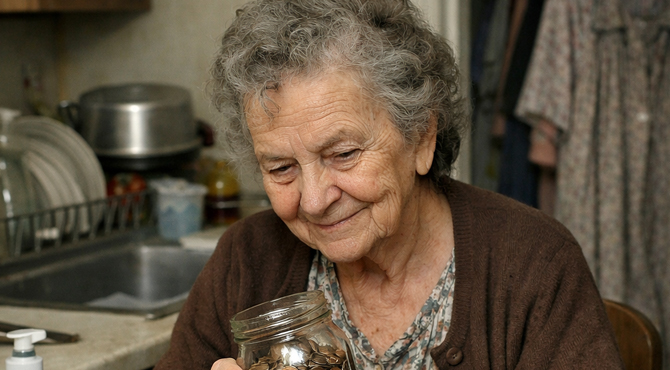
At every family gathering, my grandma was the punchline. “She brought her own tea bag again,” my uncle would whisper, just loud enough for everyone to hear. “And she’ll probably take it home afterward,” my cousin would add, snickering. Grandma never seemed to mind. She’d just smile softly, dipping that same tea bag into her cup like it was the most natural thing in the world. To us, she was simply… cheap.
She washed paper plates and hung them to dry like they were fine china. She saved every scrap of aluminum foil, carefully smoothing it out for “next time.” Her house always smelled faintly of starch and old books, and every drawer was filled with neatly folded things no one else would think to keep—rubber bands, twist ties, used envelopes.
And her clothes… I swear, I never saw her in anything new. The same faded blue dress appeared in photos spanning decades—holidays, birthdays, even my graduation. When we teased her about it, she’d pat the fabric gently and say, “Still does the job.” We thought she was just afraid to spend money. Or maybe she simply didn’t have any.
So when she passed away quietly one winter morning, none of us expected much when we gathered to sort through her belongings. Her house was small, almost bare. No jewelry box filled with heirlooms. No hidden cash tucked under mattresses. Just the same careful order she’d maintained all her life.
I remember sitting on the edge of her bed, holding one of her sweaters, still carrying the faint scent of lavender. It felt like even in death, she had left as quietly as she lived. It was my mom who found the ledger. It was tucked inside her knitting basket, beneath balls of yarn in muted colors—grays, creams, pale blues. At first, it didn’t look like much. Just an old notebook with worn edges. “Probably grocery lists,” my aunt said dismissively. But my mom opened it anyway.
And everything changed.
At first glance, it was just columns of numbers and dates, written in Grandma’s neat, careful handwriting. But then we started noticing patterns. Names. Amounts. Notes. “Paid in full.” “Cleared.” “Balance: zero.” We flipped through page after page, confusion turning into something heavier, something harder to name. “What… is this?” I asked. My mom’s voice trembled. “These are… student accounts.”
We didn’t understand at first. Not until we saw the heading on one of the pages: “Elementary School Lunch Fund.” The room went completely still. For thirty years—thirty years—my grandmother had been keeping track of payments. Small amounts at first. Five dollars. Ten. Twenty. Then sometimes more. Each entry was tied to a name. A child. And next to each one, always the same quiet conclusion: “Paid.” “Cleared.” “No balance.”
We stared at the pages, trying to make sense of it. “She was… paying for school lunches?” my cousin whispered. My mom nodded slowly, tears already streaming down her face. “For kids who couldn’t afford them.”
It felt impossible. Unreal. But as we kept reading, the truth became undeniable. Every time a child’s lunch account went into debt—every time they were at risk of being denied a hot meal—someone had stepped in. A “mystery donation.” No recognition. No name attached. Just enough money to make the balance disappear. And that someone… was Grandma.
The realization hit like a wave crashing over all of us at once. All those years we’d laughed at her for reusing paper plates. For wearing the same dress. For counting every penny. All those years we thought she was hoarding money… She hadn’t been keeping it. She had been giving it away. Quietly. Consistently. Relentlessly.
I imagined those kids—standing in line at school, trays in hand, bracing themselves for the humiliation of being told they couldn’t eat. The whispers. The stares. The shame. And then… suddenly, their balance cleared. A hot meal placed on their tray. A small, invisible miracle. Over and over again. A thousand times.
“She lived like she had nothing,” my aunt said, her voice breaking. “So they could feel like they had enough.” No one made jokes anymore. No one had anything to say. Because suddenly, every memory of her changed.
That reused tea bag wasn’t stinginess—it was sacrifice. That old dress wasn’t neglect—it was a choice. Every dollar she didn’t spend on herself became a meal for someone else. We had mistaken her simplicity for smallness. But it wasn’t small at all.
It was the largest, most extravagant kind of generosity—the kind that asks for nothing in return. The kind that stays hidden. The kind that changes lives without ever needing to be seen.
At her funeral, the church was fuller than we expected. Not with people we knew. But with strangers. Grown men and women, some with children of their own, who stood quietly at the back, holding tissues, eyes filled with gratitude.
One woman approached us afterward, her voice shaking. “I don’t know if you knew,” she said, “but… someone paid for my lunches when I was a kid. My mom couldn’t afford it. I never found out who it was.” She paused, looking down at her hands. “But I never forgot how it felt. To not be turned away. To not be embarrassed in front of everyone.” She looked up, tears slipping down her cheeks. “I think… I think it might have been her.”
My mom reached for her hand, unable to speak. And in that moment, I understood something I wish I had seen sooner. My grandma wasn’t cheap. She was rich. Richer than anyone I’ve ever known.
Because she understood something most of us spend a lifetime trying to learn—
That true generosity isn’t about how much you give. It’s about what you’re willing to give up… so someone else doesn’t have to go without.