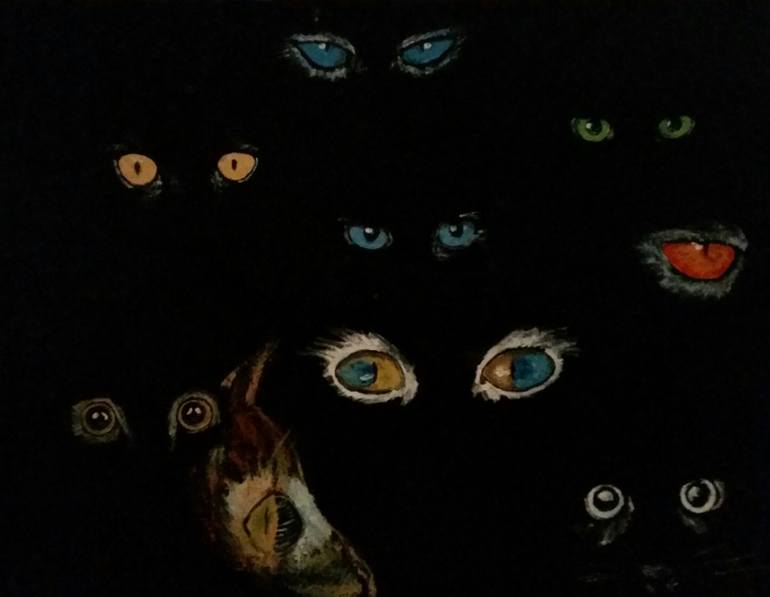
No one knows exactly when the obsession began. Some say it started in childhood, others insist it came later, after fame had already wrapped itself around him like a velvet cloak. What is certain is this: the world’s most famous painter of our time creates his most haunting works in complete darkness — and every single one of them is a pair of eyes.
By day, his name is spoken with reverence in galleries from Paris to New York. Critics call him a genius, collectors fight over waiting lists that stretch for years, and museums reserve entire halls for his exhibitions. His public persona is polished, controlled, almost serene. But at night, when the lights go out and the city sleeps, he becomes someone else entirely.
He closes the doors. He covers the windows. He switches off every lamp.
And then he paints.
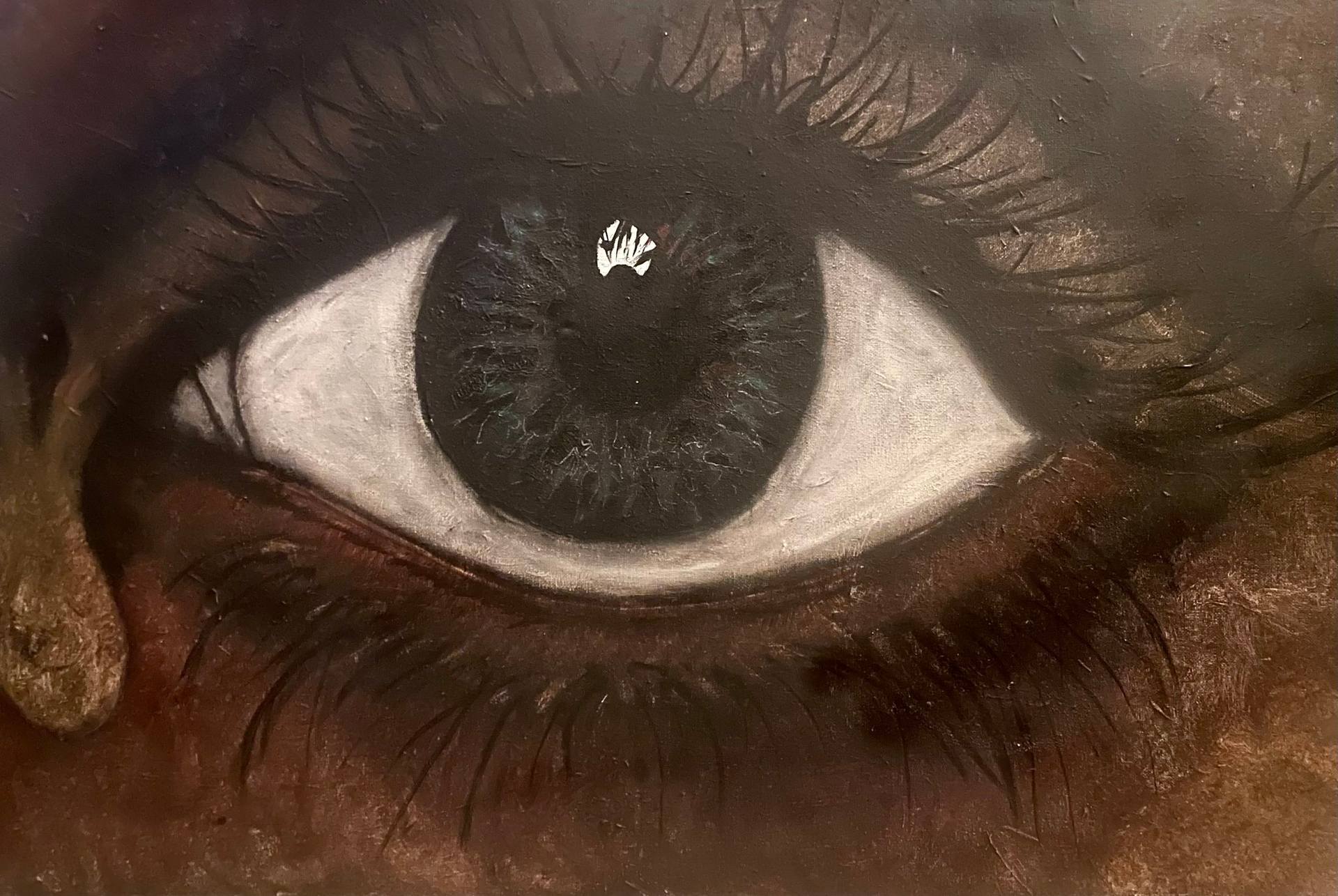
The studio, plunged into absolute blackness, becomes a space without time. There are no reflections, no colors visible to guide his hand, no reassuring outlines. Only darkness — thick, suffocating, total. He claims that this is the only moment when truth appears. When vision disappears, perception sharpens.
“I don’t paint what I see,” he once said in a rare interview. “I paint what looks back at me.”
Those words unsettled many. But they would unsettle the world far more once people finally saw the paintings.
The eyes he creates are not portraits. They do not belong to specific people, at least not in any obvious way. Some are wide and terrified, frozen in the instant before a scream. Others are calm, heavy-lidded, almost tender. Some appear ancient, burdened by centuries of memory. Others look impossibly young, as if they have only just opened for the first time.
What connects them is the sensation they provoke.
Viewers often describe the same reaction: the feeling of being watched. Not metaphorically — physically. People shift their weight, glance over their shoulders, step back from the canvas as if the eyes might blink. Security guards have reported visitors whispering apologies to the paintings. More than one person has left an exhibition in tears, unable to explain why.
Psychologists have written essays about it. Neurologists have speculated. Spiritualists have claimed the paintings are portals. The artist, meanwhile, remains silent.

Those close to him say the darkness is essential. In light, he hesitates. In darkness, he moves with certainty. His hands know where to go, guided not by sight but by memory, instinct, and something deeper he refuses to name.
There are rumors, of course. There always are.
Some say he lost someone — a lover, a child, a twin — and has been painting their eyes ever since, trying to find them again in the void. Others claim he once survived a near-death experience, a moment of total blackness pierced only by the sensation of being watched. A few insist the eyes are not human at all, but echoes of something ancient, something that existed long before us.
None of these stories have been confirmed. He never corrects them. He never encourages them either.
What he does admit is that he cannot stop.
“There are nights when I don’t want to enter the studio,” he once confided to a friend. “But if I don’t paint, the eyes come anyway.”
That sentence never made it into print, but it spread through inner circles like a whispered curse.
Collectors who own his works describe strange experiences. One woman swears the eyes in her living room seem different at night — softer, sadder. A businessman removed a painting after waking repeatedly at 3 a.m., convinced someone was standing at the foot of his bed. Another owner refused to sell his piece at any price, claiming it “knows” him now.
Despite this, demand only grows.
Each new collection sells out before the public even knows it exists. Each exhibition draws record-breaking crowds. And every time, the same question echoes through the halls: how can eyes painted in darkness look so alive?
Art historians point out the technical impossibility of it. Without light, perspective should fail. Proportion should collapse. And yet the eyes are flawless — luminous, precise, disturbingly real. Some suggest he sketches beforehand. Others suspect hidden lights, secret techniques, elaborate tricks.
He denies all of it.
“The dark isn’t empty,” he says. “It’s full of everything we refuse to see.”
Perhaps that is why his work resonates so deeply in a world drowning in images. We are surrounded by light, by screens, by constant visibility. And yet, we are more unseen than ever. His eyes do not flatter. They do not entertain. They confront.
They ask something of you.
Visitors often linger in front of a single canvas far longer than intended. Minutes stretch into half an hour. Time behaves strangely in the presence of those eyes. People leave changed, unsettled, reflective. Some feel exposed. Others feel understood for the first time in years.
As for the artist, he continues his ritual.
Night after night. Darkness after darkness.
When dawn comes, he steps back and turns on the lights, seeing the eyes for the first time just as everyone else eventually will. Sometimes he smiles. Sometimes he looks away.
And sometimes — very rarely — he destroys the canvas entirely.
No one knows what he sees in those moments. No one knows which eyes are allowed to face the world, and which must disappear forever.
But one thing is certain.
Once you have stood before one of his paintings, once you have met those eyes born in darkness, you will carry them with you. In mirrors. In shadows. In the quiet moments just before sleep.