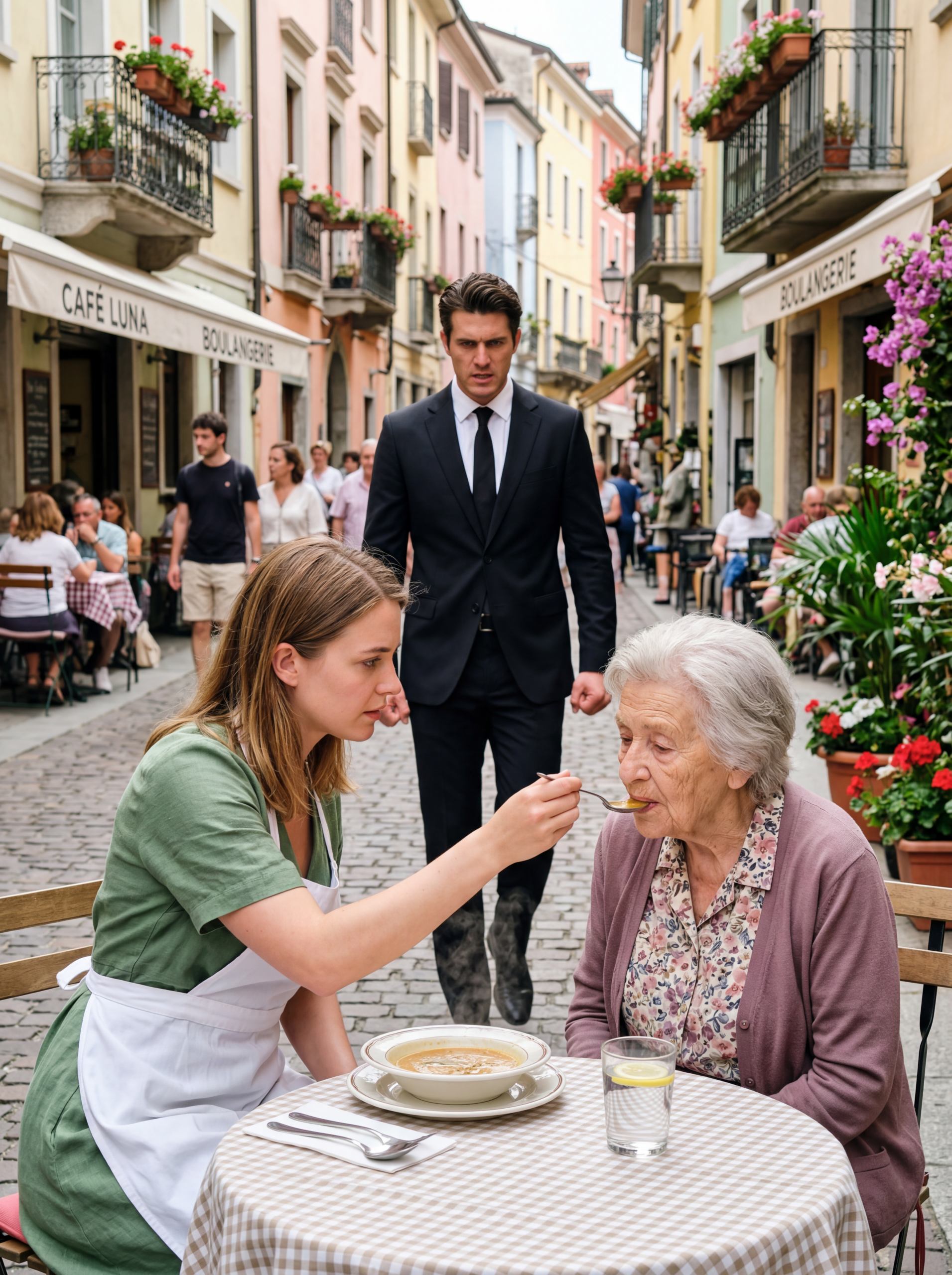
The Afternoon A Waitress Chose Kindness
On a narrow street in the older part of Asheville, North Carolina, there stood a small restaurant called The Copper Willow Café, a place known less for luxury and more for the warmth that drifted out of its kitchen every afternoon when the lunch crowd filled the modest room with voices, clinking silverware, and the comforting scent of soup simmering on the stove.
At noon the café moved like a living organism, every table occupied by office workers, delivery drivers, retirees, and travelers who had wandered in from the busy streets nearby, while waiters moved between chairs and trays the way musicians move through a familiar melody, each step practiced yet slightly rushed because the day rarely slowed long enough for anyone to breathe.
At the center of that quiet chaos worked Marlowe Pierce, a twenty-three-year-old waitress whose days rarely seemed long enough to contain everything she needed to do. She arrived before sunrise to help prepare the dining room and stayed late into the evening after the last table had been wiped clean, and once the restaurant closed she often climbed onto a battered scooter to deliver groceries around town so that she could afford the rent on a tiny studio apartment that barely held a bed, a chair, and the memory of a life that had once felt simpler.
Her feet ached most evenings, and there was usually a folded utility bill tucked into the pocket of her apron waiting for a moment when she could pay it, yet there was something about Marlowe that made people pause when they watched her move through the restaurant. She carried the fatigue of long days, but she also carried a habit that could not easily be explained: whenever she noticed someone struggling, her attention drifted toward them as naturally as breathing, as though the discomfort of strangers belonged to her as well.
That habit was the reason she noticed the woman sitting alone at the table in the far corner.
The woman’s hair was a soft shade of silver, styled carefully in a way that suggested she had once lived a life filled with formal dinners and elegant gatherings, and although her cream-colored blouse and neatly folded scarf hinted at refinement, there was a quiet vulnerability in the way her hands trembled above the plate of food placed before her.
She had ordered enchilada-style crepes the café served as a specialty, yet the fork in her hand shook so much that each attempt to lift a bite toward her mouth ended halfway between the plate and her lips, the motion interrupted by tremors that turned something as simple as eating into a small, private struggle.
Marlowe was carrying a pitcher of water in one hand and the check for another table in the other when she noticed the woman’s difficulty, and although a customer at table seven had already tapped his spoon impatiently against a glass, she slowed her steps anyway.
She approached quietly so the rest of the dining room would not notice, bending slightly toward the woman with a gentle expression.
“Ma’am, are you doing alright?”
The woman looked up, and although fatigue rested beneath her eyes, there was still dignity in her gaze, the kind that refuses pity even when the body begins to fail.
“I have Parkinson’s,” she replied softly. “Some days my hands behave, and some days even lunch becomes a challenge.”
The words stirred something deep inside Marlowe, because years earlier she had watched her grandmother experience the same condition, remembering how those once-steady hands had begun to tremble while trying to hold a teacup, and how quietly embarrassed the older woman had felt needing help with the simplest tasks.
Marlowe set the pitcher down.
“Give me a minute,” she said with a warm smile. “I’ll bring you something easier.”
She hurried to the kitchen, asked the cook for a bowl of warm vegetable soup, and returned only a few minutes later while the other customers continued glancing at their watches and calling for service.
Pulling a chair beside the woman, she sat down as though the entire restaurant could wait.
“Slowly,” Marlowe said, guiding the spoon carefully toward the woman’s hand. “There’s no rush today.”
A small laugh escaped the woman, light but sincere.
“Thank you, dear.”
“Did you come here alone?” Marlowe asked gently while helping steady the spoon. “Is someone meeting you later?”
The woman opened her mouth to answer.
But before she could speak, another pair of eyes had already been watching the entire scene from across the room.
The Man Who Had Not Expected To Feel
Standing near a column at the far end of the café was a tall man in a charcoal suit whose presence drew little attention from the other diners because his wealth was not the loud kind that announces itself through jewelry or spectacle.
His name was Callan Avery, and at forty-two he owned several manufacturing companies scattered across the Southeast, along with a handful of boutique hotels and technology logistics firms that had made him one of the most influential entrepreneurs in the region.
Local newspapers often described him as brilliant.
Employees described him as efficient.
Competitors described him as ruthless.
Even Callan himself had never imagined anyone would describe him as sentimental.
Yet as he stood there watching the waitress help the woman in the corner, something unfamiliar stirred quietly inside him.
The elderly woman sitting at that table was his mother.
Her name was Eleanor Avery, and although she had attended countless business dinners, charity galas, and corporate events over the years, Callan realized in that moment that he had not seen her smile the way she was smiling now in a very long time.
It was not the polite smile she used when photographers appeared or when acquaintances greeted her at formal gatherings.
It was softer.
Warmer.
The kind of smile that begins in the heart before reaching the eyes.
Callan folded his arms slowly, an uncomfortable awareness spreading through him.
How many times had professional caregivers accompanied his mother to appointments or restaurants while quietly checking their phones?
How many assistants had treated her like an obligation instead of a person?
How many times had Callan himself been too busy to notice whether she was comfortable?
Yet here was a young waitress who did not know her name, who likely had far more problems of her own, and she had chosen to sit beside an elderly stranger simply because the moment called for kindness.
When Marlowe eventually stood and returned to her duties, Eleanor gently touched her wrist.
“What is your name, dear?”
“Marlowe,” she replied.
“That suits you,” Eleanor said kindly. “It sounds like someone who notices people.”
Marlowe laughed softly and returned to work without realizing that Callan had already walked over to the table.
He sat down across from his mother.
“Did you know her?” he asked.
Eleanor shook her head.
“No,” she said. “She was simply kind, Callan. Sometimes kindness is enough.”
Within minutes Callan had quietly asked the restaurant manager about the young waitress.
He learned that Marlowe had worked there for more than a year, rarely missed a shift, often covered for coworkers who needed time off, and spent her weekends delivering groceries to supplement her income.
The information surprised him.
Someone who struggled that much with daily life had still paused to help a stranger.
When Marlowe returned to wipe down the table, Callan finally spoke to her.
“Did you know my mother before today?”
She frowned slightly.
“No.”
“Then why help her the way you did?”
Marlowe seemed confused by the question.
“Because she needed help.”
Callan removed a business card and placed it on the table.
“Call me tomorrow,” he said calmly. “I’d like to discuss a job opportunity with you.”
Marlowe studied the card, then looked back at him with a level expression before gently sliding it back across the table.
“With respect, sir, I didn’t help her to gain anything.”
She returned to work before he could reply.
Callan watched her walk away with a strange feeling he could not easily explain.
For the first time in years, someone had refused something he offered without fear or performance.
That night he slept poorly.
Before going to bed, his mother called him.
“You know what your companies are missing?” she asked.
“What’s that?”
“More people who do the right thing when no one is watching.”

A Proposal That Was Different
The following morning Callan returned to the café.
This time he did not bring a business card.
He brought something else instead.
Humility.
Marlowe was arranging glasses behind the counter when she noticed him walking in with Eleanor beside him.
She felt a slight knot form in her stomach, the kind that appears when someone powerful arrives carrying an unexpected decision.
Eleanor greeted her warmly.
“Good morning, Marlowe.”
“Good morning, Ms. Avery.”
Callan spoke directly.
“Yesterday you declined my offer to work for me. I respected that. So let me ask differently. Would you consider working with my mother instead?”
Marlowe paused.
“Doing what?”
“Spending time with her,” he explained. “Not as a nurse following a checklist, but as someone who sits with her at breakfast, accompanies her to appointments, and treats her like a person instead of a responsibility.”
Marlowe folded her arms thoughtfully.
“Why me?”
“Because yesterday you helped her without knowing who she was.”
She hesitated.
“And the salary?”
Callan told her.
The amount made her blink.
It was more than three times what she earned now.
That was precisely why she felt uneasy.
“That sounds like too much.”
Callan shook his head.
“My mother deserves someone who chooses to be there.”
Eleanor smiled gently.
“Yesterday you reminded me of someone I once knew.”
Marlowe tilted her head.
“Who?”
Eleanor sighed softly.
“A young woman named Lydia Bennett who worked in my home many years ago.”
Callan stiffened slightly.
“Mother…”
“Let me finish,” she said quietly.
Marlowe sensed the tension immediately.
“Who was Lydia?”
Eleanor’s eyes softened with memory.
“She was Callan’s mother.”
The sounds of the restaurant continued around them, but for a moment the conversation existed in its own silence.
Callan spoke again, his voice lower now.
“I found Lydia three years ago.”
Eleanor turned toward him in shock.
“You never told me.”
“I didn’t know how,” he admitted.
The truth slowly unfolded across the table.
Years earlier Lydia had been forced away by a manipulative relative who feared scandal and threatened to ruin her life if she returned.
Eleanor had never known.
Callan had grown up believing his mother simply disappeared.
Now Lydia lived quietly in a small town several hours away.
And she was unwell.
Eleanor looked toward Marlowe with determined eyes.
“I want to see her,” she said.
Callan nodded.
“Then we leave tomorrow morning.”
Marlowe hesitated only a moment before replying.
“Then I’ll come too.”
The Journey That Changed Everything
The road stretched across rolling hills as Callan drove.
Eleanor sat beside him, her hands folded together, while Marlowe watched the landscape pass through the rear window with the growing sensation that she had stepped into a story far larger than her own life.
After a long silence, Eleanor asked gently,
“Do you have family, Marlowe?”
She swallowed.
“My grandmother raised me,” she said. “She passed away two years ago. My mother left when I was very young.”
Callan tightened his grip on the steering wheel.
“What was her name?” Eleanor asked.
Marlowe answered automatically.
“Lydia.”
The car slowed.
Callan pulled to the side of the road.
Eleanor turned slowly toward Marlowe.
“How old are you?”
“Twenty-three.”
Callan whispered,
“I was three when my mother vanished.”
Marlowe stared back.
“So was I.”
No one spoke for several long seconds.
Finally Eleanor asked quietly,
“Do you have a photo?”
Marlowe removed an old envelope from her bag and handed it forward.
Inside was a faded picture of a young woman with bright eyes and a shy smile.
Eleanor covered her mouth.
“That’s Lydia.”
Marlowe’s breath caught.
“That can’t be.”
But something deep inside her already knew the truth.

The Reunion
The small house stood at the edge of a quiet town, its front window framed by simple white curtains and a pot of basil resting beside the door.
Callan knocked.
Footsteps approached slowly.
The door opened.
Lydia Bennett, now sixty-two, stood in the doorway with silver threaded through her dark hair.
When she saw Callan, her entire body seemed to freeze.
“Callan…”
His voice softened.
“Hi, Mom.”
When she saw Eleanor behind him, tears filled her eyes.
But when her gaze reached Marlowe, something else appeared on her face.
Recognition.
“Oh my goodness…” she whispered. “Marlowe?”
Marlowe blinked.
“How do you know my name?”
Lydia stepped forward.
“Because I gave it to you.”
The embrace happened almost instinctively, a collision of years of absence and longing that neither of them could have prepared for.
Inside the house, between cups of coffee and long pauses, the truth finally surfaced.
Lydia had searched for both children for decades.
Callan had located her years earlier but never realized the identity of her daughter.
Now the missing pieces of their lives had finally come together.
Eleanor wiped her eyes gently.
“Forty years were taken from us,” she said quietly. “Let’s not lose another day.”
The Life That Followed
Weeks passed.
Marlowe divided her time between Eleanor’s home and Lydia’s small house.
Callan adjusted his work schedule for the first time in decades, choosing family over constant business travel.
Eleanor regained her laughter.
Lydia no longer slept alone in a silent home.
Eventually Callan created a small charitable foundation that quietly supported older adults living with neurological conditions and the caregivers who helped them.
When reporters later asked why he had named it The Lydia Foundation, he gave a simple answer.
“Because the world is held together by people who care for others when no one is watching.”
And all of it had begun one ordinary afternoon, in a small café on a busy street, when a tired waitress chose to sit beside an elderly woman whose hands trembled and help her finish a bowl of soup.
Sometimes life returns what seemed lost long ago.
Not with noise.
But the same way genuine kindness appears.
Quietly.
And all at once, everything changes.