A petite, 62-year-old Caucasian woman with short silver hair tucked behind one ear, in the same light blue windbreaker and faded black sneakers, always at 7:10 a.m. She moved with that careful, measured pace of someone who had once walked fast but now carried invisible weight.
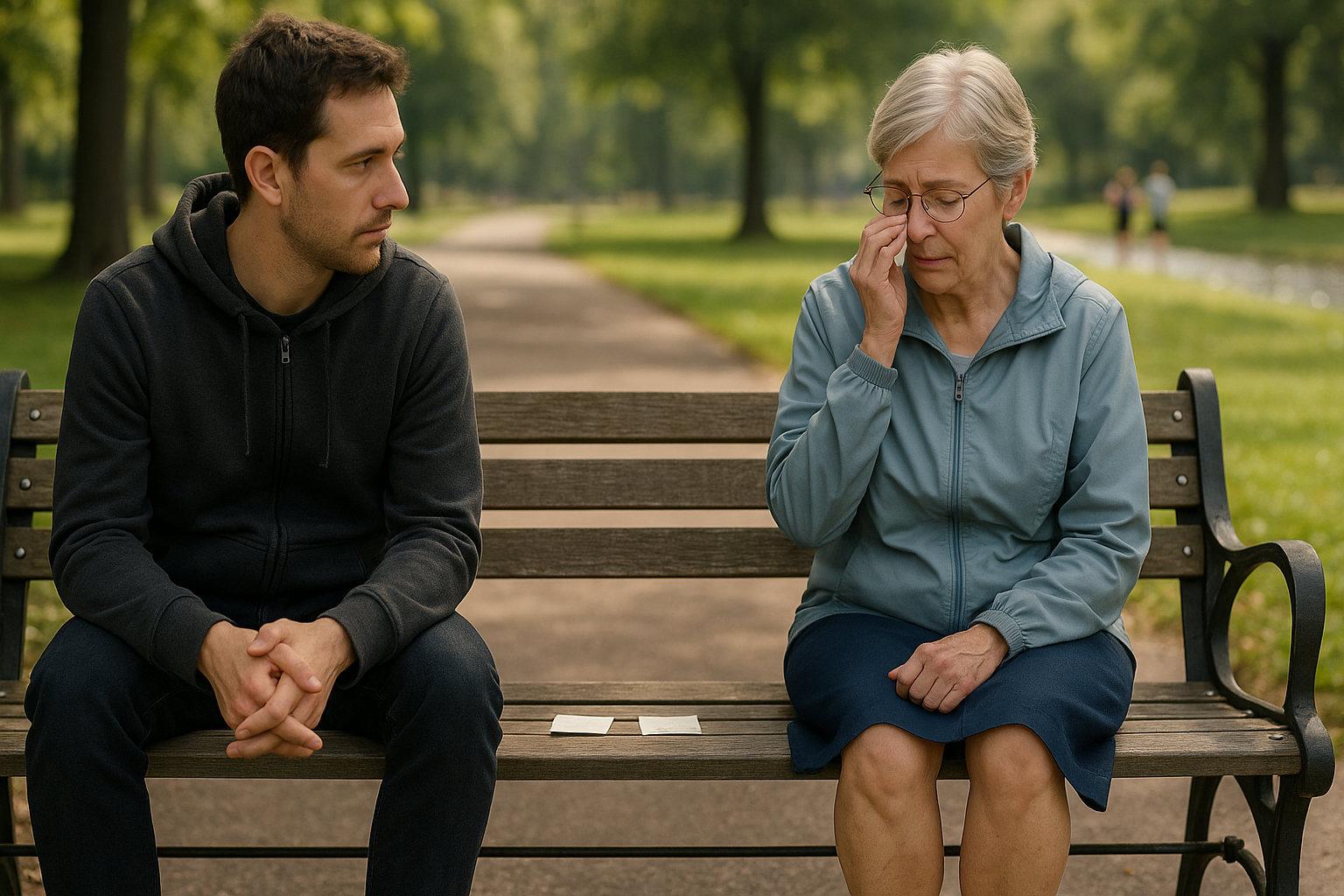
Every morning she stopped at the third bench from the pond in our neighborhood park, smoothed her navy skirt, sat for exactly one minute, took out a small folded note from her beige canvas bag, placed it on the bench and walked away.
No phone. No coffee cup. No lingering.
Just a note.
At first I thought it was nothing. People leave flyers, forgotten napkins, random trash. But this was different. It was deliberate. Ritualistic.
On the fifth morning of seeing her, my curiosity finally outweighed my shyness. As soon as she left, I walked up to the bench, heart stupidly pounding.
A small white square of paper, folded once.
My fingers actually shook as I opened it.
“Good morning, my boy. I hope today hurts a little less. – Mom”
The word “Mom” hit me like a punch. I looked around, suddenly feeling like an intruder in someone else’s sacred moment.
No one was watching. Joggers passed, a dog barked at ducks, cyclists rang their bells. Life went on around this tiny, aching sentence.
The next morning, I was back. I told myself I just liked early walks now, but that was a lie. I came for her.
7:10. Right on time.
This time, I watched more closely. The way her slim hands trembled slightly when she pulled the paper from a small floral notebook. The way she stared at the empty bench for a second before placing the note down, as if expecting someone to suddenly appear there.
That day I didn’t touch the note. I waited until she disappeared behind the row of maple trees, then just sat on the bench, next to the folded square, like I was sitting beside a stranger’s grief.
People passed. No one picked it up.
The day after that, I couldn’t help myself.
“Day 128 without you. I made your favorite pasta yesterday and cried over the sink. If you were here, you’d roll your eyes at me. I miss your eye rolls. – Mom”
Day 128.
My throat tightened. I’m a 34-year-old guy who designs websites and drinks too much coffee. I don’t cry easily. But that number, that quiet counting of days, felt like a scream written in tiny, polite letters.
For a week I read every note.
“Remember when you fell off your bike and refused to cry? I cried for both of us.”
“You would have turned 29 today. I bought a small cake anyway.”
“I sat on our couch and pretended you were in your room with headphones on. The silence was too loud.”
Each line was a thread, pulling me into a story I didn’t know but felt in my bones.
By then, watching wasn’t enough.
One Tuesday, I made a decision that felt both wrong and necessary.
I would follow her.
As she left the bench, I waited a few seconds, then walked after her, keeping a distance. I told myself I just wanted to understand, to see where this grief went when it left the park.
She turned onto Maple Street, passed the bakery, nodded to the barista setting out chairs, crossed at the light without ever taking out a phone. Her world felt quieter than everyone else’s.
She stopped at an old brick building with peeling white paint and a small sign: “Hopeview Hospice Center.”
My chest went cold.
She went inside.
I stayed on the sidewalk, staring at the sign. Hospice. The word you don’t want to see connected to anyone you love.
I almost left then. It felt too personal, too invasive. But five minutes later, she came back out with a tall, dark-haired nurse in green scrubs, maybe late 20s, Hispanic, her long black braid hanging down her back. They stood by the door, talking.
I couldn’t hear them, but I could see the nurse place a gentle hand over the woman’s, then point toward the park, toward the direction of the bench.
The older woman nodded, wiped under her glasses with a crumpled tissue, and gave a small, practiced smile. The kind of smile people wear when everyone tells them they’re “so strong.”
I walked away before they could notice me, feeling like I’d stolen a piece of someone’s diary.
The next morning, something changed.
I came earlier than usual and sat at a different bench, ten meters away, pretending to scroll my phone. At 7:10, she arrived. Same windbreaker. Same careful steps.
But when she reached the bench, she froze.
Because this time, there was already a note waiting.
My note.
I’d sat up half the night writing and deleting sentences until I finally wrote the only thing that felt honest:
“I don’t know your story, but your love for your son is the most powerful thing I’ve ever seen. He would be proud of you. – A stranger who reads your notes”
I watched her pick it up with a puzzled frown, unfold it, read.
Her shoulders started to shake.
For a moment I thought I’d made a horrible mistake, that I’d shattered a fragile ritual that kept her going.
Then she sat down.
Very slowly.
She didn’t cry dramatically. No audible sobs. Just silent tears running down the gentle lines of her face, catching the morning light.
I couldn’t sit and pretend anymore.
I walked over, every step a battle between guilt and something like courage.
“Hi,” I said softly. “I’m… I’m sorry. I wrote that.”
She looked up at me, eyes red but curious.
“You?” her voice was quiet, a little hoarse.
“I see you here every morning,” I admitted, feeling like a kid caught spying. “I started reading the notes. I know I shouldn’t have. But they… they helped me, somehow.”
She blinked. “Helped you?”
I sat at the far end of the bench, leaving a respectful gap. “I lost my dad three years ago. I never talk about it. Your notes… they made me feel less crazy for still talking to him in my head.”
For a long moment, she just studied my face, like she was deciding whether to be angry or grateful.
Finally she nodded. “I’m Helen,” she said. “My son was Daniel. 28. Car accident. Hospice is where I volunteer now. I couldn’t save him, so I try to sit with other people’s children when their time comes.”
There it was. The thing I’d been circling without naming.
I swallowed. “I’m Alex.”
She folded my note back up, carefully, like it was something precious, and slipped it into her floral notebook.
“I thought no one ever saw them,” she admitted. “I leave them here because this was our spot. He used to sit here before school, drinking terrible instant coffee and pretending it was ‘sophisticated.’” Her mouth curved into a small, trembling smile.
“Why every day?” I asked quietly.
“Because grief doesn’t only visit on anniversaries,” she said. “It’s in every morning you wake up and remember. The notes… they make the remembering gentler.”
We sat in silence for a minute, listening to the city wake up.
Then she reached into her bag, tore out a blank page from the notebook and handed it to me.
“Write him one,” she said. “Your dad. Leave it with mine. It helps not to keep all the words inside.”
My instinct was to refuse. Grown men don’t write notes to dead fathers on park benches, right?
But then I thought about all the mornings I’d walked past her, assuming she was just another stranger in the background of my life.
So I took the paper.
My handwriting looked awkward next to hers. I wrote: “Hey Dad. I got the promotion. I wish you were here to tell me it doesn’t change who I am. I’m trying to be less scared. – A”
I folded it, placed it on the bench next to her daily note.
We didn’t hug. We didn’t say anything profound.
We just sat there, two people bound by different losses, watching the sunlight slide over a simple wooden bench that had somehow become an altar.
Now, months later, there are often three, four, sometimes five notes on that bench.
People noticed. Someone must have read mine, or hers, or both. I’ve seen a teenage boy with headphones slip a paper under a corner of the seat. An elderly man in a brown coat leave a neatly folded envelope. A young woman in a gray hoodie with puffy eyes stand there for a long time before placing a small yellow sticky note on the backrest.
She still writes to Daniel.
But she doesn’t sit alone anymore.
And every time I pass that bench and see a new little square of paper waiting in the sunlight, I remember the morning I decided to follow a stranger—only to discover that sometimes, the most incredible thing isn’t a secret at all.
It’s the quiet, stubborn way love refuses to disappear, even when the person you love is no longer there to read your notes.