The Night the House Went Silent
Have you ever had the sense that no matter how carefully you move through the world, no matter how softly you speak or how hard you work, you remain unseen, as though you are part of the furniture rather than a human being with a name and a pulse? For some people, that feeling comes and goes, but for others it settles into their bones and becomes a way of living, especially when the weight of responsibility includes two tiny lives who depend on you entirely, even though the world insists on pretending they are not there.
That was the kind of quiet that filled the Hawthorne estate, a place that looked impressive from the outside, with its pale stone columns and manicured hedges arranged in perfect symmetry, but felt hollow once you stepped inside, where the air carried a chill that had nothing to do with temperature and everything to do with absence.
The Young Woman Everyone Overlooked
Her name was Eliza Moore, and at twenty-two, her hands already told a story of long days and short nights, with skin roughened by cleaning chemicals and nails kept short not for style but for survival, while her shoulders carried an invisible weight that came from always being the one who stayed after everyone else had left.
She had been on her feet since before sunrise, moving quietly across marble floors that reflected her tired face back at her, polishing silverware that was rarely touched, and preparing meals that often went cold because no one came down to eat them, all while her stomach reminded her, again and again, that she was the last person in the house who deserved to rest.
In the Hawthorne estate, exhaustion was not considered understandable; it was treated like a personal failure.
The Children in the East Wing
What most people in that house never noticed, or chose not to notice, was that Eliza carried a secret that cried softly in the night and weighed more heavily on her heart than any bucket or tray ever could.
At the far end of the east wing, away from the master suite and the offices that dominated the main floor, slept the twins, Oliver and Samuel, only three months old, wrapped in soft cotton pajamas and smelling faintly of baby powder and loneliness.
Their mother was no longer there, having been lost during childbirth in a way that left behind silence instead of answers, and their father, Nathaniel Hawthorne, responded to that absence by disappearing in his own way, burying himself in work, flights, and meetings, convincing himself that distance was the only way to survive his grief.
Professional caregivers had come and gone, each one leaving with an excuse that sounded polite but meant the same thing, because the house felt too quiet, the man of the house was never home, and the babies cried more than they expected.
Eliza stayed.
What Love Looks Like Without a Job Title
She was not hired to be a caregiver, nor paid to warm bottles at dawn or hum lullabies in the dark, yet every time the twins’ cries echoed through the empty halls and no one came, something in her chest tightened until she could not ignore it.
She would lift them carefully, one in each arm, and whisper songs her grandmother had taught her back in a small town she rarely spoke about anymore, becoming the only steady warmth those children recognized.
She did not think of it as sacrifice, because to her it felt like the only thing that made sense.
The Coldest Night
That winter night was different, harsher than the others, with the cold pressing against the walls as though it were trying to force its way inside, and the heating in the nursery failing just enough to turn the room into a place no infant should have been.
The cribs felt stiff and unwelcoming, and one of the twins burned with a troubling warmth while the other cried harder, as if sensing his brother’s discomfort and responding in panic.
Eliza walked the length of the house for hours, cradling them close, her knees shaking and her feet aching until the world blurred around the edges, while she murmured softly, “It’s all right, I’m here, I won’t leave you,” until their cries faded into uneven breaths and finally into sleep.
Choosing the Floor Over the Crib
When she looked toward the staircase that led back to the cold nursery, something inside her refused to move, because carrying them back into that chill felt wrong in a way she could not explain.
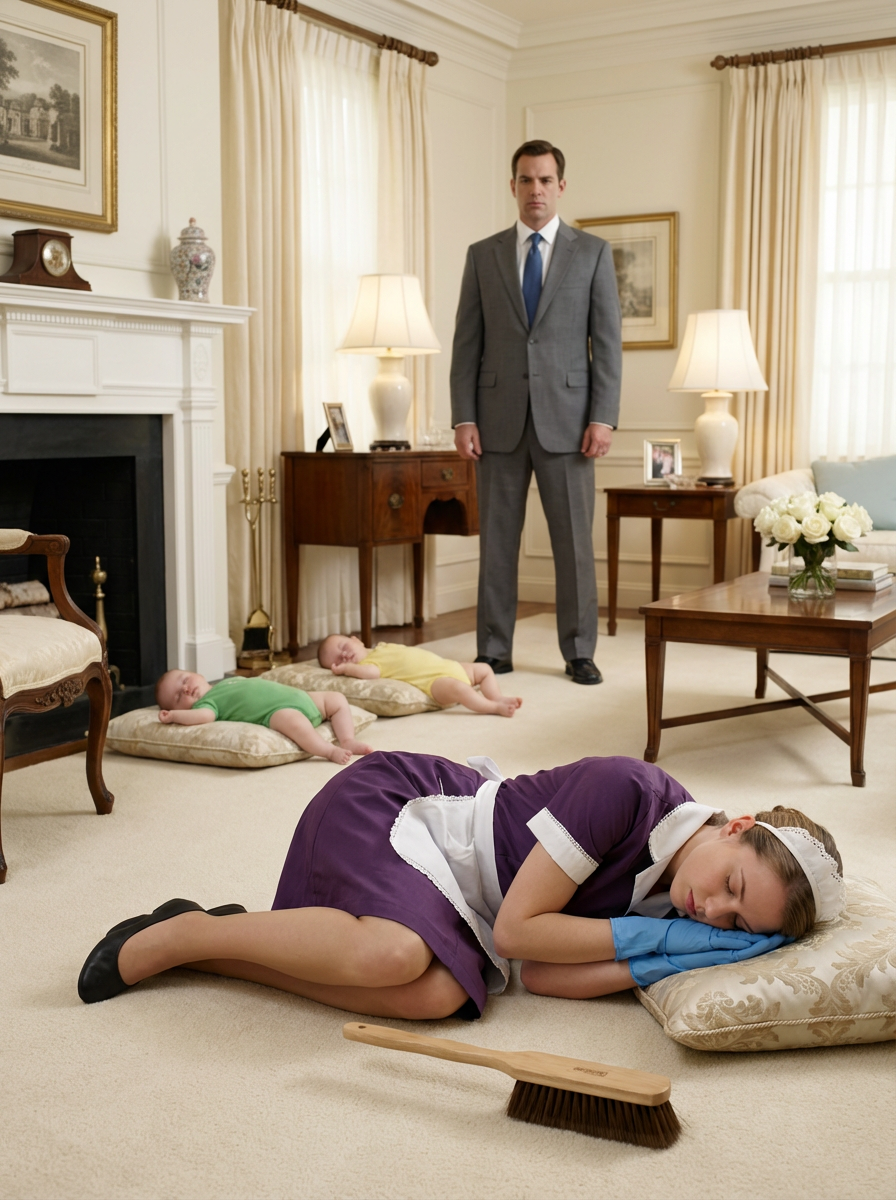
Instead, she spread a thin blanket over the thick rug near the fading warmth of the living room fireplace, laid the twins down with care, and curled her body around them as if she could become a wall against the cold, her worn hand resting gently on one small chest, counting breaths.
She told herself she would close her eyes for just a moment, just long enough to gather the strength to stand again.
The Door That Changed Everything
The quiet did not last.
The sound of the front door unlocking cut through the room, sharp and final, and Eliza woke with her heart racing, fear flooding her veins as she looked up and saw a tall figure standing in the doorway.
Nathaniel Hawthorne had come home.
Dressed in a tailored dark coat, briefcase still in hand, he stared at the scene before him as though his mind could not reconcile what his eyes were seeing, because his employee was on the floor of his pristine living room, and his children were there with her, small and fragile and impossibly real.
A Voice Filled With Accusation
The silence that followed felt heavier than shouting ever could.
Eliza pushed herself up, instinctively placing a protective hand over the twins as they stirred, and Nathaniel’s voice cut through the room, low and sharp, “What is going on here?”
She tried to speak, but her throat tightened, and when he stepped closer, his question landed like a blow, “Why are my sons on the floor, and why are you sleeping during work hours?”
She lowered her gaze, shame and anger mixing behind her eyes, until the light revealed the dark bruise along her cheek, and his expression shifted.
“What happened to your face?” he asked, confusion edging out his irritation.
The Truth She Had Never Said Aloud
Eliza swallowed hard and answered the question he had not asked, her voice barely above a whisper, “They were crying, and there’s no caregiver anymore. No one replaced her. It’s just me.”
The words seemed to strike him with unexpected force, and when he ordered her into his office, she followed with heavy steps, feeling as though each one carried her closer to losing the only thing that mattered, which was staying near the twins.
Inside the Office of Power
His office was warm and imposing, filled with dark wood and the faint scent of leather, and when he finally told her to explain herself, the words poured out of her in a rush she could no longer contain.
“The nursery is cold, the cribs feel like ice, and one of them was burning with warmth while the other wouldn’t stop crying. I’ve been working all day, I haven’t eaten, and when they finally slept, I couldn’t put them back up there alone. I laid with them so they wouldn’t feel abandoned.”
Her voice broke, and a tear traced a path over the bruise on her cheek.
“I didn’t mean to fall asleep, but I would do it again if it meant they felt loved for one night.”
The Question He Could Not Ignore
Nathaniel turned away, staring out the window as though the city beyond it might offer answers, before asking quietly, “Who did that to you?”
After a long pause, she admitted, “One of your guests, last week. I was carrying dishes, and he pushed past me. I fell, and no one said anything.”
The memory tightened his jaw, and when she added, “You’re never here. You don’t see them, and I don’t exist,” the truth hung between them, undeniable.
The Moment He Broke
Nathaniel looked down at his hands, realizing how empty they felt despite everything he owned, and for the first time since his wife’s absence, he understood what he had taken from his children by giving them everything except himself.
“Stay here,” he said abruptly, leaving the room.
When he returned carrying heavy blankets from his own bed, Eliza followed him back to the living room, watching as he knelt on the floor, awkward and unsure, covering his sons with trembling hands.
“They’re so small,” he murmured, his voice unsteady. “I forgot.”
A Promise Made on the Floor
A single tear fell as he brushed a tiny cheek, and he admitted aloud, “I was afraid to look at them because they remind me of her, but avoiding them only made me fail.”
Turning to Eliza, his voice steady but changed, he said, “Starting today, things will be different. You’ll be their primary caregiver, with proper pay and support, and that man will never be welcomed here again.”
She covered her mouth, not because of the money, but because someone had finally seen her.
What Healing Looks Like
The days that followed brought slow, careful changes, with Nathaniel learning how to hold a bottle, how to listen, and how to stay, while Eliza guided him patiently, saying, “Support their heads like this. They feel your heartbeat.”
Months later, on a rainy afternoon, the living room looked nothing like it once had, filled with blankets and toys, as Nathaniel came home and asked softly, “Is there room for one more?”
They sat together, the twins warm and safe between them, and in that quiet, rebuilt space, they were no longer employer and worker, but people choosing to care for one another.
Sometimes, family is not defined by blood or contracts, but by the moment someone chooses to kneel on a cold floor and bring a blanket instead of judgment, proving that even the harshest winters can give way to warmth when someone dares to begin.